
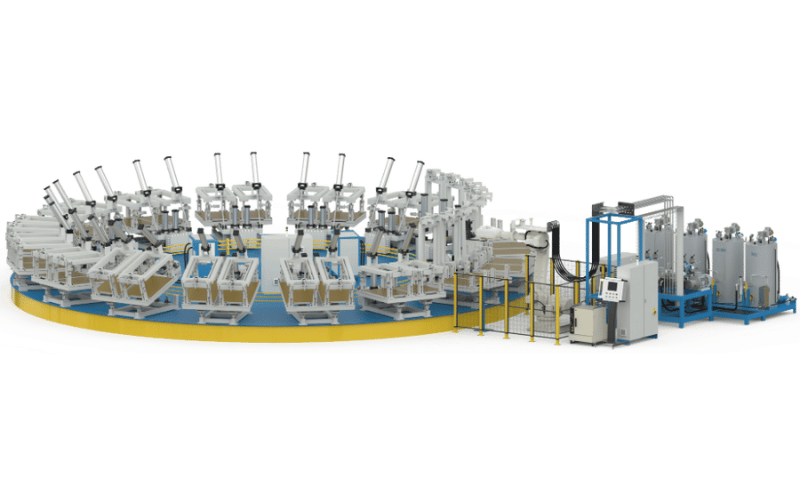
A PU foam production line is a complex manufacturing system used by engineers, chemists, and manufacturers to produce polyurethane foam in large quantities. These lines use a series of automated processes to combine liquid chemicals, which react and expand to form either flexible or rigid foam. Apart from creating large foam blocks, these lines can also be configured to mold specific shapes or to spray foam directly onto substrates. The entire system is engineered for precision, consistency, and efficiency in producing one of the world’s most versatile materials.
PU foam production lines are indispensable tools for modern manufacturing; they are used on an industrial scale to create everything from mattress blocks and automotive seats to insulation panels and packaging materials. They allow companies to develop high-quality foam products quickly and cost-effectively, bringing engineered chemical formulations into the physical world as tangible goods. In this guide, I’ll explain what PU foam production lines are, what they can do, and how they work, and I’ll also provide some resources for those looking to learn more about this advanced manufacturing technology.
What Is a PU Foam Production Line?
A PU foam production line is an automated manufacturing system designed to produce polyurethane foam continuously. A central computer system controls it, often a PLC (Programmable Logic Controller), that manages the entire process. Engineers and operators can input specific recipes and parameters into the system, and the production line will automatically mix the chemicals and produce the foam with minimal manual intervention. Once the process is initiated, the line uses a sophisticated system of pumps, mixers, and conveyors to create the final product.
The core components of a PU foam production line include storage tanks for the raw chemicals (polyols, isocyanates, and additives), high-precision metering pumps, a mixing head, a pouring or dispensing unit, and a long conveyor system. The conveyor is often enclosed in a tunnel to control temperature and contain vapors as the foam rises and cures. This setup allows the creation of continuous foam blocks, known as “slabstock,” or the direct injection of foam into molds to produce specific parts.
The versatility of these production lines is a key advantage. By adjusting the chemical formulation, flow rates, and temperature, a single line can produce a wide range of foam types. This includes soft, flexible foams for furniture, dense, rigid foams for insulation, and specialized high-resilience (HR) foams for automotive seating. This adaptability makes PU foam production lines a cornerstone of many manufacturing sectors, enabling mass production of diverse products.
How Does a PU Foam Production Line Work?
All PU foam production lines follow the same fundamental process: the precise mixing of liquid chemicals that undergo an exothermic reaction to create foam. The process begins with the raw materials, primarily a polyol and a diisocyanate, which are stored in large, temperature-controlled tanks. Additives such as catalysts, surfactants, and blowing agents are also stored in separate containers. High-precision metering pumps draw these components from the tanks at exact ratios determined by the specific foam recipe being produced.
These carefully metered chemical streams are then fed into a high-pressure mixing head. Inside the mixing head, the components are intensely blended for just a fraction of a second before being dispensed. The mixture is poured onto a moving conveyor belt lined with paper or a plastic film to prevent the foam from sticking. As the liquid mixture flows down the conveyor, the chemical reaction begins. The blowing agent creates gas bubbles, causing the mixture to expand rapidly and “rise” into a large foam block.
The conveyor belt carries the rising foam through a long, enclosed tunnel where the temperature and curing process are carefully controlled. This ensures the foam develops a uniform cell structure and achieves its desired physical properties. As the foam exits the tunnel, it has solidified but is not yet fully cured. Automated cutting machinery, such as a large traversing blade, cuts the continuous foam block into manageable lengths for storage and further processing.
After the initial cut, the large foam blocks are moved to a curing area, where they sit for 24 hours or more to allow the chemical reactions to complete. During this time, the foam strengthens and stabilizes. Quality control is paramount throughout this process. Sensors monitor temperatures, pressures, and flow rates in real-time. Samples of the foam are regularly taken and tested in a lab to assess properties such as density, hardness, and cell structure, ensuring the final product meets exact specifications.
Types of PU Foam Production Lines
There are three main types of PU foam production lines, distinguished by the foam they produce. Although the core machinery is similar, each line is optimized with specific components and control parameters to create foam with distinct properties and for different market applications.
Flexible PU foam production lines are the most common. These are typically “slabstock” lines designed to produce large, continuous blocks of flexible foam. The process is optimized for creating foams with open-cell structures, which give them their softness and breathability. These lines are used to manufacture foam for furniture cushions, mattresses, and carpet underlay. They often feature long conveyor tunnels and sophisticated ventilation systems to handle large volumes and ensure consistent properties throughout the foam block.
Rigid PU foam production lines are engineered to create foam with a closed-cell structure, which is key to its excellent thermal insulation properties. These lines can be either slabstock lines for producing insulation boards or discontinuous lines for panel manufacturing. In a discontinuous panel line, the liquid chemical mixture is injected between two facings (e.g., steel sheets) in a large press. The foam expands and bonds to the facings, creating a strong, insulated sandwich panel used in construction and refrigeration. These lines require precise temperature and pressure control to ensure complete adhesion and a uniform foam density.
High-resilience (HR) and specialty foam production lines are more advanced systems used to create premium foam products. HR foam, used in high-end furniture and automotive seating, has a less uniform cell structure that provides greater support and durability. These lines use special polyols and isocyanates and require exact control over the chemical reaction. Other specialty lines might be configured for molding processes, in which robots inject foam into complex molds to produce items such as car dashboard components or shoe soles. These are often called “molded foam” lines and are highly automated for high-volume production of identical parts.
Design Software for PU Foam Production
Optimizing a PU foam production line relies heavily on specialized software for process design, control, and monitoring. This is not design software in the traditional CAD sense but rather sophisticated process control and simulation software. Chemical engineers and plant operators use these systems to develop and test foam formulations virtually before running them on the physical production line. This software allows them to predict how changes in chemical ratios, temperatures, or catalyst levels will affect the final foam properties, such as density, hardness, and rise profile. This simulation capability saves time and reduces material waste from failed trial runs.
These process control systems are integrated directly with the machinery on the production line. The software provides a central interface for operators to set production parameters, such as the flow rates for each chemical pump, the conveyor speed, and the temperature inside the curing tunnel. During production, the software monitors thousands of data points from sensors throughout the line. It displays real-time data on dashboards and alerts operators to any deviations from the set parameters. This continuous monitoring is crucial for maintaining tight quality control and ensuring the product remains within specification from start to finish. Advanced systems even use machine learning algorithms to suggest process adjustments to optimize efficiency and product quality.
Cutting and Shaping PU Foam
Once the large, continuous foam block comes off the production line, it needs to be cut and shaped for its final application. This is a critical secondary process that requires a range of specialized machinery. The initial cut is made by a “cut-off” saw at the end of the conveyor, which slices the long slab into more manageable blocks, often several meters in length. These blocks are then moved to a separate cutting area for more detailed processing.
For creating sheets and simple geometric shapes, large band saws and slitting machines are used. A horizontal band saw can slice a large block into sheets of varying thicknesses, much like slicing a loaf of bread. Vertical band saws are then used to trim these sheets to the desired width and length. These machines can be operated manually or fully automated with CNC (Computer Numerical Controlled) systems for high-volume, repetitive cutting. The accuracy of these initial cuts is vital for minimizing waste.
For more complex shapes, CNC contour cutting machines are employed. These advanced machines use a fast-oscillating blade or a tensioned wire to cut intricate profiles based on a digital design file. This allows for the creation of custom shapes for furniture components, specialized packaging inserts, or automotive parts. The ability to follow a digital pattern with high precision enables the mass production of complex designs that would be impossible to achieve with manual cutting methods.
The importance of accuracy in cutting cannot be overstated. Any deviation in dimensions can lead to wasted material, which is costly. Modern foam cutting machinery is designed for precision down to the millimeter. Calibration of the blades, tension of the wires, and the accuracy of the CNC controllers are regularly checked to ensure that every cut piece meets the exact design specifications. This precision is essential for producing high-quality finished goods and maintaining profitability in a competitive market.
Surface Treatment and Finishing
After cutting, PU foam components often require surface treatment or finishing to enhance their properties or prepare them for assembly. One common technique is “flame lamination,” in which a thin layer of the foam’s surface is melted by quickly passing it over a controlled flame. This process typically bonds fabric or other textiles directly to the foam surface without adhesives. It is widely used in the automotive industry to create headliners and fabric-covered door panels.
Finishing processes can also be applied to improve the foam’s durability, feel, or appearance. For specific applications, foam parts may be coated with a protective layer. For example, foam used in medical positioning devices might be coated with a seamless, cleanable vinyl skin to meet hygiene standards. In the furniture industry, a soft “fiber wrap” is often applied to foam cushions to give them a softer feel and a more rounded, appealing shape before they are inserted into a fabric cover.
Surface quality is crucial for products in which the foam is visible or directly interacts with the user. In applications like molded foam armrests or steering wheels, an “in-mold coating” process is used. A specialized paint or coating is sprayed into the mold before the liquid foam is injected. As the foam expands and cures, the coating chemically bonds to its surface, creating a durable and cosmetically perfect finish directly out of the mold.
Key Settings for PU Foam Production
Efficient and consistent PU foam production hinges on the precise control of several critical settings. These parameters are dialed in based on the specific foam formulation and desired end-product characteristics. Any slight deviation can significantly alter the final properties of the foam, so maintaining these settings is a primary focus for production line operators. The most successful operations rely on a combination of automated control and experienced human oversight.
Temperature control is arguably the most critical parameter. The raw chemicals—polyol, isocyanate, and additives—must be stored and metered at a specific, stable temperature, typically around 20-25°C. The chemical reaction itself is exothermic, meaning it generates heat. The temperature profile within the curing tunnel must also be carefully managed to ensure the foam rises and cures uniformly. Too much heat can cause scorching or cracks in the foam, while too little can result in an incomplete reaction and poor physical properties.
The chemical ratio is another non-negotiable setting. The ratio of isocyanate to polyol (known as the “index”) must be controlled with extreme precision by the metering pumps. A slight change in this ratio can dramatically affect the foam’s hardness, density, and elasticity. Operators use flow meters and computer controls to maintain this ratio to within a fraction of a percent. The amounts of catalysts, surfactants, and blowing agents must also be metered with equal accuracy to control reaction rate and cell structure.
Curing time and conditions are also critical. After the foam block is cut at the end of the line, it must be allowed to heal for a period, typically 24 hours or more, in a well-ventilated area. During this time, the internal chemical reactions are complete, and the foam stabilizes. The temperature and humidity of the curing area can affect this final stage. Rushing the curing process can lead to shrinkage or deformation of the foam blocks later on.
Designing for PU Foam Applications
Designing products that use PU foam requires a deep understanding of the material’s properties and the manufacturing process. Unlike designing with solid materials like wood or metal, designing with foam involves specifying properties such as density and hardness, which directly affect performance and feel. The design process must account for how the foam will behave under compression and over time.
For flexible foam applications, such as sofa cushions or mattresses, the design focuses on comfort and support. Designers use a measure called Indentation Load Deflection (ILD) or Indentation Force Deflection (IFD) to specify the foam’s hardness. A higher ILD value means a firmer foam. Often, products are designed with multiple foam layers of varying densities and ILDs to create a specific feel—for example, a soft top layer for initial comfort and a firmer base layer for support.
For rigid foam applications, the primary design consideration is thermal performance and structural integrity. In construction, designers must calculate the required thickness of the foam insulation to meet a specific R-value (a measure of thermal resistance). When designing sandwich panels, engineers must consider the foam’s compressive strength and its adhesion to the facing materials to ensure the final panel can withstand structural loads.
In all cases, prototyping and testing are essential parts of the design process. Small batches of foam with different formulations are often produced and tested to find the perfect balance of properties for a new application. For molded parts, prototype molds may be created to test foam flow and ensure the final part fills completely without voids or defects. This iterative process of design, prototyping, and testing is key to launching successful PU foam products.
Material Thickness and Density
In slabstock foam production, the concepts of thickness and density are fundamental to the final product. Thickness is typically determined during the secondary cutting process, where large blocks are sliced into sheets. However, the overall height of the initial foam block as it comes off the line is controlled by the amount of liquid chemicals poured onto the conveyor and the formulation’s rise profile. Consistency in this initial height is crucial for minimizing waste during subsequent cutting.
Density is one of the most critical properties of PU foam and is determined by the chemical formulation, specifically the amount of blowing agent used. It is measured in kilograms per cubic meter (kg/m³) or pounds per cubic foot (pcf). A higher-density foam has more polymer material and less air per unit volume, making it heavier, more durable, and generally more supportive. Lower-density foams are lighter and often softer but may not be as resilient over time.
Maintaining consistent density throughout a large block of foam is a significant challenge in production. Variations can occur due to slight temperature fluctuations or inconsistencies in the mixing process. To manage this, quality control teams take core samples from different parts of the foam block and measure their density. This data is used to grade the foam and make real-time adjustments to the production line settings to ensure consistency in subsequent runs.
Fine Details and Customization
The precision of modern PU foam production and cutting technologies allows for the creation of products with surprisingly fine details. In molded foam applications, the liquid chemical mixture can fill very intricate mold cavities, capturing complex surface textures and small features. This is essential for products like automotive interior components, where fit and finish are critical. The ability to replicate fine details allows designers to integrate functional elements and aesthetic textures directly into the molded part.
Customization is a growing trend across industries, and PU foam production is adapting to meet this demand. For example, in the bedding industry, manufacturers can offer mattresses with customized firmness zones by laminating together different types of foam cut into specific patterns. CNC contour cutting machines can execute these complex designs with high precision, enabling mass customization in which each product can be tailored to an individual customer’s preferences.
This level of detail and customization is made possible by advanced machinery and the integration of digital design. The link between a CAD file and a CNC cutter or a molding robot enables the seamless translation of a digital design into a physical product. As machinery becomes more sophisticated and software more powerful, the potential for creating highly detailed and personalized foam products continues to expand, pushing the boundaries of what is possible with this versatile material.
Joining PU Foam Components
In many applications, individual PU foam components must be joined together to create a final product. The most common method for joining foam is using adhesives. Specialized water-based or hot-melt adhesives are designed to bond foam to itself or to other materials such as wood, fabric, or plastic. The adhesive is typically sprayed onto the surfaces to be joined, and the parts are then pressed together. The choice of adhesive depends on the required bond strength, flexibility, and production speed.
Mechanical joining methods are also used, particularly in furniture construction. Foam cushions may be attached to a wooden frame using staples or clips, although this is less common for foam-to-foam connections. In some specialty applications, techniques such as ultrasonic welding can be used to fuse certain types of foam without adhesives, creating a very clean, strong bond by vibrating the material at high frequency.
Innovative joining solutions are constantly being developed to improve efficiency and performance. For instance, some manufacturers use interlocking designs cut directly into the foam with a CNC machine. These parts can be assembled like a puzzle, reducing the need for adhesives and speeding up the assembly process. This approach is not only efficient but can also make the product easier to disassemble for recycling at the end of its life, contributing to a more circular economy.
Stacking and Layering PU Foam
Stacking and layering are standard techniques for creating composite foam structures with enhanced properties. In structural applications, multiple layers of high-density rigid foam might be laminated together to create thick, lightweight blocks used for applications such as boat hulls or architectural models. The layers are bonded with a strong adhesive, and the resulting block is often much more dimensionally stable than a single, thick foam piece.
In comfort applications like mattresses and high-end cushions, layering is key to performance. A manufacturer will stack and laminate sheets of different foam types to achieve a specific feel and level of support. A typical design might involve a firm, high-density foam base for durability and support, a medium-firm middle layer for pressure distribution, and a soft top layer of memory foam or latex-like foam for initial comfort. The layers are carefully bonded together to function as a single, cohesive unit.
Flexible PU Foam and Living Hinges
The inherent flexibility of certain types of PU foam makes it suitable for innovative design techniques, such as creating living hinges. While most foams are brittle when cut into thin sections, some elastomeric or very low-density flexible foams can be designed to bend repeatedly without breaking. This property is exploited to create single-piece products with integrated hinges.
A living hinge is a thin, flexible section that connects two or more rigid parts of a single piece of material. While more common in injection-molded plastics, the concept can be applied to foam. By using a CNC cutter to create a specific pattern of cuts and thin sections in a sheet of flexible foam, designers can create extremely pliable areas. This allows the foam sheet to be folded into a three-dimensional shape, such as a custom protective case or a collapsible container.
This technique is instrumental in packaging design, where a single flat piece of foam can be intricately cut and scored to be folded up and perfectly encase a product. This reduces assembly time and material waste compared to using multiple separate foam pieces. The application of living hinge concepts to flexible PU foam showcases the material’s versatility and the creative possibilities unlocked by precision cutting technology.
Related Technologies in PU Foam Production
Several related technologies complement and enhance the PU foam production process. CNC machines are central to the post-production stage. Beyond contour cutters for foam, CNC routers are often used to shape rigid foam blocks into precise forms for mold-making or prototyping. These machines provide the high level of accuracy needed to create master patterns used to produce other parts.
3D printing is also playing an increasingly important role, particularly in the design and prototyping phases. Engineers can 3D-print complex mold designs to test how liquid foam flows and fills a cavity before committing to expensive metal tooling. In some cases, 3D printing is even used to create the final molds for short-run or custom foam parts, drastically reducing lead times and costs.
Automation and robotics are heavily integrated into modern foam production lines. Robotic arms are used for tasks like demolding parts, spraying adhesives or coatings, and stacking finished components. This automation increases production speed, improves consistency, and enhances worker safety by automating repetitive tasks and minimizing chemical exposure.
More recently, sustainability-focused technologies are gaining traction. This includes chemical recycling technologies designed to break down end-of-life foam back into its raw polyol components, which can then be used to make new foam. These processes represent a significant step towards creating a closed-loop system for polyurethane, reducing the industry’s reliance on virgin petrochemicals and minimizing landfill waste.
Resources for PU Foam Production
Equipment Manufacturers
- Hennecke: A leading global manufacturer of machinery and systems for polyurethane processing.
- Cannon Group: Offers a wide range of solutions, from mixing heads to complete production plants.
- KraussMaffei: Provides reaction process machinery for a variety of PU applications.
- Baumer: Specializes in foam cutting machinery and plant engineering.
- Viking: Manufacturer of cutting and handling equipment for the foam industry.
Software Providers
- Siemens: Offers PLC and process control software (like SIMATIC) used to automate production lines.
- Rockwell Automation: Provides integrated control and information systems for manufacturing.
- Wonderware (AVEVA): Develops industrial software for operational management and control.
Training and Certification Programs
- Center for the Polyurethanes Industry (CPI): Offers technical sessions, workshops, and professional development courses.
- Polyurethane Manufacturers Association (PMA): Provides educational resources and training events for its members.
Industry Associations and Forums
- Polyurethane Manufacturers Association (PMA): An association for the cast polyurethane industry with resources and networking.
- Center for the Polyurethanes Industry (CPI): A division of the American Chemistry Council focused on promoting sustainable use of polyurethanes.
- EUROPUR: The European association of flexible polyurethane foam block manufacturers.