
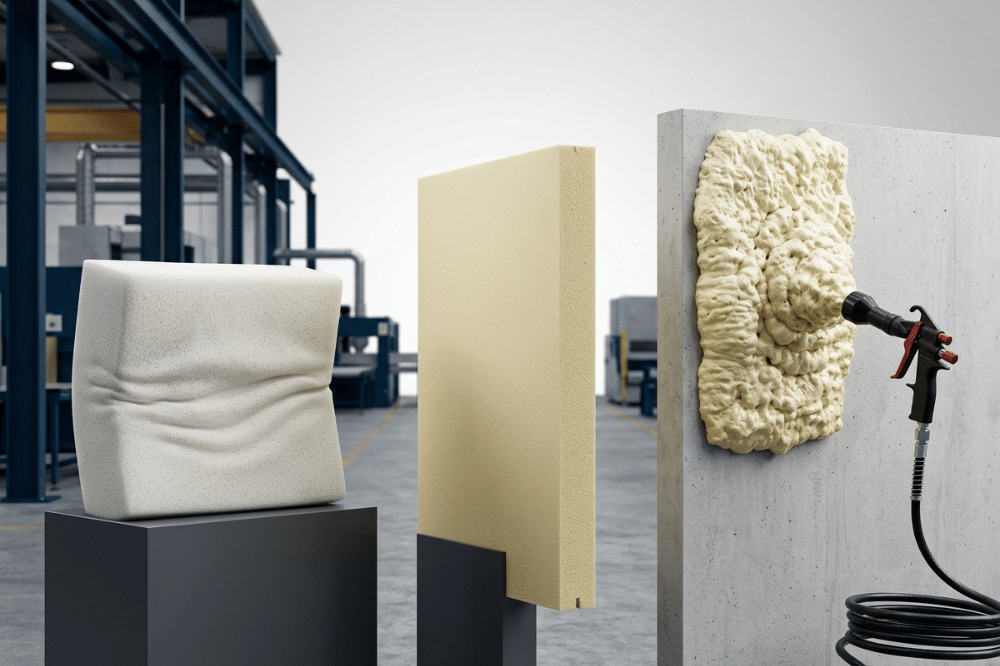
Polyurethane foam comes in three primary forms—flexible, rigid, and spray—each built for a different job. Flexible foam handles comfort and impact absorption. Rigid foam delivers thermal insulation and structural strength. Spray polyurethane foam (SPF) seals building envelopes on-site and conforms to any surface. Choosing the right one comes down to cell structure, density, R-value, and how the foam is processed and applied. And here’s what most buyers overlook: no matter which foam you pick, its real-world performance is determined by the equipment producing it—its accuracy in ratios, temperature control, and consistent output.
Polyurethane foam is everywhere—inside the chair you’re sitting in, behind the walls of your home, and sealed into the roof of a commercial building. But the foam in a seat cushion is chemically and structurally different from the foam insulating a refrigerated warehouse, and both differ from the SPF sprayed into a crawlspace. Treating them as interchangeable is one of the most common specification mistakes in the industry.
This guide walks through all three foam types from a production and processing standpoint. You’ll learn what makes each one work, where it performs best, what specs to evaluate, when not to use it, and how to match the right foam to your application. We’ll also cover the piece that ties it all together: why the equipment behind the foam determines whether it meets spec for years or fails quietly in the field.
What Are the Main Types of Polyurethane Foam?
All three foam types start from the same core chemistry—an isocyanate reacting with a polyol. What changes are the cell structure, the density, and how the material is processed? That’s what turns one chemistry platform into three very different products.
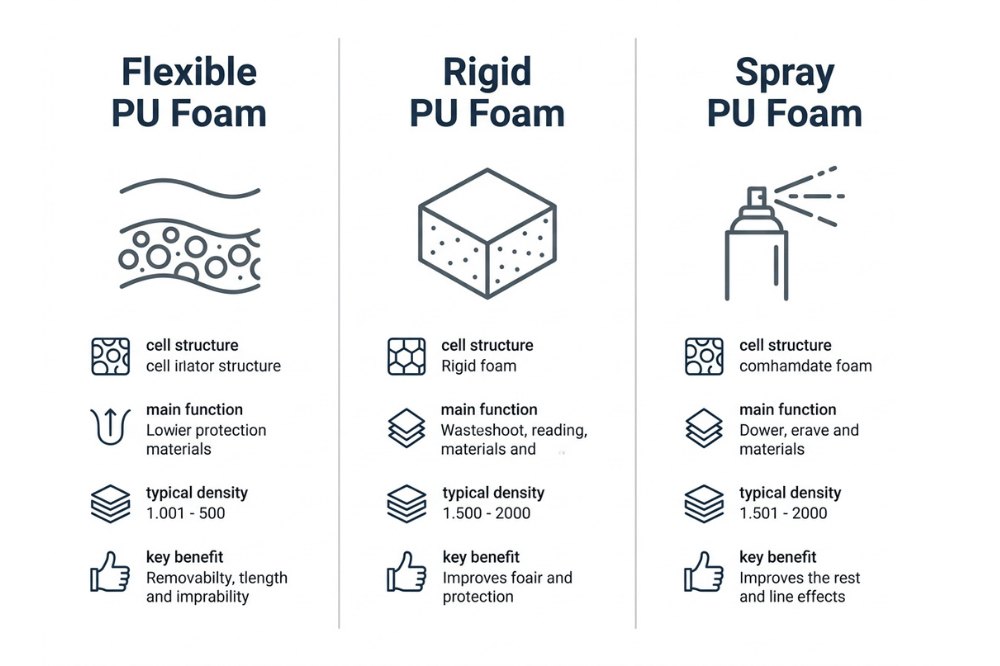
Before we go in-depth on each type, here’s a quick comparison.
|
Foam Type |
Cell Structure |
Main Function |
Typical Density |
Key Benefit |
Common Applications |
|---|---|---|---|---|---|
|
Flexible PU Foam |
Open-cell |
Comfort and cushioning |
1.5–2.5 pcf |
Softness, resilience, airflow |
Furniture, bedding, automotive seating |
|
Rigid PU Foam |
Closed-cell |
Thermal insulation and structure |
1.8–3.5 pcf |
High R-value, moisture resistance, stiffness |
Panels, refrigeration, roofing |
|
Spray PU Foam |
Open- or closed-cell |
On-site sealing and insulation |
0.5 or ~2.0 pcf |
Air sealing fills irregular cavities |
Attics, walls, crawlspaces |
Keep this table in mind as you read. Each section below expands on one row—and every one ends at the same place: the processing discipline that makes the foam perform.
Flexible Polyurethane Foam
What it is
Flexible polyurethane foam has an open-cell structure. The cell walls rupture during foaming, leaving an interconnected network of air-filled cells. That structure gives the material its softness, recovery, and breathability—air flows through it freely.
The foam forms when an isocyanate reacts with a polyol blend in the presence of water and additives. The water reacts with the isocyanate to generate CO₂, which drives the rise and opens the cells. Controlling that reaction—the rise profile, the gelation point, the cell-opening behavior—is where the real processing skill lives.
Key specs
Two specs define flexible foam quality more than any others, and confusing them leads to bad purchasing decisions.
- Density (measured in pcf or kg/m³) reflects the mass of the polymer matrix, not the air inside it. Higher density means the foam holds its support and firmness longer under repeated compression. A seat cushion at 1.8 pcf degrades noticeably faster than one at 2.5 pcf.
- Firmness is measured by Indentation Force Deflection (IFD)—the force needed to compress a sample by 25% of its height. Low IFD feels soft; high IFD feels firm. You can have high-density foam that’s soft or low-density foam that’s firm. Density governs how long the foam lasts; firmness governs how it feels on day one.
- Support factor (the ratio of 65% IFD to 25% IFD) measures resistance to bottoming out. It typically ranges from 1.5 to 2.6, and higher is better for healthcare or high-use commercial seating.
Per the Polyurethane Foam Association (PFA), an air flow of at least 2.0 cubic feet per minute (cfm) is the benchmark for optimal flexible foam performance.
Applications
- Furniture and bedding — seat cushions, mattress cores, pillow-top layers
- Automotive seating — headrests, seat pads, armrests, door panels
- Packaging — die-cut foam that cushions fragile equipment in transit
- Carpet cushion — a layer that absorbs cyclical compression and foot-traffic abrasion
- Protective gear — helmets, padding, medical positioning aids
Equipment and process considerations
For production, the critical variables are mix ratio control (to hold the polyol-to-isocyanate index precisely), raw material temperature at the mix head, and consistent shot control. A drift in mix ratio shows up in the cured foam as a change in firmness or density—subtle enough to pass a visual check, serious enough to trigger field complaints six months later.
When not to use it
Don’t reach for flexible foam anywhere thermal insulation matters. Its open-cell structure and low density make it useless as an insulator. It’s also the wrong pick where moisture or vapor control is part of the spec.
Rigid Polyurethane Foam
What it is
Rigid polyurethane foam forms a closed-cell structure—cells that remain sealed and filled with a low-conductivity blowing-agent gas rather than air. Those intact cell walls are the source of nearly every advantage the material offers: high thermal resistance, low moisture vapor transmission, structural rigidity, and compressive strength.
The closed-cell morphology forms when the chemistry and blowing agent are tuned to prevent cell-wall rupture during rise. The result is a dimensionally stable, self-supporting material that can be molded into panels, poured into cavity molds, or laminated continuously between metal or plastic facings on a double-belt laminator.
Key specs
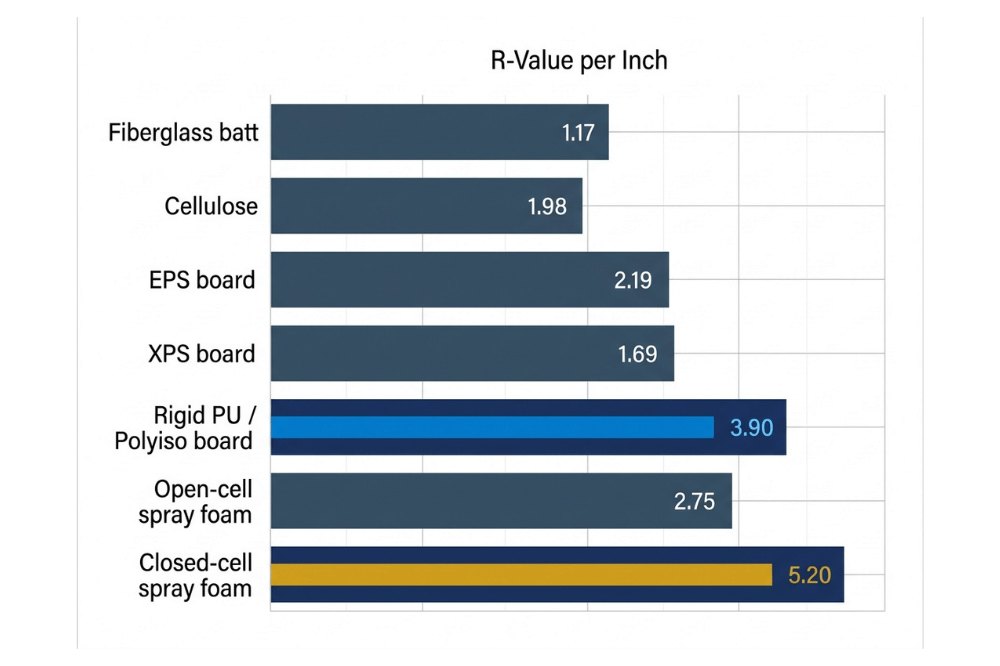
Rigid foam’s headline number is R-value per inch, and it consistently beats other insulation on a per-inch basis.
|
Material |
R-value per inch |
|---|---|
|
Fiberglass batt |
R-2.5 to R-4 |
|
Cellulose |
R-3.2 to R-3.8 |
|
EPS rigid board |
~R-4 |
|
XPS rigid board |
~R-5 |
|
Rigid PU / polyiso board |
R-6 to R-6.5+ |
|
Open-cell spray foam |
~R-3.5 |
|
Closed-cell spray foam |
R-6 to R-8 |
For a walk-in cooler or refrigerated trailer where wall thickness costs interior square footage, the difference between R-4 and R-6.5 per inch is not a rounding error. It affects how many inches of foam you need, which in turn affects wall thickness, cargo volume, and the load on the refrigeration system.
Applications
- Building envelopes and roofing — rigid PU and polyiso boards as the primary thermal layer
- Refrigeration and cold chain — walk-in coolers, refrigerated trucks, cold storage cores between metal facings
- Entry doors and composite panels — foam cores that add thermal, acoustic, and bending stiffness to thin facings
- Below-grade and foundation — exterior foundation walls where moisture resistance and thermal continuity matter
Equipment and process considerations
Rigid foam processing demands precise ratio control at the pour head and well-managed raw material temperatures. Most rigid formulations are viscosity-sensitive—cold polyol pours unevenly and produces non-uniform cell structure, which shows up directly as density and R-value variation across a panel. Heated storage and heated hoses between the tanks and mix head are standard on any line where consistent finished-product quality is a requirement, not a hope.
When not to use it
Skip rigid foam where you need cushioning, flexibility, or impact recovery—it’s stiff by design. It’s also not the answer for sealing irregular, hard-to-reach cavities on-site; that’s where spray foam earns its keep.
Spray Polyurethane Foam (SPF)
What it is
SPF is a two-component (2K) system: an isocyanate (A-side) and a polyol resin blend (B-side) that react on contact. The materials are stored separately, pumped at controlled temperatures through heated hoses, and combined at a plural-component spray gun—either by impingement mixing in the gun chamber or through a static mix element. The reaction begins instantly, with the foam gelling and expanding within seconds of hitting the substrate.
That speed is both the strength and the constraint. It lets installers move quickly across large areas without waiting for cure. It also means the ratio and temperature must be correct before the trigger is pulled. With SPF, there’s no fixing a bad mix once it’s on the wall.
Open-cell vs closed-cell SPF
Both types start with the same basic chemistry, but the formulation determines whether cells remain open or closed, producing two very different field materials.
|
Property |
Open-Cell SPF |
Closed-Cell SPF |
|---|---|---|
|
Density |
~0.5 lb/ft³ |
~2 lb/ft³ |
|
R-value per inch |
~R-3.5 |
R-6 to R-8 |
|
Expansion |
High (100–150x liquid volume) |
Moderate |
|
Vapor behavior |
Vapor-permeable (retarder) |
Vapor barrier at 2–3 inches |
|
Structural contribution |
Minimal |
Adds racking resistance |
|
Best for |
Interior air sealing, attics |
Crawlspaces, rim joists, and moisture control |
Applications
- Attics — open-cell at the roof deck creates a conditioned attic; closed-cell where R-value per inch is the constraint
- Crawlspaces and basements — closed-cell on walls and rim joists insulates and moisture-seals the perimeter at once
- Wall cavities — both types beat batt insulation by eliminating the gaps around wires, outlets, and framing where air infiltration actually happens
Equipment and process considerations
Heated proportioners hold A and B components at target temperatures throughout application. The polyol blend is typically high-viscosity at room temperature and must be warmed to atomize and mix correctly. Temperature stability in the proportioner and along the hose run is the most direct lever for a consistent spray pattern, consistent ratio, and consistent finished foam.
When not to use it
SPF isn’t the pick where a factory-produced board or molded part is cheaper and more consistent—continuous lamination beats on-site spray for volume panel production. And in occupied interior spaces, it can’t be left exposed. Code requires a thermal barrier, which brings safety into the conversation.
Safety and code, in brief: SPF involves isocyanate chemistry, so supplied-air respirators and full chemical PPE are required during application and initial cure. Isocyanates are respiratory sensitizers. On the code side, IRC 2015 Section R316 requires SPF on interior surfaces to be separated from occupied space by an approved thermal barrier—typically 1/2-inch gypsum board—because foam plastic is combustible. Know the code before the application is specified.
How to Choose the Right Polyurethane Foam
Polyurethane foam isn’t a single material—it’s a chemical platform that produces distinctly different products depending on how the reaction is controlled. So the selection decision should follow the application’s actual performance requirements, not habit or price alone.
Start with what the job needs, then work back to the foam.
|
If you need… |
Best Foam Type |
|---|---|
|
Comfort and impact absorption |
Flexible foam |
|
Thermal insulation in panel form |
Rigid foam |
|
On-site sealing around irregular surfaces |
Spray foam |
|
Highest R-value per inch |
Rigid or closed-cell SPF |
|
Vapor permeability with air sealing |
Open-cell SPF |
|
Structural reinforcement in panels |
Rigid foam |
|
Low-cost cushioning with durability |
Flexible foam (spec density carefully) |
|
Vapor barrier for below-grade or crawlspace |
Closed-cell SPF or rigid board |
A quick way to sanity-check any choice: if the answer to “does this need to be soft?” is yes, you’re in flexible territory. If it needs to be insulated, you’re choosing between rigid and SPF—and the deciding factor is usually whether the work happens in a factory (rigid) or on-site around complex geometry (spray).
Why Equipment and Process Control Matter
Here’s the part most specification guides skip. Two batches of foam can carry identical datasheets and behave completely differently in the field. The reason is almost always production. The chemistry is only as good as the machine delivering it.
The three levers that determine foam quality are the same across all foam types, even though they appear different.
Ratio accuracy
The polyol-to-isocyanate ratio drives cell structure, density, and cure. Hold it tight, and you get repeatable foam. Let it drift, and you change firmness in flexible foam, density and R-value in rigid foam, and cure behavior in SPF. In fast-set spray systems, especially, the mix happens at the gun in seconds—there’s zero room to correct a bad ratio after the fact.
Temperature control
Component temperature shapes viscosity and reaction. Cold polyol pours and sprays unevenly, producing irregular cells that quietly erode both R-value and moisture resistance. Heated storage, heated proportioners, and heated hoses aren’t upgrades—they’re part of the ratio control system. Stable temperature is what makes the reaction predictable.
Output consistency
Foam quality depends on repeatability, not just a good formula. A well-maintained line that holds ratio, temperature, and output steady across a full run turns out foam that meets spec batch after batch. Inconsistent output produces variation within the same run, which later surfaces as field complaints and rework.
The takeaway for anyone producing foam: precise metering, accurate mixing, stable temperatures, and disciplined maintenance are what separate consistent, on-spec foam from a gamble.
Common Mistakes to Avoid
|
Mistake |
Why It Matters |
What to Do Instead |
|---|---|---|
|
Using flexible foam where insulation is required |
It has no meaningful R-value |
Specify rigid or spray foam for thermal work |
|
Choosing open-cell foam where vapor control is critical |
Open-cell is vapor-permeable and lets moisture through |
Use closed-cell SPF or rigid board for vapor barriers |
|
Comparing density across foam categories |
A 2 pcf flexible foam and a 2 pcf rigid foam mean very different things |
Compare specs within the same foam type |
|
Specifying by day-one firmness or R-value only |
Poorly processed foam degrades faster than the datasheet implies |
Weigh long-term retention and production quality |
|
Ignoring equipment calibration in production |
Off-ratio or cold material underperforms its own spec |
Hold tight ratio and temperature control on the line |
|
Specifying SPF without checking code and re-occupancy |
Foam is combustible and needs a thermal barrier |
Confirm IRC requirements and cure timelines first |
Sustainability Trends in Polyurethane Foam
The polyol side of the equation is getting greener, and it’s worth knowing where things actually stand.
Bio-based polyols—derived from soybean oil, rapeseed, castor oil, and agricultural byproducts—can partially replace conventional petroleum polyols in both flexible and rigid formulations. They’re gaining traction in building, automotive, and furniture applications, driven by green building programs like LEED and rising demand for lower-carbon materials.
Recycled polyurethane follows a separate path. Chemical depolymerization turns post-consumer foam waste—discarded mattresses, for example—back into repolyol. Per Circufoam, recycled polyols are produced through controlled chemical recycling and designed to meet standard industrial specs, including hydroxyl and acid number targets.
The honest picture: both pathways are used at partial-replacement levels today, not at full substitution. But regulatory pressure—frameworks like the EU’s Ecodesign for Sustainable Products Regulation (ESPR)—is accelerating adoption. From a production standpoint, these alternative polyols can alter viscosity and reactivity, making stable temperature and ratio control even more important on the line.
Frequently Asked Questions
What is the difference between open-cell and closed-cell polyurethane foam?
Open-cell foam has a soft, interconnected cell structure that lets air and vapor pass through. Closed-cell foam has sealed cells that block both air and moisture vapor. Closed-cell is denser, stronger, and delivers higher R-values per inch. Open-cell is lighter, more flexible, and expands more on application—useful for filling irregular cavities.
Which type of polyurethane foam provides the highest R-value?
Closed-cell spray polyurethane foam has an R-value of roughly R-6 to R-8 per inch, according to the U.S. Department of Energy. Rigid polyurethane board reaches R-6 to R-6.5 per inch. Open-cell SPF sits around R-3.5 per inch.
Can flexible polyurethane foam be used for insulation?
No. Flexible foam is formulated for comfort, support, and impact absorption—not thermal resistance. Its open-cell structure and low density make it inappropriate for insulation. Use rigid or spray foam for insulation work.
How long does spray polyurethane foam take to cure?
SPF gels within seconds and is often tack-free within minutes, but full chemical cure typically takes 24 hours before recoating or encapsulation. Occupants should generally stay out of the space for at least 24 hours after application, though product-specific safety data sheets and manufacturer guidance should govern the timeline every time.
What density of flexible foam should I specify for high-traffic commercial furniture?
For high-use commercial seating, a minimum polymer density of 2.0 to 2.5 pcf is a reasonable starting point. Higher-density foam holds its firmness and support factor longer under repeated compression. Pair it with an appropriate IFD for the seating depth and use case. Low-density foam in commercial furniture almost always produces a durability complaint within a year or two.
Can rigid polyurethane foam be used below grade?
Yes. Rigid polyurethane board is common on exterior foundation walls because its closed-cell structure resists moisture and maintains thermal performance in damp conditions. Specify a product rated for below-grade use and confirm its moisture absorption characteristics. Don’t use open-cell foam in below-grade or ground-contact applications.
Does the equipment used to make the foam really affect the finished product?
Yes—more than most buyers realize. Ratio accuracy, component temperature, and output consistency directly shape cell structure, density, and cure across all three foam types. Two batches with identical datasheets can perform very differently if one came off a tightly controlled line and the other didn’t.
Choosing the Right Foam—and the Right Equipment Behind It
Polyurethane foam is a chemical platform that yields three distinct products. Each one serves a defined role, and the specification decision should align with the application’s actual performance requirements.
Three takeaways to carry into your next project:
- Match the foam to the function. Flexible for comfort, rigid for thermal insulation and structure, and spray for on-site sealing around irregular geometry.
- Compare specs within a category. Density, IFD, and R-value mean different things across foam types—never compare them side by side as if they’re equivalent.
- The foam is only as good as the equipment behind it. Consistent, on-spec foam starts with precise ratio control, stable temperatures, and repeatable output.
That last point is the one worth sitting with. Whether you’re producing flexible cushioning, rigid panels, or spray foam systems, foam that meets spec run after run comes from equipment that maintains tight ratios, keeps material at the right temperature, and delivers consistent output.
If you’re producing polyurethane foam—or planning a new line—the equipment is the difference between foam that meets spec and foam that quietly falls short. Our team engineers high-precision metering, mixing, and dispensing systems built for stable ratios, tight temperature control, and repeatable output across full production runs. If you want foam that performs as specified for the long haul, let’s talk about the equipment that makes it possible.