
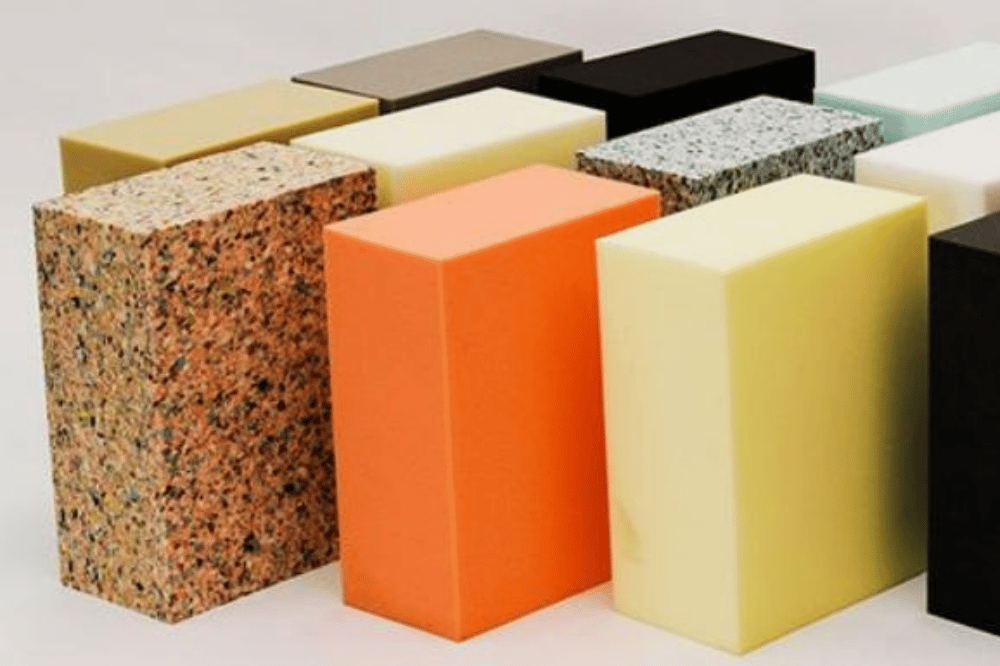
Polyurethane (PU) isn’t a single material—it’s a polymer family formed by reacting a polyol with an isocyanate to create urethane bonds. That one reaction can produce soft, flexible foam, rigid insulation panels, tough thermoplastic parts, protective coatings, and industrial elastomers. Roughly 20 million tons are produced worldwide each year. But here’s what most buyers miss: whichever form you choose, its real-world performance depends as much on the equipment producing it—ratio precision, temperature stability, and moisture control—as on the formulation itself.
Walk through any modern factory floor—automotive, construction, furniture, footwear—and polyurethane is almost certainly part of the product coming off the line. It fills vehicle seat cushions, insulates cold storage walls, coats industrial floors, and forms the soles of work boots. Few materials match this range across so many manufacturing environments.
Understanding polyurethane starts with the chemistry. Once you know how it forms, why different formulations behave differently, and what drives those differences at the molecular level, the downstream engineering and processing decisions get much clearer. This guide works through the chemistry, properties, product types, and real-world manufacturing considerations that determine whether a given polyurethane system performs as expected—or becomes a costly production headache.
It’s written for engineers, procurement professionals, formulators, and production managers who work with polyurethane materials or equipment and want a solid technical foundation for better decisions.
Polyurethane at a Glance
Before we go deep, here’s the whole material family in one view.
|
Aspect |
Summary |
|---|---|
|
What it is |
A polymer family formed by reacting polyols with isocyanates to create urethane bonds |
|
Main forms |
Flexible foam, rigid foam, thermoplastic polyurethane (TPU), CASE (coatings/adhesives/sealants/elastomers), waterborne dispersions (PUDs) |
|
Key properties |
Abrasion resistance, thermal insulation, elasticity, chemical resistance, tunable hardness |
|
Typical uses |
Furniture, insulation, coatings, footwear, industrial wheels and rollers, adhesives, seals |
|
Processing needs |
Precise ratio control, stable temperature, moisture management, and consistent output |
Keep this table in mind as you read. Every section below expands on one row—and they all point to the same conclusion: the chemistry is only as good as the process that delivers it.
How Polyurethane Chemistry Works
Otto Bayer first developed polyurethane chemistry in 1937. Commercial production followed in the 1950s, and the material has continued to expand its footprint ever since.
There’s no single polyurethane formula
This is the first thing to get straight. Polyurethane is not a single compound with a fixed chemical formula. It’s a family of polymers defined by a shared bond—the urethane linkage (–NHCOO–), which gives the group its name.
The core reaction joins an isocyanate (which carries reactive –N=C=O groups) with a hydroxyl-bearing compound, usually a polyol (which carries –OH groups). These two react exothermically, often at room temperature, and the urethane bonds link them into long polymer chains. Because you can swap in different polyols and different isocyanates, the repeating unit changes from one formulation to the next. That variability is exactly what lets formulators engineer a huge range of mechanical and physical properties from the same basic chemistry.
So when someone asks for “the formula for polyurethane,” the honest answer is that it depends on which polyurethane. The bond is constant; the building blocks are not.
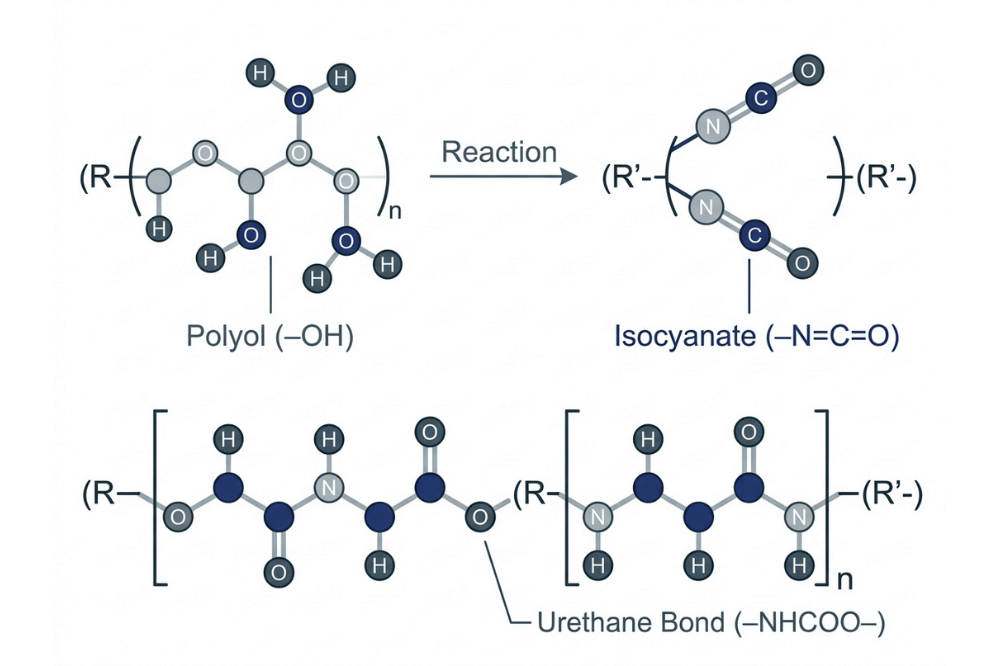
The building blocks
The polyol controls crosslinking and, by extension, flexibility. A diol (two hydroxyl groups) reacts with an isocyanate to produce a more linear, flexible polymer. Polyols with more reactive hydroxyl groups create denser crosslinking and a more rigid end product.
The isocyanate provides the reactive backbone. Two dominate the market:
- TDI (toluene diisocyanate) — used mainly in low-density flexible foams.
- MDI (methylene diphenyl diisocyanate) — the workhorse behind rigid foams and adhesives.
Together, TDI and MDI account for over 90% of global isocyanate use. For applications where UV and color stability matter, aliphatic isocyanates step in:
- HDI (hexamethylene diisocyanate) and IPDI (isophorone diisocyanate) — specialized use in coatings, though under 5% of total isocyanate volume.
Catalysts and the blowing reaction
Catalysts aren’t a minor detail. They control the reaction rate, gel time, and the balance between urethane formation and the water side reaction. When moisture is present, isocyanate reacts with water to form carbamic acid, which breaks down into urea and carbon dioxide gas. That CO₂ is what drives foam expansion. Managing—or suppressing—that reaction is the catalyst system’s job.
Catalysts fall into two broad camps:
- Amine catalysts (e.g., DABCO, DMDEE) promote both urethane formation and the water reaction, making them standard in foam production. They can add odor and affect color.
- Organometallic catalysts—tin-based (e.g., dibutyltin dilaurate) — are the most common and selectively promote the urethane reaction. Bismuth and zinc catalysts are gaining ground for their lower toxicity, especially in CASE applications facing tighter regulation. Mercury catalysts, once prized for long pot life and fast back-end cure, have fallen out of favor over toxicity concerns.
Catalyst choice feeds directly into equipment design and process parameters—a point that comes back later when we talk about dispensing and mixing.
Key Properties of Polyurethane
Polyurethane’s commercial dominance isn’t luck. It combines properties that few other polymer systems can match across such a wide range of formulations.
- Abrasion and wear resistance — Cast polyurethane elastomers outperform natural rubber, which is why they’re the go-to for mining wheels, forklift tires, conveyor belts, and screen panels under constant mechanical stress.
- Thermal insulation — Rigid closed-cell foam delivers high R-value in thin cross-sections. With heating and cooling accounting for roughly 56% of energy use in a typical American home (U.S. Department of Energy), rigid PU foam is heavily specified in roof and wall insulation.
- Elasticity and load-bearing — Properly formulated elastomers withstand repeated load cycles without permanent deformation, making them ideal for automotive suspension bushings and industrial rollers.
- Chemical resistance — generally surpasses that of natural rubber across many oils, solvents, and acids, which is why PU seals and gaskets are used in hydraulic systems, chemical processing, and food production.
- UV and weathering (with a caveat) — Aromatic-based PU (TDI or MDI) tends to yellow and degrade under prolonged UV. Aliphatic isocyanates deliver superior color and performance, making them the choice for exterior coatings.
Main Types of Polyurethane
The polyurethane family is divided into several product categories, each optimized for different processing methods and end uses. Here’s each one in a consistent structure.
Flexible Foam
- What it is: Open-cell foam with a soft, breathable, resilient structure.
- Key property: Comfort and recovery; density and firmness tune independently.
- Common uses: Furniture cushioning, mattresses, automotive seating, carpet underlay, packaging.
- Processing method: Pour-in-place, slabstock, or molded foam lines.
- When to choose it: When comfort, cushioning, or acoustic damping is the primary function. Flexible foam is about 30% of the North American PU market.
Rigid Foam
- What it is: Closed-cell foam with sealed cells holding low-conductivity gas.
- Key property: High R-value per inch plus structural stiffness.
- Common uses: Refrigerator and freezer insulation, commercial roofing, insulated doors and panels, spray-applied air barriers.
- Processing method: Pour, mold, or continuous lamination between facings.
- When to choose it: When thermal insulation, moisture resistance, or panel stiffness drives the design.
Thermoplastic Polyurethane (TPU)
- What it is: A fully thermoplastic PU that can be melted and reprocessed.
- Key properties: High elasticity, impact resistance, and abrasion resistance, with design freedom in color and hardness.
- Common uses: Footwear outsoles, automotive components, wire and cable jacketing, hydraulic hoses.
- Processing method: Standard polymer equipment—extrusion, injection molding, blow molding, compression molding.
- When to choose it: When you need a durable elastomeric part that can be processed using conventional thermoplastic methods.
CASE (Coatings, Adhesives, Sealants, Elastomers)
- What it is: A broad, technically diverse segment of non-foam PU systems.
- Key property: Protective performance, strong bonding, and abrasion resistance.
- Common uses: Automotive and industrial floor coatings, wood finishes, construction and composite-wood adhesives, cast rollers, and screen panels.
- Processing method: Spray, cast, roll, or dispense; aliphatic systems for UV-exposed work.
- When to choose it: When you need surface protection, bonding, or high-abrasion cast parts—use aliphatic CASE wherever UV and color stability matter.
Waterborne Polyurethane Dispersions (PUDs)
- What it is: PU systems that use water as the primary carrier instead of a solvent.
- Key property: Significantly lower VOC emissions with good clarity and no yellowing.
- Common uses: Industrial coatings and adhesives under tightening emissions rules.
- Processing method: Waterborne coating and dispersion equipment.
- When to choose it: When VOC and hazardous air pollutant limits are a compliance priority.
How to Choose the Right Polyurethane System
Formulation chemistry is only half the decision. Start with what the application needs, then work back to the type.
|
If you need… |
Best Polyurethane Type |
Why |
|---|---|---|
|
Cushioning and comfort |
Flexible foam |
Open-cell softness and resilience |
|
Thermal insulation |
Rigid foam |
Closed-cell structure retains low-conductivity gas |
|
Reprocessable elastomeric parts |
TPU |
Melts and runs on standard thermoplastic equipment |
|
UV-stable exterior coating |
Aliphatic CASE |
Holds color and gloss under sunlight |
|
Low-VOC coating system |
Waterborne PUD |
Water carrier cuts emissions |
|
High-abrasion industrial parts |
Cast PU elastomer |
Outlasts rubber under wear and load |
A quick sanity check: if it needs to be soft, you’re in flexible-foam territory. If it needs to be insulated, you’re choosing between rigid foam and spray systems. If it needs to be a durable molded or extruded part, look at TPU or cast elastomers.
Why Processing Equipment Matters
Here’s the part most material guides skip. On the production floor, two batches built from the same formulation can behave completely differently. The reason is almost always the process. The chemistry is only as good as the equipment delivering it—and four levers decide the outcome.
Mixing ratio precision
Two-part PU systems demand accurate volumetric metering of the polyol and isocyanate streams. Off-ratio material cures under- or over-reacted—both are rejection events. Metering technology (gear, piston, or rod-displacement meters) has to match the flow rate, viscosity range, and tolerance window of the formulation. Hold the ratio tight, and you get repeatable parts; let it drift, and defects follow.
Temperature stability
Temperature control across the supply, metering, and mixing circuit directly affects viscosity and reaction consistency. Variable ambient conditions on a production floor make active temperature control—electric, water, or otherwise—an operational necessity, not a nicety. Cold material meters and mixes unevenly; stable temperature keeps the reaction predictable.
Moisture and degassing management
Moisture is the quiet enemy, especially for rigid foams and elastomers. Residual moisture in polyol drums generates CO₂ at the mix head, leaving voids and porosity in finished parts. Vacuum degassing systems and desiccant dryers on vent lines are standard in precision PU operations.
Automation and repeatability
Automation should meet the job’s volume and consistency requirements. For high-volume production, gantry or articulating robots paired with servo-driven metering deliver the repeatability, cycle time, and material efficiency that manual dispensing can’t sustain.
The takeaway: precise metering, stable temperatures, disciplined moisture control, and matched automation are what separate a PU operation that produces first-quality parts from one that generates scrap, rework, and downtime.
Advantages, Limitations, and Safety
|
Category |
Key Points |
|---|---|
|
Strengths |
Highly tunable properties; excellent strength-to-weight ratio; superior abrasion and chemical resistance; effective thermal and acoustic insulation; compatible with many processing technologies (pour-in-place, spray, RIM, extrusion, injection molding) |
|
Limitations |
Sensitive to high temperatures during processing and service; aromatic formulations degrade under UV; moisture-sensitive during processing—minor humidity swings can hurt surface quality and mechanical properties |
|
Safety |
Isocyanates are respiratory sensitizers; spray, RIM, and open-pour processes need ventilation, monitoring, and PPE within regulatory limits; blocked isocyanate systems reduce handling hazard for some single-component and waterborne formulations |
Sustainability and End-of-Life
Polyurethane recycling is advancing on several fronts. Mechanical recycling—grinding flexible foam into rebond material for carpet underlay—is already well established in commercial practice. Chemical recycling methods like glycolysis, hydrolysis, and pyrolysis can recover polyol feedstocks from post-industrial and post-consumer waste, though large-scale deployment is still maturing.
On the raw-material side, bio-based polyols derived from vegetable oils and other renewable feedstocks are increasingly available as drop-in or partial replacements for petrochemical polyols, lowering the carbon footprint of finished products. One practical note for producers: bio-based and recycled polyols can alter viscosity and reactivity, making stable temperature and ratio control on the line even more important.
Frequently Asked Questions
Is polyurethane toxic after it cures?
Once fully cured, polyurethane is generally considered chemically inert and non-toxic in most consumer and industrial applications. The health concerns center on the uncured isocyanate during processing. Adequate cure time, ventilation, and process control bring residual isocyanate levels in finished products down to safe levels.
What is the difference between polyurethane and polyurea?
Polyurethane forms when a polyol reacts with an isocyanate, usually in the presence of a catalyst. Polyurea forms when a diamine reacts with an isocyanate—no catalyst needed. Polyurea cures in seconds, resists moisture better, and performs at temperatures as low as -20°F. Polyurethane is softer, more flexible, less expensive, and better suited to foam, sealant, and coating work where a longer working time helps. For industrial protective coatings in harsh environments, polyurea is often the better call.
Can polyurethane be recycled or repurposed?
Yes. Flexible foam is routinely recycled into rebonded foam products. Chemical recycling via glycolysis or hydrolysis recovers polyol feedstocks for reuse. Chemical recycling is growing commercially but hasn’t yet reached the maturity of mechanical routes.
How long does polyurethane last outdoors?
Aromatic PU coatings are typically yellow and degrade within 1–2 years of direct UV exposure. Aliphatic PU coatings using HDI or IPDI maintain their appearance and performance for much longer, which makes isocyanate selection a key decision for any exterior application.
Why is polyurethane preferred over rubber for industrial wheels and rollers?
Cast PU elastomers beat natural rubber on abrasion resistance, load capacity, oil resistance, and operating temperature range. In mining, warehousing, and material handling, PU wheels and rollers often last two to three times longer than rubber ones, reducing downtime and total replacement costs.
What is the difference between water-based and oil-based polyurethane coatings?
Water-based PU (PUD) uses water as the carrier, dries faster, emits fewer VOCs, and stays clear without yellowing. Oil-based PU uses solvent carriers, dries more slowly, and adds a warmer amber tone. Oil-based systems have long been seen as more durable for heavy traffic, though high-performance waterborne formulations have largely closed that gap.
Getting the Most From Polyurethane
Polyurethane’s chemistry is genuinely flexible—and that’s both its greatest strength and the source of its complexity. The range of formulations, processing methods, and end-product forms is vast. Getting the most from it in a manufacturing setting means understanding not just what the material can do, but also what the processing system must do to deliver that performance consistently.
Accurate metering, controlled temperatures, proper moisture management, and matched equipment design aren’t secondary concerns. They’re what separates a polyurethane operation that runs efficiently and produces first-quality parts from one that generates scrap, rework, and unplanned downtime. Choose your formulation with your application in mind, and choose your equipment with your formulation in mind. The chemistry and the process have to work together.
If you’re producing polyurethane parts—or planning a new line—your equipment is the difference between parts that meet spec and parts that quietly fall short. Our team engineers high-precision metering, mixing, and dispensing systems built for stable ratios, tight temperature control, effective degassing, and repeatable output across full production runs. If you want first-quality parts with less scrap and less downtime, let’s talk about the equipment that makes it possible.