
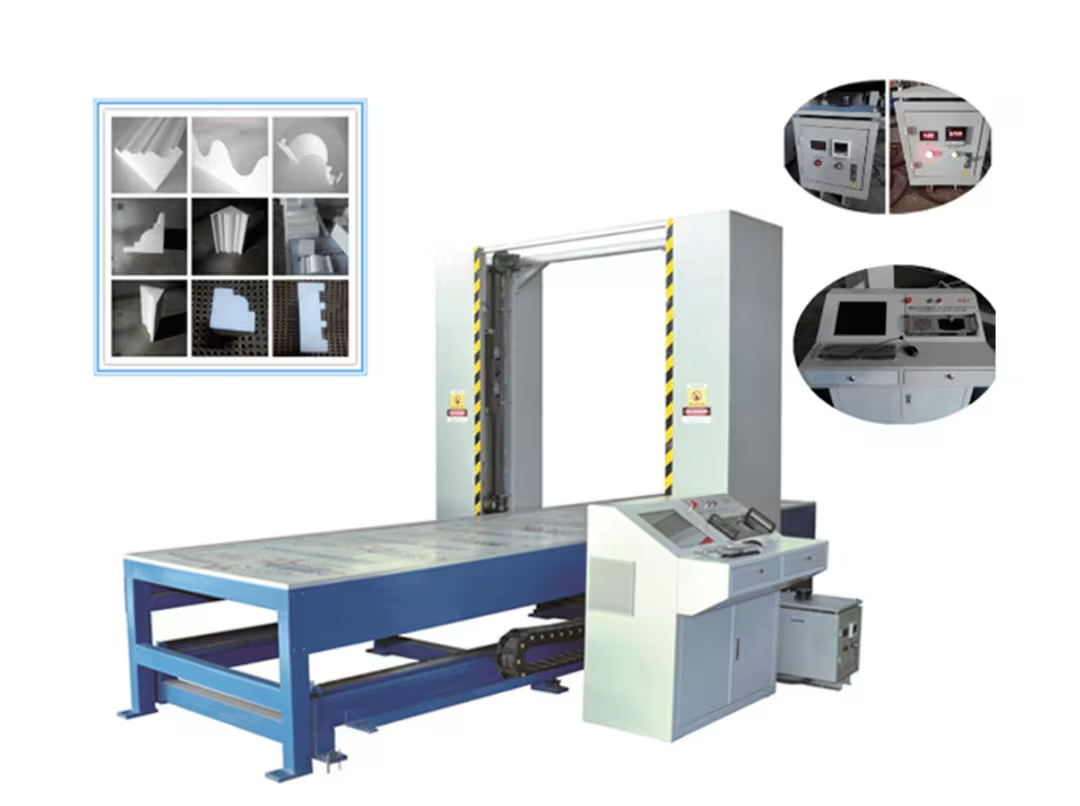
Most foam cutting equipment gets specified in the wrong order. Someone decides they need a CNC cutter, then looks for one—without first nailing down the foam type, product geometry, or realistic production volume. The machine name is the last thing to land, not the first. Work out the material, the production reality, and the right machine type, and the right machine usually becomes obvious.
This guide follows that sequence. It covers what differentiates cutting methods, how foam chemistry limits your options before anything else, and what hidden costs quietly reshape the purchase decision after the invoice is signed.
What a Foam Cutting Machine Actually Does
A foam cutting machine converts raw foam — blocks, slabs, rolls — into finished or semi-finished parts using a heated wire, a mechanical blade, or a computer-guided tool path.
That single sentence describes an enormous range of equipment. A horizontal splitter sheeting PU blocks to mattress depth, and a five-axis CNC contour cutter profiling automotive seat inserts are both “foam cutting machines,” and they share almost nothing — not in capital cost, not in operational complexity, not in the skill they demand from the people running them.
The practical measure isn’t “does it cut foam.” It’s whether the machine converts your material into your product shape at your required volume and tolerance, with waste you can live with. Those four variables — material, geometry, throughput, tolerance — are what every equipment decision comes back to.
Why Most Machine-Type Lists Mislead Buyers
Open any industry overview and you’ll find a flat list: hot wire, CNC, horizontal, vertical, contour, laser. The problem is that list mixes three completely different dimensions into a single menu — and comparing across those dimensions creates false choices.
These terms don’t all describe the same thing. They describe machines across three separate axes.
How the foam is cut. The cutting principle — hot wire, blade, or laser — is determined primarily by your material. It’s the most fundamental decision and the one that eliminates options fastest.
How the machine moves. Horizontal, vertical, and contour describe the cutting path and format. This is driven by your product geometry — sheets, sized blocks, or complex profiles.
How the machine is controlled. Manual, semi-automatic, and CNC describe the automation layer. This depends on your volume and how much shape complexity you’re managing.
CNC belongs on the third axis, not lumped in with horizontal or vertical. You can run a CNC hot wire machine or a CNC blade contour cutter — the control system is independent of the cutting principle and the machine format. Once you hold these three axes apart, the whole category becomes easier to reason about. You’re not choosing from a menu of six machines. You’re making three sequential decisions, each governed by a different variable.
The Cutting Principles: Hot Wire, Blade, and Laser
Hot wire uses an electrically heated element that melts a path through foam. It works cleanly on thermoplastic foams that melt in a controlled way — EPS and XPS are the obvious cases. Cut edges are smooth, waste is minimal, and there’s no blade to sharpen or replace. On flexible PU, hot wire fails — the foam doesn’t melt cleanly and just chars or drags along the wire.
Blade cuts by physical contact — a band knife or reciprocating blade slicing through the foam. This is the standard method for flexible foams: PU, PE, latex. Blade quality and sharpness directly determine cut quality, and blade wear is a real recurring cost. Higher-density foam and abrasive fillers accelerate it.
Laser vaporizes the cut line using a focused beam. It handles thin, soft sheet with fine precision and no tool contact. On most industrial foam, though, it’s slow, heat-sensitive, and produces fumes that need managing. Most foam plants treat laser as a specialist tool for detailed or decorative work, not a production workhorse. Guides that present it alongside hot wire and blade as an equivalent mainstream option are describing a different industry to the one most buyers are working in.
How Your Foam Determines the Right Cutting Principle
Material is where the selection starts, because it rules certain approaches out before anything else comes into consideration.
EPS and XPS. Both melt cleanly under heat, which makes hot wire the natural starting point. Edges are smooth, waste is low, and there are no blades to maintain. For packaging inserts, insulation board, or architectural profiles, a hot wire system — often CNC-controlled for shaped cuts — is where most buyers should start looking. Blade cutting is workable on EPS but produces more dust and static-charged beads, which create housekeeping and extraction problems.
PU flexible foam. Flexible PU does not melt cleanly, so hot wire is ruled out. The cutting principle here is blade — band knife for sheeting, vertical or contour blade systems for sizing and profiling. Foam density matters significantly: harder, denser PU dulls blades faster and demands a more rigid machine with better feed control. A machine that handles soft upholstery foam may struggle when the same plant starts cutting high-density mattress grades.
EPE and EVA. Closed-cell polyethylene and ethylene-vinyl acetate foams sit in the middle. Thin sheet might suit heat cutting; thicker blocks for technical gaskets or protective packaging usually call for blade or CNC contour work. The right answer depends on thickness, product geometry, and your tolerance requirements. Don’t assume a method that works on one product in this family transfers cleanly to another — run a trial on your actual stock.
Rigid PU and technical foam grades. Denser rigid materials need blade or CNC profiling and usually bring a dust management requirement that softer foams don’t. Treat these separately rather than grouping them with flexible PU grades.
The clearest thing you can do before comparing machines is bring a sample of your actual foam to any trial or demonstration. Datasheet density figures and the block on your production floor behave differently under a wire or blade. No specification table replaces a cut test on your material.
Horizontal, Vertical, and Contour: Matching Format to Product
Horizontal cutting splits blocks into sheets. The block feeds through and a horizontal element — wire or blade — slices it at a set height. This is the backbone of high-volume slab production: mattress cores, packaging layers, insulation sheet. The metrics that matter are thickness consistency across the full cut width and blade tracking over long runs.
Vertical cutting works on the upright plane, breaking blocks into smaller blocks or rough shapes. It handles straight profile cuts that a horizontal splitter can’t, and it’s common in furniture and packaging operations where foam is being sized before further processing. Most serious production lines run both: horizontal to sheet the block, vertical to size and square the pieces.
Contour cutting produces shaped profiles rather than uniform sheets or blocks. Think egg-crate mattress toppers, car seat profiles, stepped packaging cavities. This is where product geometry complexity lives, and where CNC control usually earns its place. If your product is defined by its shape rather than by a fixed thickness, contour is the format category you need to be looking at.
These aren’t competing choices. In most real plants they’re sequential stages: block arrives, gets split horizontally, gets sized vertically, gets profiled on a contour machine. Map the production journey from raw block to finished part and the format requirements fall out of that map naturally.
When CNC Is Worth It — and When It Isn’t
CNC gets pushed hard by suppliers, and for some operations it’s genuinely the right call. For others it’s expensive automation that produces mediocre straight cuts. The decision comes down to what your product mix and output volumes actually require, not what looks capable on a factory tour.
CNC makes sense when your parts involve complex geometries that manual setup can’t hold repeatably, when you run enough volume on the same programmed shapes to recover setup time, when tolerance requirements are tight enough that operator-to-operator variation becomes a scrap problem, or when you manage frequent design revisions and want to pull a saved program rather than re-rig a machine from scratch.
CNC is harder to justify when your cutting is mostly straight sheets and simple block sizing — a well-specced horizontal or vertical machine handles that faster and without the software layer. It’s also hard to justify when volumes are low and varied enough that programming time erases the efficiency gain, or when the team doesn’t have and won’t build the CAD skills the system needs to deliver its advantage.
That last point causes more failed CNC purchases than any technical specification. A contour cutter with no one who can drive the software produces straight cuts at five times the cost. Training and operator capability are part of the machine decision — budget for them explicitly, or don’t buy the machine. CNC returns its value on shape complexity and repeat volume, not on intention.
Production Task to Machine: Where the Selection Actually Resolves
Industry labels like “packaging” or “furniture” are too broad to drive equipment decisions. What resolves the selection is the production task — the specific operation being asked of the machine.
Sheeting blocks into consistent slabs. High-volume, dimensional accuracy, repeatable thickness. This is a horizontal cutter. The key purchase criteria are tracking stability across the cut width and blade or wire longevity under your foam grade.
Sizing and squaring blocks. Furniture offcuts, packaging blanks, pre-profile preparation. Vertical cutter territory, often paired with a horizontal system upstream. Simple to run, easy to maintain.
Producing flat inserts and simple nested shapes. EPS packaging, basic protective inserts. Hot wire for EPS; blade for flexible foam. Volume and shape repetition determine how much automation is worth adding.
Profiled surfaces and complex custom geometry. Seat contours, convoluted toppers, stepped packaging nests, technical gaskets. Contour cutting with CNC, matched carefully to tolerance and material. Speed matters less here than precision and repeatability.
Mixed production with frequent changeovers. Short runs, varied products, design revisions. This is where CNC earns its keep on flexibility — but the operator skill requirement is real and has to be factored in.
The pattern across all of these is the same: material determines the cutting principle, product shape determines the format, and volume plus complexity determine where on the automation scale you need to be.
The Costs That Don’t Appear on the Quote
The purchase price is what everyone compares first and what matters least over a machine’s working life.
Blade and wire consumption. These are ongoing costs, not one-time purchases. How fast consumables wear depends on your foam density, fill type, and run length — and suppliers rarely volunteer the worst-case figure. Get replacement intervals for your specific material and calculate annual consumable spend before comparing quotes.
Dust and offcut management. EPS and XPS cutting generates fine particle dust and static-charged beads. They clog machinery, create fire risk if they accumulate, and become a serious air-quality issue in enclosed plants. Confirm whether extraction is part of the machine or a separate system you need to design and fund. Buyers who treat this as an afterthought manage it as a daily problem.
Fume extraction for heat cutting. Melting foam releases fumes that need controlled ventilation. This applies to hot wire systems and laser cutting. In a high-volume or enclosed production environment, the extraction requirement can be significant enough to affect the overall installation cost.
Operator skill. A manual band knife and a CNC contour cutter are fundamentally different machines from a staffing perspective. The skill gap between them is a real cost — in training time, in scrap during ramp-up, in wear caused by incorrect operation. Factor this in at the selection stage rather than discovering it after installation.
Software capability and learning curve. For CNC machines, the control software is as important as the mechanical specification. Check which CAD/CAM formats it accepts, how long an operator realistically takes to become productive, and whether the supplier provides hands-on training or documentation you have to figure out yourself.
Spare parts availability. Ask for lead times on blades, wires, drive components, and control parts — for your region, not from a central warehouse. A line down for three weeks waiting on a part costs significantly more than the price difference between a well-supported and a poorly-supported supplier.
What Gets Bought Wrong, Repeatedly
Specifying by machine name before defining the job. “We need a CNC cutter” isn’t a specification — it’s a category preference stated before the actual requirement has been worked out. The right sequence is: material first, product geometry second, volume and tolerance third, machine type last.
Buying CNC for operations that don’t need it. High-automation equipment on low-complexity, low-volume work sits underused and ties up capital. Straight sheets and simple block sizing don’t require programmed tool paths.
Leaving consumable costs out of the comparison. A cheap machine with high blade turnover on dense foam, or a hot wire system requiring expensive wire on a heavy-use line, isn’t actually cheap. Annual consumable spend and replacement downtime are part of the true operating cost.
Ignoring extraction at the purchase stage. Dust and fume management tends to be treated as an installation detail rather than a design requirement. It often ends up retrofitted, which costs more and works less well than a properly integrated system.
Mismatching material to cutting principle. Hot-wiring flexible PU produces poor edges and frustrated operators. Blade-cutting EPS without dust control creates a housekeeping and safety problem. The cutting principle has to suit the material — this is a harder constraint than it looks on a spec sheet.
Trusting a supplier demo over a real trial. Demos run on prepared foam, under ideal conditions, with experienced operators. Your plant runs your foam, with your people, at your volume. A cut test on your own material on the actual machine you’re considering is a reasonable request, and a supplier who won’t accommodate it has told you something.
Questions Worth Asking Before You Commit
- Will you run a cut test on a sample of my actual foam — at my density and the thickness I’ll be cutting?
- Which cutting principle fits my material, and what’s the case against the alternatives?
- What dimensional tolerance does this machine hold consistently across a full production run, not a short trial?
- What are the blade or wire replacement intervals and costs under my material and volume?
- Is dust and fume extraction included, or do I need to scope and budget that separately?
- What operator skill level does this machine require, and what training do you provide at commissioning?
- Which file formats does the CNC system accept, and how long does it realistically take an operator to get productive?
- What are actual lead times on critical spare parts — blades, wires, control components — stocked in my region?
- What after-sales response time and service coverage can you commit to?
- Can you connect me with buyers cutting the same material for a similar product?
Pre-Purchase Checklist
- Foam type, density, and thickness defined for all products you’ll run
- Cutting principle confirmed to suit your material
- Machine format matched to your product geometry
- Automation level matched to your volume and shape complexity
- CNC justified on real product mix and volume — or explicitly ruled out
- Cut test completed on your own foam
- Tolerance verified over a full run, not a single sample
- Annual consumable costs estimated for your material and run length
- Dust extraction and fume handling scoped and budgeted before purchase
- Operator skill requirement assessed and training agreed
- CAD/CAM compatibility confirmed for CNC machines
- Spare parts lead times confirmed for your region
- After-sales support and response time agreed in writing
- References from relevant buyers reviewed
Anything still open is a conversation to finish before signing.
FAQ
What is the best foam cutting machine for EPS?
Hot wire is usually the right starting point for EPS and XPS. These foams melt cleanly, giving smooth edges with minimal waste and no blade costs. For basic sheets, a straightforward hot wire system is sufficient. For shaped or grooved profiles — insulation board with tongue-and-groove edges, architectural shapes — a CNC-controlled hot wire gives you accurate, repeatable cuts. Blade cutting works on EPS but generates significantly more dust and static-charged beading.
Can one machine cut both EPS and flexible PU foam?
Not well with a single cutting principle. EPS suits hot wire; flexible PU requires blade cutting. If you’re regularly cutting both materials, you either need separate machines or a CNC blade system versatile enough to handle both — and you should run a cut test on each material before committing to any configuration.
Is CNC worth the cost for a smaller operation?
If the work involves complex shapes at enough repeat volume to pay back programming and setup time, yes. For straight sheets, simple block sizing, or low-volume varied runs, a quality horizontal or vertical machine does the job faster and without the software overhead. CNC returns its investment on geometry complexity and repeat volume, not on the ambition to have capable equipment.
What’s the real difference between horizontal and vertical foam cutters?
Horizontal cutters split blocks into sheets at a set thickness — the standard tool for continuous slab production. Vertical cutters work on the upright plane to size and square blocks or cut straight profiles. Many plants run both in sequence: horizontal to sheet, vertical to size. They’re complementary rather than competing.
Why does dust extraction matter so much for EPS cutting?
EPS generates fine particle dust and static-charged beads that accumulate in machinery, create fire risk in significant quantities, and cause air-quality problems in enclosed plants. Whether extraction is integrated or a separate installation requirement affects both cost and effectiveness. Buyers who overlook it at the quotation stage almost always deal with it operationally once production starts.
How do I keep blade and wire replacement costs down?
Match the cutting method to your material, maintain correct blade tension, and clean wires and blades regularly. Denser and more abrasive foams wear consumables faster than softer grades — factor that into the annual operating cost before purchase. A supplier who can give you real replacement intervals for your specific material is worth more than one who only quotes the machine price.
Before You Commit
The selection sequence matters: define the foam, define the product geometry, define the volume and tolerance — then the cutting principle, machine format, and automation level follow from those facts. The machine name is where the decision ends up, not where it starts.
Run a cut test on your own material. Press the supplier on consumables, extraction, spare parts, and support before comparing prices. A supplier willing to run your foam, give you honest comparisons between machine types, and back the equipment with real service is a partner worth working with. One who deflects those questions and focuses on the sticker price has shown you what the relationship will look like once the line is running.