

A blowing agent creates the gas that turns liquid polyol and isocyanate into foam. On a formula sheet, it can look like a minor line item. In practice, it isn’t.
Your blowing agent shapes foam density and R-value. It also affects how the mix flows, how safely your plant runs, and which regulations apply to you.
I work with formulators and procurement teams who want to know which blowing agent fits their foam and how a switch will affect their line. This guide skips the chemistry lecture. It shows how to choose, what changes, and when switching makes sense.
What PU Foam Blowing Agents Actually Do
Every foam cell starts as a tiny pocket of gas. The blowing agent supplies that gas, and its timing and makeup shape the foam that comes out of your mold. The first few seconds of the reaction explain why the effects go well beyond expansion.
How a Blowing Agent Builds Foam Structure
When polyol and isocyanate mix, the reaction releases heat. That heat drives the blowing process.
- Physical blowing agents are low-boiling liquids that you blend into the polyol. Cyclopentane boils near 49°C, so the rising exotherm turns it into vapor.
- Chemical blowing agents create gas through a reaction. Water is the main one. It reacts with isocyanate and releases CO₂.
The gas collects in tiny bubbles in the mix. Those bubbles grow while the polymer is still liquid, then lock in place as the foam gels.
Timing shapes the result. If gas forms too early, cells can coarsen or collapse. If it forms too late, the foam may stop rising before it fills the cavity.
Most rigid systems use both types. Water supplies some CO₂, and a physical agent handles most of the expansion.
Why the Blowing Agent Changes More Than Density
In closed-cell foam, the trapped gas carries a large share of the heat flow. Gas conductivity therefore drives much of your R-value. As a rough guide:
- Air: about 26 mW/m·K
- CO₂: about 16 mW/m·K
- Cyclopentane: about 12 mW/m·K
- Common liquid HFOs: about 10 to 11 mW/m·K
Strength shifts too. Water blowing forms urea, which stiffens the foam but can make it brittle and friable. It also consumes extra isocyanate.
Aging is where many formulas fall short. CO₂ tends to leave the cells relatively quickly, while air slowly moves in. Lambda creeps up, and low cell pressure can lead to shrinkage. Hydrocarbons can also condense at low temperatures, which matters in freezer cabinets and cold-store panels.
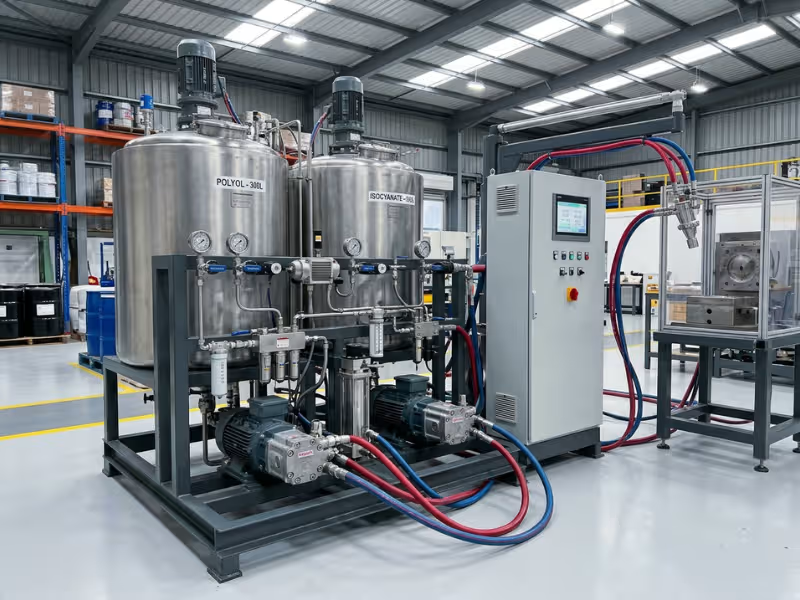
Processing changes as well. Boiling point affects flow and mold pressure, and solubility affects viscosity. I’ve seen plants switch agents at the same density and then find voids in cabinet corners. Expect to retune catalysts, surfactants, and machine settings. On production lines, that often means checking mixing accuracy, pressure control, and the overall setup of the polyurethane foaming machine before you scale up.
The Main Types of PU Foam Blowing Agents in Use Today
On paper, the list of options looks long. In most plants, the choice narrows to four families. Here’s a quick overview before we look at each one.
|
Type |
Main advantage |
Main drawback |
Common uses |
|---|---|---|---|
|
Hydrocarbons (cyclopentane, pentane blends) |
Low cost, zero ODP, very low GWP |
Flammable; needs explosion-proof plant design |
Refrigerator and freezer foam, PIR/polyiso boardstock, panels |
|
HFOs (e.g., HFO-1233zd(E), HFO-1336mzz(Z)) |
Very low GWP, low lambda, most liquid grades nonflammable |
Higher price, limited number of producers |
Closed-cell spray foam, premium rigid insulation, appliances in regulated markets |
|
Water / CO₂ |
Simple, widely available, no added blowing agent cost |
Weaker long-term insulation in rigid foam; adds friability and exotherm |
Flexible slabstock, molded foam, open-cell spray foam, co-blowing in rigid systems |
|
HFCs and legacy agents (HFC-245fa, HFC-365mfc, HCFC-141b) |
Familiar processing, nonflammable, good insulation |
High GWP, tightening restrictions, shrinking supply |
Legacy formulas and transition systems |
Hydrocarbons: Low Cost, Real Fire Risk
Cyclopentane leads in refrigerator and freezer foam. Pentane blends, including isopentane and n-pentane, are widely used in polyiso and PIR boardstock.
These agents cost little, carry zero ozone depletion potential, and have a very low GWP. Cyclopentane also delivers solid insulation for the price.
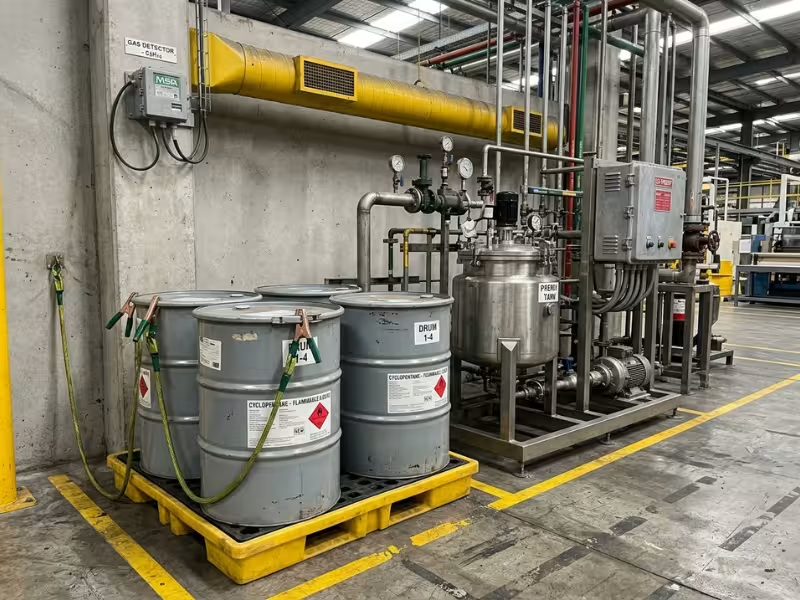
The catch is flammability. Pentane vapor can ignite at low concentrations in air. A plant running hydrocarbons typically needs:
- Explosion-proof premix stations
- Gas detectors and alarms
- Strong, monitored ventilation
- Nitrogen blanketing on storage tanks
Your foaming machine also needs a hydrocarbon-rated design.
If your plant already runs pentane safely, hydrocarbons are hard to beat on cost.
HFOs: Low-GWP Performance at a Premium Price
HFOs can deliver some of the lowest lambda values among common blowing agents. The two main liquid grades are HFO-1233zd(E) and HFO-1336mzz(Z). Gas-phase grades such as HFO-1234ze serve some spray and extruded foam applications.
All carry a GWP near 1. The main liquid grades are nonflammable.
Because those grades don’t burn, you can often run them on lines built for HFCs without explosion-proof upgrades. That’s one reason much of the closed-cell spray foam market in North America has moved to HFOs.
Price is the main drawback. HFOs often cost several times more per kilo than cyclopentane, and only a few producers make them. Many formulators blend HFOs with water or hydrocarbons. That reduces cost while keeping much of the lambda benefit.
Water and CO₂: Simple and Common, With Clear Limits
Flexible foam runs mostly on water. Slabstock and molded seating foam use CO₂ from the water-isocyanate reaction as their main gas. Open-cell spray foam relies on it too.
Rigid systems use water as a co-blowing agent. A small share in the polyol helps control rise and reduces how much physical agent you buy.
Pushing water higher brings problems:
- Isocyanate demand goes up
- Exotherm rises, and large slabstock blocks can scorch at the core
- Foam becomes more friable
- In rigid closed-cell foam, CO₂ diffuses out, and lambda climbs
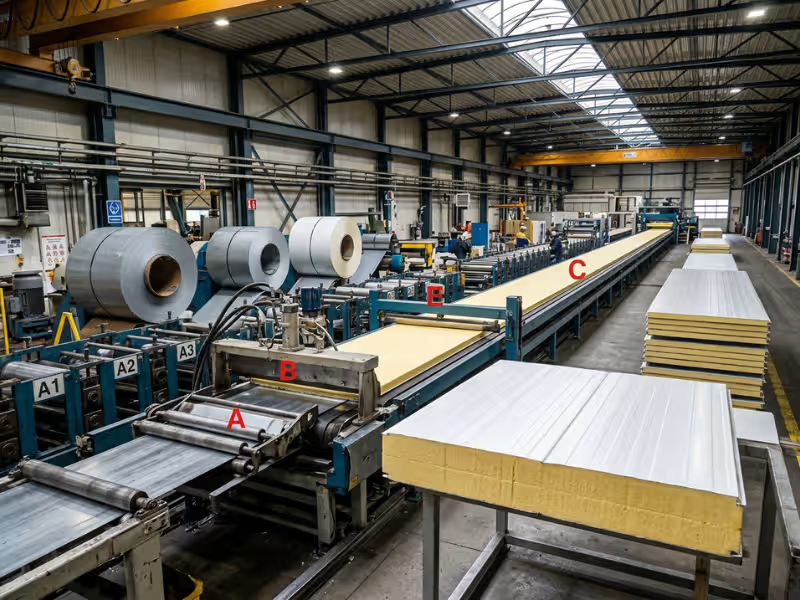
Water-only rigid foam works for some packaging and fill jobs. It rarely meets tight insulation targets for panels or appliances. In panel manufacturing, those insulation targets shape the final product, which is why blowing agent choice stays closely tied to the performance goals of a polyurethane sandwich panel line.
HFCs and Legacy Agents: Mostly a Transition Story
HFC-245fa and HFC-365mfc blends once led rigid and spray foam. They insulate well, don’t burn, and process easily. But their GWP runs from several hundred to around a thousand.
The EU F-gas rules and the US AIM Act now restrict them in most foam uses. The Kigali Amendment drives similar cuts in other markets on later timelines.
HCFC-141b goes back further. The Montreal Protocol phased it out in developed countries, and many developing markets have now phased it out of foam as well.
Few buyers adopt these agents for new formulas today. If your formula still uses one, it makes sense to plan the replacement now. Supply has tightened in many markets, and export customers may already reject foam that contains them.
How Blowing Agent Choice Changes Foam Performance
Two foams can share the same density and still perform very differently. The blowing agent is often the reason. When a client compares agents, I review four areas, and each one shows up on a different test report.
Insulation Starts With the Gas Inside the Cell
In rigid closed-cell foam, the trapped gas often carries 60% or more of the total heat flow. Polymer struts and radiation account for the rest. A lower-conductivity gas therefore lowers lambda fairly directly.
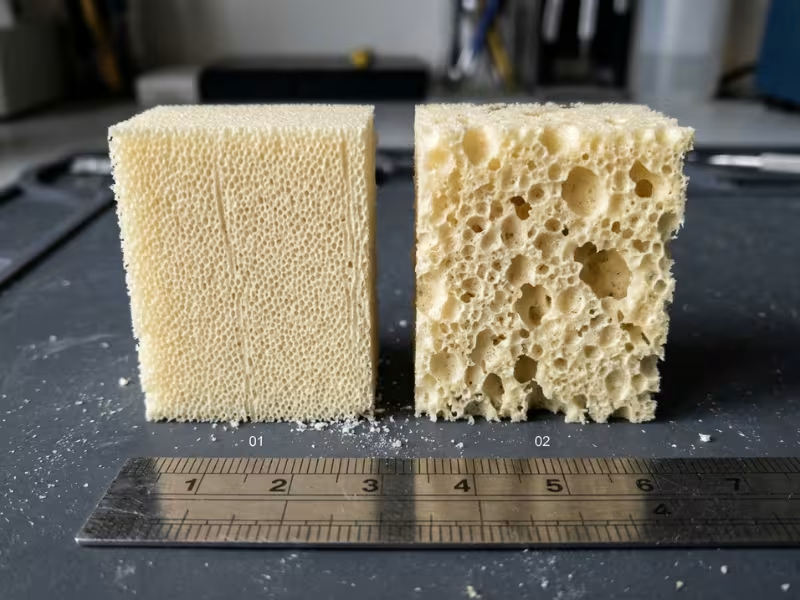
That only works if the cells stay closed. Aim for closed-cell content above 90%. Fine, even cells also help because they reduce radiant heat transfer.
A typical cyclopentane appliance foam starts around 19 to 21 mW/m·K. A well-tuned HFO blend can start 1 to 2 points lower. On a refrigerator cabinet, that gap can mean thinner walls or a better energy rating.
Density and Strength Move Together
Lower density saves material, but strength usually falls faster than density. Cut density by 10%, and you may lose roughly 15% to 20% of compressive strength.
The agent also shapes cell structure:
- Cells stretch in the rise direction, so foam often tests stronger vertically than across the panel.
- A physical agent with poor solubility can leave large, uneven cells that crush early.
- A high water share adds rigid urea, but the surface can turn crumbly.
When you switch agents, test compression in all three directions, not just the rise direction.
Aging Decides What the Foam Delivers in Year Ten
Fresh lambda flatters almost every foam. CO₂ leaves the cells relatively quickly. Oxygen and nitrogen move in over months and years, and lambda climbs. Cyclopentane and HFOs diffuse more slowly, so they tend to hold their value longer.
Facers matter too:
- Metal skins nearly stop gas exchange
- Foil facers slow it
- Open or porous faces slow it very little
Ask suppliers for aged values, not just initial ones. Use LTTR under ASTM C1303 in North America or aged lambda under EN 13165 in Europe.
Also check dimensional stability at −20°C and at 70°C with high humidity. Many specs target changes under 1%.
Processing Behavior Can Override Lab Data
Boiling point affects when the foam starts to rise. HFO-1233zd(E) boils around 18 to 19°C and tends to froth early. Cyclopentane boils near 49°C and rises later. That difference changes flow distance in long cavities and the pressure on your molds and fixtures.
Thick sections bring their own risks. Extra exotherm can split or scorch the core. If cells open during cure, internal pressure drops, and the part may shrink days later.
Run trials on your production machine at real shot sizes. Measure overpack, demold time, and panel flatness after 24 hours.
How to Choose the Right Blowing Agent for Your Application
Clients rarely benefit from asking which blowing agent is “best.” A more useful question is which agent fits their foam, their plant, and the markets they sell into. Start with the table below, then read the scenario closest to yours. Most plants face more than one of these limits.
|
Application |
What matters most |
Typical blowing agent direction |
|---|---|---|
|
Rigid insulation panels and boardstock |
Aged lambda, dimensional stability, fire performance |
Pentane blends or HFO/hydrocarbon blends, plus water as co-blowing agent |
|
Appliance foam (refrigerators, freezers) |
Thin walls, energy rating, flow in long cavities |
Cyclopentane or cyclopentane/HFO blends |
|
Flexible slabstock and molded foam |
Softness, density, processing window |
Water / CO₂, sometimes with auxiliary blowing |
|
Closed-cell spray foam |
Pass thickness, exotherm, field safety |
HFO systems with some water |
|
Open-cell spray foam |
Low density, cost, simple handling |
Water / CO₂ |
If You Make Rigid Insulation Foam
Put R-value first. Your customers buy insulation, so aged lambda often decides whether your panel or cabinet passes spec.
Dimensional stability comes next. A low-lambda foam that shrinks at −20°C or warps in humid heat can still fail an audit.
Most rigid plants choose between two paths:
- Hydrocarbons suit high-volume appliance and boardstock lines that already handle flammables. They usually offer the lowest cost per unit of insulation.
- HFOs or HFO/hydrocarbon blends suit plants that need lower lambda, thinner walls, or a nonflammable process.
Compliance narrows the choice further. HFCs now face limits in most major foam markets. If you sell into the US or EU, it’s wise to rule them out for new formulas.
If You Make Flexible Foam or Spray Foam
Water does most of the work here. Flexible slabstock and molded foam rely on CO₂ from the water reaction. Open-cell spray foam does too.
The tricky part is that water controls density and hardness together. More water lowers density, but it also adds urea, which firms the foam. To reach soft, low-density grades, many slabstock producers use auxiliary blowing, such as liquid CO₂ or variable-pressure foaming, instead of adding more water.
Closed-cell spray foam works differently. It needs a physical agent, now mostly HFO, plus some water. Watch the exotherm. If crews spray passes that are too thick, the core can scorch or crack. Keep each pass within the system supplier’s limit, which is often around 1.5 to 2 inches.
If Safety and Plant Design Limit Your Options
Pentane vapors have a lower explosive limit of roughly 1.1% to 1.5% in air, depending on the isomer. Even a small leak near a pump seal can reach that range in a poorly ventilated area.
Running hydrocarbons safely means building for it:
- Explosion-proof motors, wiring, and premix stations in classified zones
- Gas detectors with alarms set well below the lower explosive limit
- Ventilation interlocked with the foaming machine, so the line stops if airflow fails
- Nitrogen blanketing on storage and day tanks
That package can cost more than a year of blowing agent savings. For a smaller plant or a single line, HFO or water-blown systems often make more financial sense, even at a higher price per kilo. If you plan to expand volume, hydrocarbon conversion can pay back at sufficient scale.
If Future Regulations Matter as Much as Today’s Price
The AIM Act in the US and the EU F-gas rules already limit high-GWP HFCs in most foam uses. The Kigali Amendment brings similar cuts to many developing markets on a later timeline. In practical terms, blowing agents with a GWP in the hundreds face a limited future in most markets.
Avoid formulas that only solve this year’s problem. Switching from one HFC to a slightly lower-GWP HFC can force a second reformulation within a few years. You would then pay for trials, aging tests, and customer approvals twice.
Compare options over a five-to-ten-year window. Weigh:
- The unit price of the blowing agent
- The conversion cost for equipment and safety
- The risk of losing export customers
Then choose the lowest-GWP option your plant can run safely. Over the long run, that’s often the most economical choice.
What It Really Costs to Switch Blowing Agents
A supplier quote shows the price per kilo, but not the full bill. When I map a conversion with a client, the real cost sits in three layers, and the first one is usually the smallest.
Price per Kilo Is Only the First Layer
Compare cost per cubic meter of finished foam, not cost per kilo of blowing agent.
Molecular weight changes how much gas each kilo produces. HFO-1233zd(E) weighs about 130 g/mol, while cyclopentane weighs about 70. To blow the same foam volume, you need nearly twice the mass of HFO.
Then look at what the foam gives back. A lower lambda may let you reduce wall thickness by a few millimeters. That saves polyol and MDI on every part and can offset part of the premium.
Equipment and Safety Upgrades Can Change the Math
A move to hydrocarbons rarely stops at the drum. Expect to add:
- Hydrocarbon-rated metering pumps with sealed or magnetic drives
- An inline premix unit for blending pentane into the polyol
- ATEX- or Class I, Division 1-rated motors, wiring, and controls
- Gas detection, extraction, and interlocks around the pour area
Budget for downtime too. A retrofit on an existing line often takes several weeks, plus commissioning.
Switching from pentane to HFO usually costs less, but it still has costs. HFO-1233zd(E) boils around 18 to 19°C, so check tank cooling, seals, and pressure ratings before the first run.
Reformulation and Validation Take Time
A typical validation path looks like this:
- Lab cup foams: Check reactivity, free-rise density, and flow.
- Machine trials: Pour at real shot sizes on your production equipment.
- Cell structure review: Cut sections and inspect them under magnification.
- Accelerated aging: See where lambda settles over time.
- Customer approval: Appliance OEMs may want new cabinet tests. Building products may need repeat fire tests, such as ASTM E84 or EN 13823.
Customer approval often takes the longest. From first cup foam to approved product, plan for roughly 6 to 12 months. The process can run longer if your foam carries third-party certifications.
A Practical Checklist Before You Change Blowing Agent
Many conversions that struggle don’t fail in the lab. They stall because nobody wrote down the goal first. Work through these two lists before you order trial drums. The first sets your direction, and the second proves the new foam works.
Questions to Answer Before a Switch
Get clear answers to these, in writing, before you commit:
- Target properties: Which number must improve, and which can’t get worse? Name your aged lambda, density, and strength targets.
- Compliance goal: Which GWP limit or ban drives this change? Will the new agent still comply in five years?
- Equipment fit: Can your pumps, seals, tanks, and ventilation handle the new agent’s boiling point and flammability?
- Market destination: Where does the finished foam ship? Export customers may follow stricter rules than your home market.
Tests You Should Not Skip
Run each test on foam from your production machine, not just lab cups:
- Density: Check core and overall density. A shift here changes cost and strength together.
- Lambda / k-factor: Measure initial and aged values. Fresh numbers usually look better than long-term results.
- Compressive strength: Test in all three directions to catch weak cell orientation.
- Dimensional stability: Expose samples to −20°C and to humid heat at 70°C. Shrinkage often shows up here first.
- Aging: Run accelerated aging to see where lambda settles over the years.
- Processing consistency: Pour several shots across different shifts. Track flow, demold time, and voids.
If one test fails, fix the formula before you scale up.

Common Questions About PU Foam Blowing Agents
These four questions come up in almost every conversion project I support. Here are short, direct answers.
Will Switching Blowing Agents Change Foam Properties?
In most cases, yes. A new agent changes when the foam rises, how the cells form, and which gas stays trapped inside. Reactivity, cell size, density, and lambda can all shift, even at the same formula weight.
Expect to retune catalysts and surfactants. Then retest density, strength, aged lambda, and dimensional stability before you ship production parts.
Is Cyclopentane Safe in Production?
Yes, when your plant is designed for it. Appliance plants around the world run cyclopentane safely every day.
The setup makes the difference. You need explosion-proof pumps and premix units, gas detectors set well below the lower explosive limit, and ventilation interlocked with the line. If any of these is missing, the risk rises quickly.
Are HFOs Worth the Price Premium?
That depends on your foam and your markets. For rigid insulation, HFOs can deliver lower lambda with a GWP near 1. That can mean thinner walls, better energy ratings, and easier access to regulated markets like the US and EU.
For cost-driven products, the premium is harder to justify. Blending HFO with water or hydrocarbons keeps much of the benefit at a lower cost.
Can Water Alone Blow Rigid Foam Well Enough?
Rarely, if you need high insulation performance. CO₂ diffuses out of closed cells relatively quickly, so lambda climbs and cell pressure drops. Panels can then shrink or warp.
Water-only rigid foam can work for packaging and void fill. For insulation panels or appliance cabinets, you’ll usually still need a physical blowing agent.
Choosing a Blowing Agent That Lasts
A blowing agent does far more than expand foam. It shapes your aged lambda, strength, and stability, and it changes how the mix flows in your mold. It also affects your plant’s fire risk and the regulations you face.
No single agent wins everywhere. Rigid insulation, flexible foam, and spray foam each need a different balance. Your equipment, safety setup, and target markets narrow the choice further.
Start with your current formula. Check its blowing agent against the regulatory timeline in every market you sell into. Ask suppliers for aged lambda and trial data. Then run tests on your production machine before you commit to a switch.