
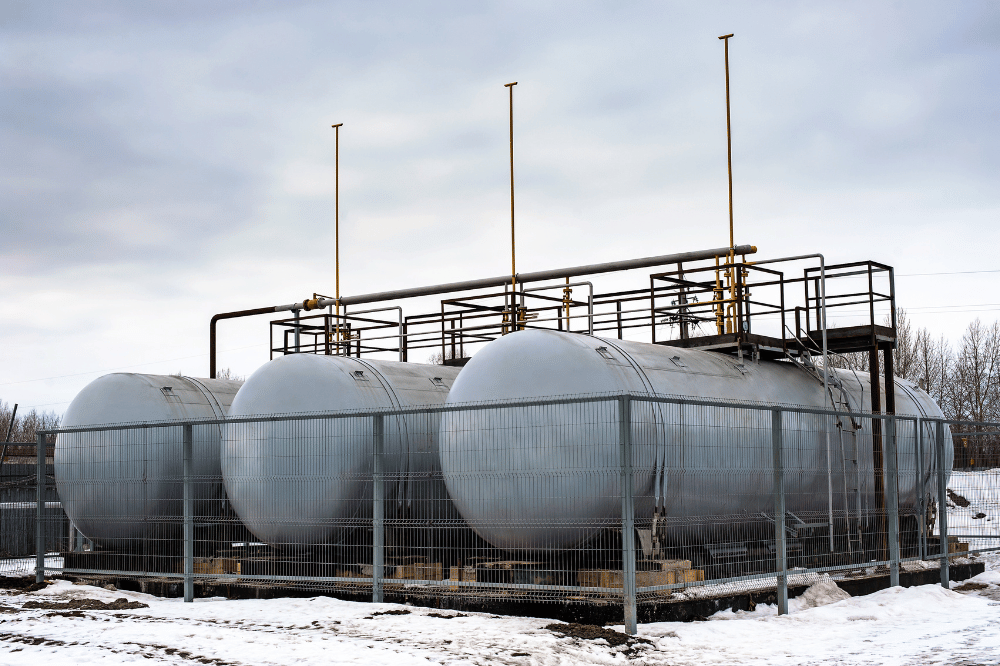
Bulk chemical tank systems replace drum and tote handling with centralized, climate-controlled storage for isocyanate and polyol. Done right, they stabilize the temperature, pressure, and viscosity your metering pumps depend on—which directly improves ratio accuracy and part quality. They also eliminate changeover downtime, reduce raw material cost per pound, and support compliance with SPCC, OSHA, and EPA. For any operation running several thousand pounds of raw material a week, moving from drums to bulk is one of the highest-ROI infrastructure decisions you can make. The catch: a bulk system only delivers if it’s engineered for your throughput, chemistry, and control requirements.
Every polyurethane reaction uses two chemicals: isocyanate and polyol. Your mixing head doesn’t care whether they arrived in 55-gallon drums or a 6,000-gallon tank. But everything upstream of that head—how you store, condition, and deliver those materials—shapes your ratio accuracy, equipment uptime, temperature consistency, and the labor load on your floor.
Drums and intermediate bulk containers (IBCs) make sense when you’re starting out or running low volume. Then throughput climbs, and the cracks show. Drum changes stop the line. Temperature swings between containers introduce ratio drift. “Empty” drums still hold pounds of unpumpable material you paid for and now have to dispose of. And staging, rotating, and handling all those container piles on labor without adding a single part to your output.
This guide walks through bulk chemical tank systems from an engineering and procurement standpoint: when the switch pays off, what a system includes, how tank design affects downstream machines, what safety and compliance rules apply, how to size it, and where specifications go wrong.
Bulk Tank Systems at a Glance
Before we get into the engineering, here’s the whole decision in one view.
|
Question |
Short Answer |
|---|---|
|
What is it? |
Centralized, conditioned storage for bulk isocyanate and polyol, feeding your machines through a controlled distribution loop |
|
Why use it? |
Stable metering conditions, higher uptime, lower cost per pound, less labor and waste |
|
When does it make sense? |
Typically once weekly consumption passes ~2,000–3,000 lb per component |
|
Key components |
ASME tanks, nitrogen blanketing, agitation, heating/cooling, instrumentation, transfer pumps, day tanks |
|
Main risks |
Moisture ingress, poor temperature control, oversized low-turnover tanks, compliance gaps |
|
Payback |
Commonly 18 months to 3 years, depending on throughput and chemical pricing |
Keep this table in mind as you read. Every section below expands on a single row—and they all lead back to the same point: upstream storage determines what your downstream equipment can actually achieve.
When to Switch from Drums to Bulk Storage
There’s no single magic number, but the signals are consistent. When several of these show up at once, your plant has outgrown its drums.
- Weekly consumption tops ~2,000–3,000 lb per component. Below that, manual handling is manageable. Above it, the labor, waste, and downtime costs start to outrun the carrying cost of bulk infrastructure.
- You’re changing drums or IBCs multiple times per shift. Every changeover pulls the line offline, and the interruptions compound across a week.
- Container handling is creating downtime. If staging, priming, and rotating containers are dictating your production rhythm, that’s a bottleneck, not a workflow.
- Temperature consistency is hard to maintain. Drums sitting at varying ambient temperatures deliver material at varying viscosity, and that shows up as ratio drift.
- Ratio drift, or scrap, keeps recurring. Off-spec parts that trace back to inlet conditions are a supply-side problem, not a machine problem.
- Floor space is under pressure. Pallets of drums and rows of IBCs eat production real estate you’d rather use for output.
- Freight and container costs are climbing. As volume grows, per-pound drum pricing and container logistics quietly erode margin.
Hit three or four of these, and the question isn’t whether to move to bulk—it’s how fast you can justify the capital.
Drums vs. Bulk Tank Systems
The differences go well beyond how much material you can store. Here’s the side-by-side.
|
Factor |
Drums / IBCs |
Bulk Tank System |
|---|---|---|
|
Labor |
High—constant staging and handling |
Low—automated transfer and refill |
|
Changeover downtime |
Frequent |
Minimal to none during a run |
|
Material waste |
Higher—2–4 lb residue per drum |
Lower—nearly all delivered material used |
|
Temperature stability |
Variable with ambient conditions |
Controlled and continuous |
|
Metering consistency |
Less stable inlet conditions |
Stable temperature, pressure, and flow |
|
Cost per pound |
Highest tier |
Lowest tier (tanker pricing) |
|
Floor space |
Consumed by containers |
Consolidated in a dedicated tank farm |
|
Scalability |
Limited |
High—capacity grows with the business |
A “used” drum typically retains 2 to 4 pounds of material a standard dip tube can’t pull out. Multiply that across the drums you burn through each week, and the wasted chemicals alone add up to a meaningful line item. With tanker deliveries, virtually everything you pay for reaches your process.
How Bulk Tank Design Affects Processing Equipment Performance
Here’s the part that matters most on a production floor. A metering machine can only be as accurate as the conditions at its inlets allow. Get the storage design wrong, and no amount of machine precision downstream will save the part.
Stable inlet conditions and metering accuracy
Metering pumps—gear, piston, or variable-speed positive displacement—perform best when inlet conditions hold steady. Three things wreck that stability: head pressure that changes as drum levels drop, viscosity that shifts with temperature, and air entrainment from running a container dry. Each one introduces a metering error, which is a ratio error.
A properly designed bulk system with a circulating distribution loop delivers material at a consistent temperature, pressure, and flow rate. That stability shows up directly as tighter ratio control at the mix head—more consistent foam, fewer off-spec parts, and less time spent tweaking machine settings to chase raw material variability.
Temperature control and viscosity
Both isocyanate and polyol are viscous, and their viscosities track temperature. Cold material meters and flows unevenly, changing head pressure at the pump inlet and pushing the ratio off target. Conditioned bulk storage continuously holds material within its specified window, so the reaction behaves the same way at 6 a.m. as it does at mid-afternoon.
Agitation and formulation integrity
Many polyol blends carry flame retardants, fillers, or additive packages that settle out of suspension without regular agitation. When that happens, the material reaching your pump no longer matches the formulation spec—and the parts show it. A tank with proper agitation keeps the blend homogeneous, so what leaves the tank is what you actually specified.
Day tank top-off and continuous flow
Most PU machines feed from a day tank—a smaller pressure-rated vessel sized for a few hours of production. Bulk systems automate the refill: when the day tank drops below a set point, a transfer pump pulls from the bulk tank and tops it back to its high-level setpoint, with no operator intervention. Vacuum degassing can be integrated into the day tank to strip dissolved air during transfer, which is important for foam systems where entrained air disrupts cell structure. The result is an uninterrupted, conditioned supply straight to the metering system.
Core Components of a Bulk PU Storage System
Tank construction materials
Isocyanate and polyol have different compatibility requirements, and tank construction must reflect these differences. The American Chemistry Council’s Guidelines for Diisocyanate Storage Tank Systems (March 2018) specifies that PMDI (polymeric MDI) and TDI tanks are typically unlined carbon steel, while MMDI (monomeric MDI) requires lined carbon steel or stainless steel for quality reasons. Fiberglass, PVC, and polyethylene aren’t suitable for isocyanate service—permeability and embrittlement rule them out.
ASME pressure-rated vessels are the standard for both chemicals. Dual-tank setups—one tank per component—are commonly supplied as 6,000-gallon ASME steel configurations, with larger and smaller sizes available. Double-wall construction adds an integrated secondary containment layer and is well-suited to sites where environmental regulations or conditions call for it.
Nitrogen blanketing and moisture control
Moisture is the primary contaminant threat for isocyanate. MDI and TDI react with water to form polyurea solids and carbon dioxide gas, degrading material quality and creating pressure hazards inside tanks and piping. Keeping moisture out isn’t optional.
The standard defense is nitrogen blanketing: holding the vapor space above the liquid under a slight positive pressure of dry, inert nitrogen. Per the American Chemistry Council, the inert gas pad’s dew point must remain at or below -40 °C. Above that, the moisture in the pad is enough to form polyurea solids inside the tank. Desiccant breathers on vent connections add a second moisture barrier during pressure equalization. Polyol tanks are less moisture-reactive but still benefit from humidity control, especially in humid climates or with amine-catalyzed blends.
Agitation systems
Polyol formulations containing flame retardants, fillers, or blended additives require agitation to remain homogeneous. Agitators for polyol service are typically electric-driven, bottom- or side-entry designs. On large tanks, a recirculation loop driven by a low-shear transfer pump can supplement or replace mechanical agitation. Standard PMDI and MDI generally don’t need agitation, though recirculation loops help maintain temperature uniformity where thermal stratification is a concern.
Heating and cooling
Viscosity control means temperature control. Shell’s product stewardship documentation lists TDI storage between 68°F (20°C) and 86°F (30°C) under normal handling; MDI is similar. The American Chemistry Council notes that isocyanate decomposition begins slowly above 160°C (320°F) and accelerates beyond that—so high-temperature excursions must be prevented. Internal coil heating is not recommended in isocyanate vessels, since a coil failure could trigger a hazardous reaction.
Recommended methods are external: heat tracing (electric, hot water, or glycol), external heating panels or coils, and recirculation loops with an external heat exchanger. Glycol loops are popular where both heating and cooling are needed—reverse them to chill material in summer when the ambient heat drops, and the viscosity is too low. PID-controlled loops with high and low alarms keep material in spec around the clock.
Instrumentation
Level monitoring typically uses ultrasonic, radar, or sonar devices. The American Chemistry Council specifically advises against glass or plastic sight tubes for isocyanate—they cloud or plug over time, and failure can cause a major spill. Weigh scales and pressure transmitters handle applications needing continuous gravimetric monitoring.
Redundancy protects you during unloading. High-level shutoff switches, independent from the primary level system, provide a second layer of overfill protection. Temperature probes with high/low alarms continuously track thermal conditions, and discharge-line pressure gauges confirm flow without manual checks. A PLC-based control system with an HMI touchscreen unifies monitoring, alarms, and safety interlocks—and the better-engineered systems interface with downstream metering and mixing equipment to enable recipe-based production from a single control point.
Safety and Environmental Compliance
Secondary containment
Secondary containment is required for all bulk storage of isocyanate and polyol. The American Chemistry Council guidelines reference EPA’s Risk Management Program rules (40 CFR Part 68) governing containment for worst-case release scenarios. The basin must be impervious—concrete lined with a chemical-resistant coating is standard—and sized to hold the largest tank’s volume plus any added volume from adjacent tanks in a shared containment area.
Facilities with aggregate aboveground oil-equivalent storage capacity exceeding 1,320 gallons are required to have an EPA Spill Prevention, Control, and Countermeasures (SPCC) plan under 40 CFR Part 112. The written plan must cover containment infrastructure, inspection procedures, personnel training, and emergency response—and it’s typically certified by a licensed Professional Engineer and reviewed every 5 years or after any significant change to the system.
Tanker unloading safety
Unloading stations require dedicated infrastructure: closed-loop piping to minimize vapor release, hose-connection stations with safety interlocks, grounding and bonding for static control, and automatic pressure relief and bypass protection. For isocyanate specifically, high-level shutoff switches must be interlocked to stop the unloading pump or close the inlet valve at the high-level setpoint.
Emergency shower and eyewash stations are required in unloading and storage areas per ANSI Z358.1. Fall protection per OSHA 29 CFR 1910 applies anywhere personnel access the top of a tank.
Vapor recovery and ventilation
Isocyanate vapor is a serious respiratory hazard. Venting systems must prevent diisocyanate vapors from entering the work environment during filling, unloading, and pressure equalization. Activated carbon has been used successfully as a vapor-treatment medium in vent streams, and the vapor recovery system should be designed alongside the tanks rather than bolted on later. For indoor tank farms, ventilation must hold isocyanate concentrations well below the OSHA permissible exposure limit for MDI (a 0.02 ppm ceiling).
Indoor vs. outdoor placement
Indoor storage gives you better temperature control—a real advantage where seasons swing hard—and protects insulated piping and tank surfaces from weather-driven corrosion. The American Chemistry Council warns that outdoor carbon steel tanks with wet insulation are at risk of external corrosion, so cladding and protective coatings should be evaluated. Outdoor storage often simplifies fire protection and containment, drainage, and reduces the risk of vapor accumulation in enclosed spaces. For flammable blowing agents like pentane, outdoor storage with explosion-proof equipment and dedicated fire suppression is the standard approach.
How to Size and Place a Bulk Tank System
Sizing formula
The core calculation is straightforward. Tank capacity equals daily consumption times the storage days you want between deliveries, plus a safety margin—typically 20%:
Tank Capacity = (Daily Consumption × Storage Days) + 20% Safety Margin
Say you use 1,000 kg of isocyanate a day and want seven days of storage. That’s 7,000 kg plus a 20% buffer, for a recommended capacity of roughly 8,400 kg. Set storage days to your supplier’s realistic lead time plus a cushion for transport delays and quality holds.
Piping and distribution loop
The distance from the tank farm to each machine drives design decisions that people tend to underestimate. Longer runs need heat-traced, insulated piping to hold temperature. Piping for isocyanate service must be carbon steel or stainless steel—never PVC, polyethylene, or fiberglass. A distribution loop that circulates material from the tank through the plant and back prevents stagnation and temperature drop in long runs.
Foundation and load
A 6,000-gallon polyol tank, full of material at roughly 8.5 to 9 pounds per gallon, weighs 50,000 to 55,000 pounds. Foundation design has to carry that plus the tank and associated equipment. Concrete pads must be engineered to the site’s load and grade conditions, and, for indoor installs, verify the floor’s load capacity before finalizing placement.
Common Specification Mistakes to Avoid
The engineering here is detailed but well-established. Most failures trace back to a handful of avoidable specification errors.
|
Mistake |
Why It Matters |
What to Do Instead |
|---|---|---|
|
Oversizing tanks relative to turnover |
Isocyanate has a finite shelf life (~6–12 months); low turnover invites degradation, stratification, and MMDI crystallization |
Size to realistic throughput; add a second tank later rather than overbuy now |
|
Underestimating heat tracing needs |
Long uninsulated runs drop material temperature and shift viscosity at the pump |
Heat-trace and insulate distribution piping matched to run length |
|
Ignoring dew point control |
A nitrogen pad above -40°C/F lets moisture form polyurea solids in the tank |
Specify and monitor dry nitrogen blanketing with dew point verification |
|
Choosing the wrong tank material |
Fiberglass, PVC, and PE fail in isocyanate service; MMDI needs lined or stainless steel |
Follow ACC construction guidance per the specific isocyanate |
|
Insufficient secondary containment |
Undersized basins fail code and worst-case release requirements |
Size containment to the largest tank plus shared-area volume |
|
No redundancy in level shutdown |
A single-level system leaves no overfill backup during unloading |
Add independent high-level shutoff interlocks |
|
Poor integration with day tanks and controls |
Manual top-off reintroduces the downtime that the bulk was meant to remove |
Automate the day tank refill and interface the tanks with machine controls |
ROI and Payback
A standard dual-tank system—two 6,000-gallon ASME tanks with transfer pumps, instrumentation, controls, distribution piping, and secondary containment—is a real capital investment. The return builds from four sources: lower raw material cost through tanker pricing, reduced labor for container handling, eliminated drum disposal costs, and improved uptime.
For most operations consuming several thousand pounds of raw material per week, payback ranges from 18 months to 3 years, depending on throughput and local chemical pricing. That difference in cost per pound, compounded over weekly or monthly consumption, is usually the largest single line in the financial case—and it keeps compounding long after the system pays for itself.
Two more factors shape the transition. Expect a four-to-eight-week window for your team to reach operational confidence on the new controls, alarm responses, and maintenance routines—bring your equipment supplier into training and commissioning. And plan for ongoing upkeep drum systems never required: level sensor calibration, temperature probe verification, pump seal and strainer inspection, and dew point monitoring on the blanketing system. These are manageable tasks, but they need assigned owners and documented procedures, not ad-hoc attention.
Frequently Asked Questions
When does it make sense to switch from drums to bulk tanks?
Most equipment engineers recommend evaluating bulk storage once weekly consumption of isocyanate or polyol passes 2,000 to 3,000 pounds per component. Below that, drum handling is manageable. Above it, the labor, waste, and downtime of manual container management consistently exceed the carrying cost of bulk infrastructure.
What are the storage temperature requirements for MDI and TDI?
MDI is typically stored between 60°F (15°C) and 80°F (27°C). TDI should stay between 68°F (20°C) and 86°F (30°C) per Shell’s product stewardship documentation. Protect both from freezing—MDI begins crystallizing below about 39°F (4°C)—and from heat, since the American Chemistry Council notes isocyanate decomposition begins slowly above 160°C (320°F).
How does nitrogen blanketing work, and why is it required for isocyanate?
Nitrogen blanketing holds a slight positive pressure of dry inert gas in the vapor space above stored isocyanate, keeping atmospheric moisture out through vents, connections, and pressure equalization. The nitrogen must have a dew point at or below -40°C/F; higher dew points bring in enough moisture to form polyurea inside the tank. Pressure regulators, relief devices, and a pressure indicator are standard parts of the system.
What type of pump is best for bulk-to-day-tank transfers?
Sealless pumps—canned motor or magnetic drive—have the longest track record in diisocyanate service because they remove mechanical seals that can leak or introduce contamination. Centrifugal or positive-displacement configurations both work, depending on flow and pressure requirements. Variable-speed drives let you adjust flow without pressure surges, which helps protect day tank levels from overfill during automated top-off.
Can bulk tanks be used for blended polyol systems containing blowing agents?
Blended polyols with blowing agents—especially pentane—require specialized infrastructure. Pentane is highly flammable, with a lower explosive limit that demands explosion-proof electrical systems, dedicated grounding and bonding, vapor detection, and rated fire suppression. Pentane storage and blending is engineered as a distinct subsystem from standard polyol storage, so involve your equipment supplier early to address safety classification and regulatory requirements.
Do bulk tanks need to be cleaned between different polyol formulations?
Yes. Switching between incompatible polyol grades requires tank cleaning to prevent contamination of the new material. Procedures, solvents, and timing depend on the specific chemistries and should be set with your chemical supplier. Documented cleaning and inspection procedures are also required under SPCC and facility safety management programs.
What does an SPCC plan require for polyurethane chemical storage?
An SPCC plan is required for facilities with aboveground storage of more than 1,320 gallons of oil or oil-equivalent chemicals. It must document tank construction, secondary containment, inspection schedules, personnel training, and emergency response. A licensed Professional Engineer certifies it, and it’s reviewed every five years or whenever the storage system changes significantly.
Build the Upstream Right, and Everything Downstream Follows
Raw material handling rarely gets the spotlight. It doesn’t draw a crowd at trade shows the way mixing head technology or a new foam formulation does. But the reliability and precision of your supply system set the ceiling on what your processing equipment can achieve.
A metering machine is only as accurate as the conditions at its inlets. A line only runs as long as material is available. And an operation only scales if its raw material infrastructure scales with it. Bulk chemical tank systems address all three at once—they stabilize the inlet conditions metering depends on, remove the interruptions drums guarantee, and give you the capacity foundation to grow without chaos.
The engineering decisions—tank sizing, materials of construction, nitrogen blanketing, temperature control, secondary containment—are detailed but not mysterious. They follow established guidance from the American Chemistry Council, ASME, EPA, and OSHA. The capital is real, and so is the return.
If you’re producing polyurethane at scale—or planning to—your bulk storage system is the foundation your process stability is built on. Our team engineers complete bulk storage and material conditioning systems: ASME tanks, nitrogen blanketing, temperature control, agitation, instrumentation, and automated day tank supply, all designed to feed your metering and mixing equipment with stable, in-spec material run after run. If you want upstream infrastructure that protects the accuracy of everything downstream, let’s talk about a system sized and specified for your operation.