
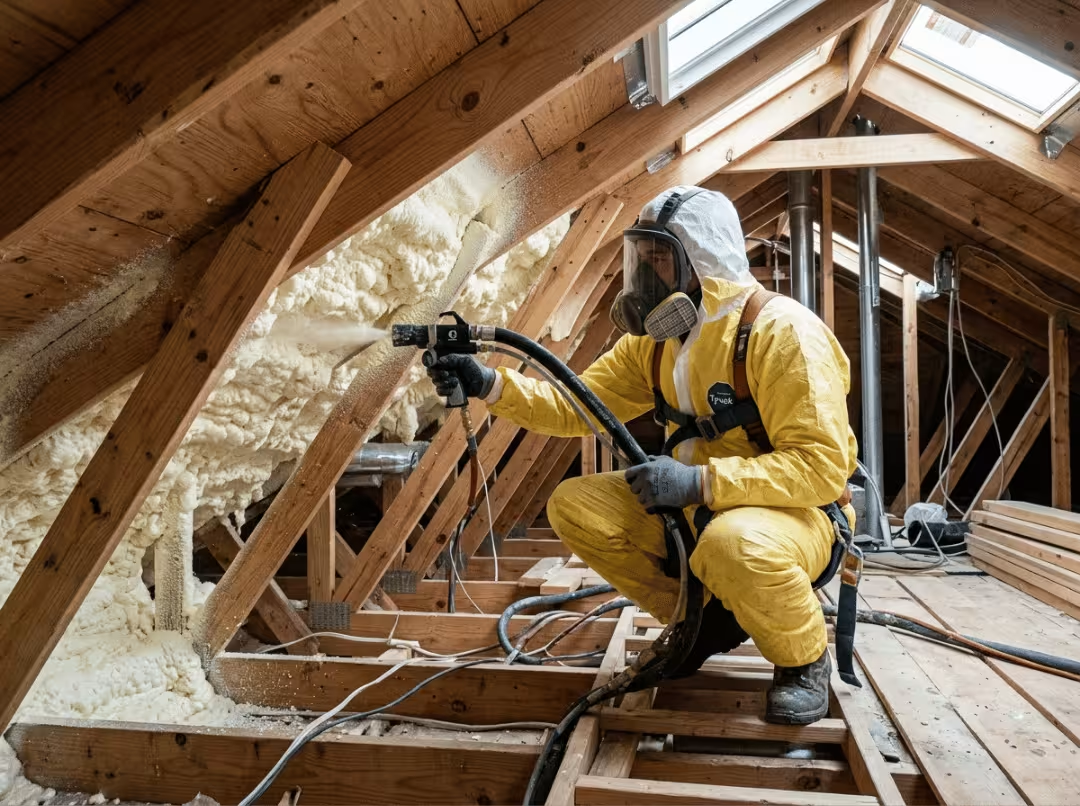
Quick answer: Closed-cell spray foam earns its cost in locations where standard insulation consistently falls short — attics, rim joists, crawl spaces, and metal buildings that need both air sealing and moisture control. It’s rarely the right call for mild climates, budget whole-house retrofits, or homes with active water problems. And wherever you use it, the installer matters as much as the material.
Closed-cell spray foam is genuinely high-performing insulation. It’s also genuinely expensive. That gap between performance and price is where most homeowners get stuck — contractors push it hard, quotes come in higher than expected, and online opinions contradict each other at every turn.
The better question isn’t whether it works. It does. The question is whether your project calls for what it actually does well. The same material that’s the right answer in one house is an expensive overcorrection in another.
This article covers how closed-cell compares to open-cell foam and fiberglass, where it’s worth the premium, where it isn’t, and what separates a contractor who knows what they’re doing from one who doesn’t.
What Is Closed-Cell Spray Foam?
Closed-cell spray foam is a two-part polyurethane material that expands and hardens on contact with the substrate. The expansion creates a dense network of sealed gas bubbles — the “closed-cell” part — at a typical density around 2 pounds per cubic foot.
That density drives two practical outcomes: a higher R-value per inch than most competing insulation types, and enough rigidity to add some stiffness to wall and roof assemblies. The structural contribution is real but secondary — it’s a useful side effect, not something to rely on in place of engineered framing.
What distinguishes closed-cell foam from most insulation is the air-sealing function. Because it expands into gaps and bonds directly to the substrate, it acts as both a thermal barrier and an air barrier in a single application. That combination is why it gets specified in situations where other materials can only solve part of the problem.
Open-cell spray foam shares the chemistry but not the behavior. Its cells are left open, producing a lighter, softer, more vapor-permeable product at lower cost. These aren’t two grades of the same thing — they suit different applications, which the comparison section covers in detail.

Why Homeowners Look Into It
Most people don’t arrive at closed-cell spray foam through curiosity. They arrive because something specific isn’t working.
The house feels drafty despite having insulation in the walls. The attic is too complicated to seal with batts — irregular framing, recessed lights, ductwork running through it in ways that make coverage inconsistent. The crawl space stays damp regardless of what’s installed. Energy bills keep climbing without an obvious cause. A wall cavity is too narrow to hit target R-values with conventional materials. A renovation has the walls open, and it seems worth doing this right while access is easy.
The common thread: standard insulation underperforms in locations that are hard to seal, moisture-prone, or physically constrained. Fiberglass works well in clean, dry, regularly shaped cavities with reliable air sealing already in place. It doesn’t work as well in awkward rim joists, complex attic geometries, or assemblies where managing moisture matters as much as managing heat flow.
That’s the problem closed-cell spray foam is built to solve. It’s a targeted tool, not a blanket upgrade.
Closed-Cell vs Other Insulation: What Actually Matters
Closed-Cell vs Open-Cell Spray Foam
Both come out of a spray gun and expand to fill the cavity, but the performance differences are substantial.
Closed-cell delivers roughly R-6 to R-7 per inch. Open-cell runs around R-3.5 to R-3.8. In a 2×4 wall, that gap produces a meaningfully different result in the same physical space.
Moisture behavior is where the distinction matters most. Open-cell foam absorbs water — if it gets wet, it holds it. That makes it a poor fit for crawl spaces, below-grade walls, or anywhere with real moisture exposure. Closed-cell foam resists moisture migration, which is exactly why it gets specified in those locations.
That said, open-cell has genuine advantages worth acknowledging. It costs less, expands more aggressively, and absorbs sound better due to its softer structure. For interior partition walls where acoustic performance matters more than moisture control, open-cell is often the sensible choice. Neither product is universally better. Each suits different conditions.
Closed-Cell vs Fiberglass
Fiberglass isn’t a bad product — it’s limited to a narrower range of applications than most people realize.
It slows heat conduction through a cavity. It does nothing about air movement through gaps, penetrations, or seams. Those have to be addressed separately with caulk, tape, or housewrap, and that air sealing is only as effective as whoever did it. In practice, it rarely closes every path.
This is where fiberglass installations lose real-world performance. Air moving through gaps around electrical boxes, at top plates, or through irregular framing degrades a wall’s actual thermal behavior — even when the batts are correctly installed, and the nominal R-value looks acceptable on paper.
Closed-cell foam removes that separation. Insulation and air sealing happen in the same step. It expands into voids, seals around penetrations, and bonds to the substrate without a supplemental air-sealing step. In difficult or irregular assemblies, that matters significantly.
Why Air Sealing Often Outweighs a Higher Labeled R-Value
R-values are measured under controlled lab conditions — no air movement, no thermal bridging. Real buildings don’t cooperate with that assumption.
Air leakage degrades real-world performance in ways a label doesn’t capture. A wall insulated to R-19 with fiberglass but full of air gaps can underperform a wall at R-13 with closed-cell foam and no gaps. Building scientists have consistently documented this: a well-sealed envelope with moderate R-values often delivers better comfort and energy performance than a leakier envelope with a higher nominal rating.
This is the core advantage of closed-cell foam. It doesn’t just add resistance to heat flow — it closes the air pathways that undercut a wall assembly’s actual performance. For homeowners weighing insulation options, that distinction tends to be more consequential than comparing R-value numbers in isolation.
How the Three Compare
|
Closed-Cell Spray Foam |
Open-Cell Spray Foam |
Fiberglass Batt |
|
|---|---|---|---|
|
R-value per inch |
~R-6 to R-7 |
~R-3.5 to R-3.8 |
~R-3.1 to R-3.4 |
|
Air sealing |
Built-in |
Partial |
None — requires separate sealing |
|
Moisture resistance |
High |
Low — absorbs water |
Low — loses performance when wet |
|
Vapor permeability |
Low — acts as vapor retarder |
Higher — vapor-permeable |
High |
|
Relative cost |
Highest |
Moderate |
Lowest |
|
Best fit |
Rim joists, crawl spaces, roof decks, metal buildings, shallow cavities |
Interior walls, sound control, dry cavities with adequate depth |
Standard cavities where separate air sealing is already solid |
The Real Benefits of Closed-Cell Spray Foam
Consistent Comfort from Better Air Sealing
The most immediate impact homeowners notice isn’t a lower energy bill — it’s fewer drafts and more evenly heated rooms. Closed-cell foam fills the cracks and voids that cut-and-fit insulation leaves behind, cutting off uncontrolled air movement through the envelope.
A tighter building also affects HVAC sizing. Equipment designed around a leaky house may be oversized once air leakage drops substantially. That’s worth flagging with an HVAC contractor before assuming the existing system is still a good match for the load.
Moisture Control in Problem Locations
Low vapor permeability makes closed-cell foam a strong fit for crawl spaces, rim joists, basement walls, rooflines, and metal building interiors — locations where condensation and moisture migration create persistent problems. Applied correctly to the right assembly, it reduces the conditions that drive condensation within the structure.
The caveat is worth stating clearly: closed-cell foam manages vapor movement. It doesn’t repair leaks. Spraying foam over a wet substrate or an assembly with active water intrusion doesn’t resolve that problem — it conceals it. Fix the source first.
Performance in Shallow Cavities
When cavity depth is fixed and can’t be increased, higher R-value per inch is directly useful. Narrow wall cavities, rafter assemblies with limited depth, and exterior retrofits where furring adds only so much room — these are the situations where a denser material does work that open-cell foam or fiberglass simply can’t match in the same space.
Closed-cell spray foam is produced using precision polyurethane processing equipment. The polyurethane foaming machines used in manufacturing — including both high-pressure and low-pressure systems — control the component mixing ratio and temperatures that determine cell structure, density, and final R-value performance. What comes out of the spray gun on a job site is only as good as the chemistry going in.

Stability Over Time
Well-installed closed-cell foam doesn’t sag, compress, or shift. It adheres to the substrate and stays there. Some batt and blown-in systems can settle or drift in wall cavities over time, gradually degrading performance and often going unnoticed. Closed-cell foam doesn’t have that failure mode — a correctly installed application maintains its position and geometry for the life of the building.
Where Closed-Cell Spray Foam Is Worth the Cost
Attics and Roof Decks
Applying closed-cell foam to the underside of the roof deck brings the attic into the conditioned envelope rather than leaving it as a vented, unconditioned buffer zone. This is particularly valuable when HVAC ductwork runs through the attic — ducts and equipment outside conditioned space are one of the more common and underappreciated sources of energy loss in older homes.
Shifting to an unvented, conditioned attic changes how the roof assembly manages moisture and ventilation. That shift needs to be part of a deliberate design decision, with the full assembly and local climate zone in view. It’s not something to do by accident.

Crawl Spaces, Rim Joists, and Basement Walls
These locations combine persistent air leakage, elevated moisture exposure, and geometry that makes it difficult to install conventional insulation reliably. Rim joists, in particular, account for a disproportionate share of heat loss relative to their surface area — they sit at the intersection of the foundation and the framed structure, with numerous penetrations and no clean geometry for fitting batts tightly.
Exterior drainage and waterproofing need to be in good shape before closed-cell foam goes in. The foam handles vapor; it doesn’t compensate for bulk water intrusion caused by poor grading or a failing drainage system.

Exterior Walls with Shallow Cavities
When framing depth is fixed and the project is already open — during a remodel or new construction — closed-cell foam’s per-inch R-value advantage makes a practical difference in what’s achievable within the available space. This is also where installation is cleanest and most cost-effective, since there’s no demolition required to access the cavity.
Metal Buildings, Pole Barns, and Shops
The primary insulation problem in metal buildings isn’t usually heat loss in the conventional sense — it’s condensation on the interior of the metal skin when outdoor temperatures swing. Closed-cell foam bonds directly to metal surfaces, controls condensation, and reduces thermal bridging through structural members in ways that batt systems, which can’t seal tightly to metal, cannot replicate.
Where It Usually Doesn’t Make Sense
Closed-cell spray foam is a poor fit in mild climates where the performance difference over cheaper materials doesn’t translate into meaningful energy or comfort gains. It’s rarely the right call for whole-house budget projects, where the premium cost produces worse return than targeting actual problem areas. It’s impractical in finished homes with inaccessible wall cavities unless a gut renovation is underway. It has no business going in where there are unresolved leaks or drainage failures. And it isn’t worth specifying simply because it sounds like the high-end option — the decision should follow a real problem the material is equipped to solve.
The Downsides to Understand Before You Commit
The Cost Is Substantial
Closed-cell spray foam sits at the top of the cost range for common insulation materials. It’s typically quoted per board foot, which makes comparisons to square-foot pricing for other products harder than they should be. Whole-envelope coverage can be a significant number, and the energy savings that offset it accumulate over years, not months.
For most homeowners, targeted application in the highest-impact locations — a crawl space, a set of rim joists, a complicated attic — delivers better value than spraying every cavity in the house. The premium is easier to justify when it’s solving a specific problem, harder when it’s applied broadly without a clear need.
Installation Quality Determines Performance
Closed-cell spray foam doesn’t forgive poor installation. Mixing ratio, ambient temperature, humidity, substrate condition, lift thickness, and curing time all influence the result. An installer who applies too much in a single pass, works outside the material’s temperature window, or ignores substrate moisture can produce foam that cures unevenly, shrinks, or loses adhesion — problems that often aren’t obvious until later.
This is the explanation behind a frustrating pattern: two homeowners spend similar amounts on nominally the same product and get different outcomes. The product didn’t change. The installation did. Closed-cell foam is not self-correcting — if the process is wrong, the result is wrong.
The Wrong Assembly Can Make Moisture Worse
Closed-cell foam is a useful moisture management tool when the assembly design is correct. In the wrong design — sprayed onto a wet substrate, or used in an assembly that eliminates a drying path that was previously functioning — it can trap moisture that previously had somewhere to go. Understanding how moisture moves within the specific assembly and whether it will still have an escape route after the foam is in place is essential before installation begins. This is building science territory, not just spray foam territory.
Removal Is Destructive
Closed-cell foam bonds aggressively to whatever it contacts. Removing it after curing requires mechanical scraping or cutting, and it’s difficult to do without damaging adjacent framing or sheathing. Getting the decision right upfront matters — correcting a bad installation is significantly more disruptive and expensive than adjusting plans before anything is sprayed.
How to Judge Whether It’s Right for Your Project
The Case for Using It
Closed-cell foam makes the strongest case in locations that are genuinely difficult to air-seal with conventional materials — irregular framing, numerous penetrations, and geometry that makes cut-and-fit impractical. It’s most defensible when a location requires air sealing, higher R-value per inch, and moisture control together, not just one. The strongest use cases remain attics, roof decks, crawl spaces, rim joists, and metal buildings. Long-term ownership makes the cost easier to justify; a shorter time horizon makes it harder.
The Case Against
It’s harder to justify in mild climates where the performance gap over cheaper materials is small. It’s often the wrong choice when the project goal is basic insulation coverage at minimum cost. It has no place in homes with active leaks or unresolved drainage problems. Whole-house retrofits in finished homes with inaccessible cavities are rarely practical without a larger renovation underway. And if there’s no identifiable air leakage, moisture, or space-constraint problem driving the decision, a less expensive material will almost always be adequate.
A More Useful Decision Framework
Don’t start with the material and work backward to a justification. Start with where the house is actually losing energy and comfort. A blower-door test or qualified energy audit identifies where air leakage is concentrated — those locations are where closed-cell foam is most likely to produce a real return. From there, prioritize the worst-performing areas rather than treating the entire building as a single project.
Most homes benefit from a hybrid approach: closed-cell foam where its specific combination of properties is genuinely needed, and less expensive insulation where the case for it is weaker. That combination captures the material’s advantages without paying premium pricing across the full envelope.
Vetting an Installer
Contractor selection matters as much as product selection. Spray foam application is sensitive to conditions that aren’t visible after the fact, so the installer’s process determines what you actually receive.
Ask about training and certification for the specific foam system being used. Ask job-specific questions: how is substrate moisture checked before application, how are temperature and humidity managed on-site, what lift thickness is planned per pass, and how are ventilation and curing time handled? Request references from comparable projects — someone experienced in residential attics may not have the same track record in crawl spaces or metal-building applications. Confirm liability insurance is current.
Be genuinely cautious about bids that come in substantially below the others for the same scope. The most common explanation for a low spray foam price is a compressed process: thinner application, skipped substrate prep, or shortcuts on temperature and curing conditions. Those compromises don’t show up visually at installation and tend to surface as performance problems down the road. If you want to explore what professional-grade polyurethane processing equipment looks like on the production side — the machinery that determines foam chemistry and consistency before it reaches the job site — Henghui’s PU foaming machine range gives a useful reference point for what precision processing in this material category actually involves.
Frequently Asked Questions
How much does closed-cell spray foam cost?
Pricing is typically quoted per board foot and varies by region, project scope, and required thickness. It consistently sits at the high end of common insulation costs. Targeted application to specific problem areas almost always produces better return than whole-house coverage.
Is it worth it over fiberglass?
In locations with air leakage, moisture exposure, or limited cavity depth, yes. In a clean, dry, regularly shaped cavity where separate air sealing is already solid, fiberglass performs adequately at a fraction of the cost. The application drives the answer, not the materials in isolation.
Can it cause moisture problems?
It can, if the assembly isn’t designed correctly or if it’s applied over a wet substrate. When the underlying assembly is sound and drying potential has been considered, it helps control vapor movement. When it eliminates a previously functioning drying path, it can make things worse. Existing leaks and drainage failures must be resolved before the foam is installed.
Can you install it yourself?
DIY kits exist for minor gap-sealing jobs. For building envelope applications — walls, roof decks, crawl spaces — the sensitivity to mixing ratio, temperature, and lift thickness makes professional installation worthwhile. Errors that seem minor at installation tend to surface as performance or adhesion problems later.
How long does it last?
A correctly installed application is durable and stable. It doesn’t sag, settle, or degrade over time the way some other insulation types can. Longevity is closely tied to installation quality — foam applied under the wrong conditions is more likely to develop problems than foam applied correctly.
Does it require a thermal barrier?
In most occupied spaces, building codes require an ignition or thermal barrier — typically drywall or an approved coating — over exposed spray foam. Requirements vary by jurisdiction and application type. Confirm with the contractor and the local building authority before work begins.
Final Assessment
Closed-cell spray foam isn’t a default upgrade. Its value is concentrated in locations where air leakage, moisture exposure, and limited cavity depth undercut the performance of conventional insulation — rim joists, roof decks, crawl spaces, shallow wall assemblies, and metal buildings. In those places, the cost tends to be justified. Applied indiscriminately across an entire building envelope, it often isn’t.
What determines whether a closed-cell spray foam installation succeeds is assembly design and installation quality. Get those right, in the right location, and the material earns its place. Get them wrong, and the label on the product data sheet won’t save the outcome.