
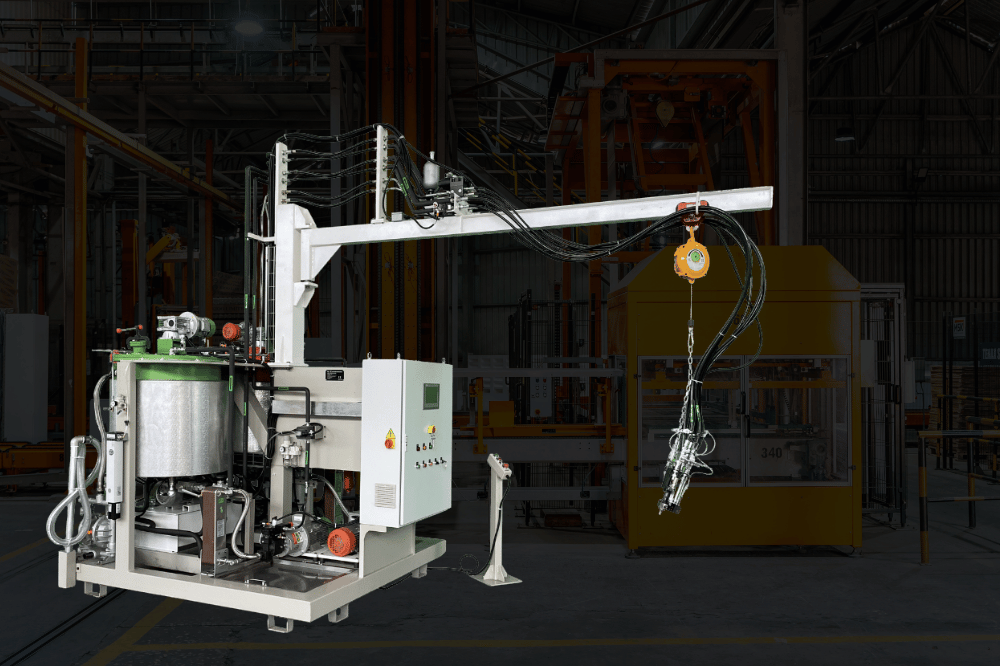
Polyurethane dispensing equipment meters, mixes, and delivers isocyanate and polyol in precise ratios to produce consistent foam, elastomers, and coatings. The right system depends on your output volume, material viscosity, shot size, automation level, and finished-product specifications. The biggest single decision is high-pressure versus low-pressure mixing. But here’s what ties it all together: a dispensing machine is only as good as the conditions feeding it—stable temperature, clean inlet pressure, and precise ratio control decide whether you get first-quality parts or spend your shifts chasing variation.
Polyurethane is everywhere. It’s in the seat you’re sitting on, the refrigerator keeping your food cold, the shoe sole under your foot, and the insulation panel in the wall behind you. All of it came out of a dispensing machine—a system that took two reactive chemicals, mixed them in exact proportion, and delivered them to a mold, surface, or cavity before the chemistry took over.
That sounds simple. It isn’t. Polyurethane chemistry is unforgiving. The isocyanate-to-polyol ratio has to be exact. Both materials have to sit at a controlled temperature. The mixing has to be complete and consistent. And the shot has to land at the right flow rate, in the right amount, in the right time window—before the reaction gets ahead of you.
The dispensing machine is where all that precision comes together, and choosing the right one is among the most consequential decisions a polyurethane operation makes. This guide covers what you need to make that call well: how the equipment works, what separates high-pressure from low-pressure systems, which machine types suit which jobs, what to evaluate before you buy, and how to keep it running once it’s yours.
Polyurethane Dispensing Equipment at a Glance
Before we go deep, here’s the full decision at a glance.
|
Question |
Short Answer |
|---|---|
|
What does it do? |
Meters, mixes, and delivers isocyanate and polyol in controlled ratios |
|
Main machine types |
High-pressure, low-pressure, slabstock, elastomer casting, spray foam rigs, micro-dispensing |
|
Most important choice |
High-pressure vs low-pressure mixing |
|
What drives selection? |
Output volume, material viscosity, shot size, automation level, product specs |
|
What affects performance most? |
Ratio accuracy, temperature stability, stable inlet conditions, disciplined maintenance |
Keep this table in mind as you read. Each section below expands on a single row—and they all point to the same conclusion: the machine is the center of a process, not a standalone box.
How a Polyurethane Dispensing System Works
Every dispensing system shares the same building blocks, regardless of pressure range, output capacity, or application. Understanding them makes the machine-type decisions that follow much clearer.
Supply tanks and day tanks
Supply and day tanks hold the isocyanate and polyol upstream of the metering system. Day tanks—smaller, pressure-rated vessels positioned close to the machine—feed the metering pumps at controlled head pressure and consistent temperature. The stability of conditions at the pump inlet directly determines how accurate your metering can be. Variable temperature, inconsistent viscosity, or entrained air at the inlet introduces a ratio error that no downstream adjustment can fully correct.
Metering pumps
The metering pumps are the precision core of the system. Depending on the design and application, these are axial piston pumps, gear pumps, or hydraulic cylinders for filled or high-viscosity formulations. Flow meters and mass flow sensors, paired with servo- or frequency-controlled motors, continuously monitor output and maintain the programmed ratio within tight tolerances. Pump type matters: piston pumps hold output well at elevated pressures, while gear pumps flex across a broader viscosity range.
Temperature control
Temperature control systems regulate both components throughout the machine. Polyurethane reacts faster when warm and slower when cold, so temperature consistency isn’t a comfort feature—it’s a process requirement. Heat exchangers, temperature-controlled day tanks, and heated supply lines keep each component inside a narrow target band, measured in degrees rather than broad ranges.
The mix head
The mix head is where the chemistry begins. It brings the metered streams together and starts the reaction. The design—high-pressure impingement or low-pressure mechanical—determines the physics of mixing, how clean it is, and how the head manages itself between shots. More on that next.
Controls and automation
PLC-based control systems with HMI touchscreens tie everything together. They manage recipe storage, ratio control, temperature setpoints, pressure monitoring, shot counters, and alarms from a single interface. For multi-component systems or multi-cavity tooling, the controls also sequence outputs and track production data across shifts.
High-Pressure vs Low-Pressure Dispensing
This is the most consequential choice in polyurethane dispensing. Both technologies mix isocyanate and polyol, but the physics of how they do it, and the operating realities that follow, are fundamentally different.
|
Factor |
High-Pressure |
Low-Pressure |
|---|---|---|
|
Mixing method |
Impingement—streams collide at high velocity |
Mechanical stirrer at 3,000–6,000 RPM |
|
Operating pressure |
~100–200 bar |
~5–20 bar |
|
Cleaning method |
Self-cleaning hydraulic plunger |
Solvent flush or hot water cycle |
|
Solvent use |
None |
Recurring solvent waste |
|
Viscosity range |
Best for lower-viscosity systems |
Handles high-viscosity and filled materials |
|
Material loss per shot |
Minimal |
~3–5% (lead/lag effect) |
|
Upfront cost |
Higher |
Lower |
|
Operating cost per part |
Lower |
Higher (solvent, waste, downtime) |
|
Best use cases |
High-volume, high-cycle, automated production |
Specialty formulations, low-volume, flexible runs |
How high-pressure impingement mixing works
High-pressure systems force both components through opposing nozzles, where the streams collide in a small chamber at extreme velocity. That turbulence homogenizes the chemicals almost instantly, with no moving parts in the head itself, producing thorough mixing and excellent surface quality.
The self-cleaning mechanism is what makes these systems efficient. After each shot, a hydraulically driven plunger sweeps the chamber clean. No residual material stays behind, so no solvent flush is needed, and the machine is ready for the next shot immediately. That’s why high-pressure is the standard for high-volume, high-cycle work: automotive seating, refrigeration insulation, continuous panel lines, and furniture molding. The trade-off is capital cost—high-precision piston pumps, hydraulic units, and chillers—plus skilled maintenance. At very low flow rates, impingement mixing loses effectiveness, so it’s rarely the right pick for small-shot or specialty jobs.
How low-pressure mechanical mixing works
Low-pressure machines blend components with a mechanical stirrer inside the chamber. Components enter at lower pressure and mix physically rather than by collision. The resulting laminar flow mixes adequately for many applications and handles high-viscosity or filled materials that can’t pass reliably through high-pressure nozzles.
The catch is cleaning. After each shot, residual mixed material remains in the chamber and must be flushed before it cures—usually with a solvent, sometimes with a hot-water cycle. That flush adds time between shots, creates solvent waste to dispose of, and introduces recurring costs that high-pressure systems avoid. A lead/lag effect at the start and end of each pour also wastes a small amount of off-ratio material, typically 3 to 5% per shot. Still, low-pressure machines cost less, handle a wider viscosity range, and convert between formulations more easily—making them the better fit for CASE applications and specialty molding with filled or reactive polyols.
Types of Polyurethane Dispensing Equipment
Not every machine is built on the same platform. Rigid foam, flexible slabstock, elastomer casting, spray foam, and micro-dispensing each have equipment designed for their specific demands. Here’s each one in a consistent structure.
Rigid Foam Dispensing Machines
- What it is: High-pressure systems built for the low-viscosity, fast-reacting formulations used in insulation.
- Best applications: Refrigeration insulation, building panels, water heater jackets.
- Key features: Precise temperature control, high output rates, and cycle times under 30 seconds on automated refrigerator lines.
- When general-purpose won’t work: Fast reactivity and tight cycle targets demand dedicated temperature control and output stability, which a general-purpose machine can’t sustain.
Flexible Foam and Slabstock Systems
- What it is: Continuous open-pour systems that lay foam onto a moving conveyor to form open-cell blocks.
- Best applications: Mattresses, furniture cushioning, automotive seating.
- Key features: Very high throughput and simultaneous control of multiple streams—polyol, isocyanate, water, amine catalyst, silicone surfactant, and blowing agents.
- When general-purpose won’t work: Managing that many streams at that ratio continuously is beyond a single-shot molding machine.
Elastomer Casting Machines
- What it is: Two-component systems for cast polyurethane elastomers.
- Best applications: Industrial rollers, wheels, seals, and wear parts.
- Key features: Handle high-viscosity, long-pot-life formulations; degassing to eliminate bubbles; precise temperature control of both components to ensure proper reactivity and cured properties.
- When general-purpose won’t work: Without degassing and tight temperature control, cast parts trap bubbles and fail to meet physical-property targets.
Spray Foam Rigs
- What it is: Mobile dispensing systems in which mixing occurs at the gun, via impingement or in-line static mixing.
- Best applications: Construction insulation, roofing, and industrial coatings.
- Key features: Heated, insulated hose sets that hold temperature across runs exceeding 200 feet; proportioners control pressure and temperature, the gun controls mix and pattern.
- When general-purpose won’t work: Stationary machines can’t maintain material temperature over long, mobile hose runs.
Micro-Dispensing Systems
- What it is: Small-shot, high-precision systems using gear or progressive cavity pumps for extremely fine flow control.
- Best applications: Electronics gasketing, potting of small assemblies, formed-in-place foam gaskets (FIPFG) for automotive and appliance sealing.
- Key features: Shot volumes measured in grams; ratio accuracy that depends on very tight pump calibration.
- When general-purpose won’t work: Large-shot machines can’t hold ratio accuracy at gram-scale volumes.
How to Choose the Right Machine
Suppliers can spec a machine for almost any application. The real question is whether their spec matches what your process needs. Start with what the job requires, then work back to the equipment.
|
If you need… |
Best Equipment Type |
Why |
|---|---|---|
|
High-volume foam molding |
High-pressure impingement |
Fast cycles, solvent-free self-cleaning |
|
Filled or high-viscosity systems |
Low-pressure mechanical mixing |
Handles difficult formulations reliably |
|
Continuous flexible foam |
Slabstock system |
Multi-stream control with conveyor pouring |
|
Wear parts and rollers |
Elastomer casting machine |
Viscosity handling, degassing, and temperature control |
|
On-site insulation or roofing |
Spray foam rig |
Mobile, temperature- and pressure-controlled application |
|
Small precision gasketing |
Micro-dispensing system |
Fine flow control and shot-to-shot accuracy |
Beyond machine type, a few factors decide whether the specific unit fits your process:
- Output and flow range should bracket your actual needs—not just the high end. A machine that’s accurate at maximum output but drifts at low flow will fail you on short shots and startup.
- The viscosity range has to match your materials. Request pump performance curves across your specific formulations, not generic specs.
- Mix ratio flexibility matters if you run multiple formulations or adjust the iso index. Confirm that the metering system can accurately adjust the ratio without extensive recalibration.
- Part size and mold configuration drive shot volume, pour timing, and whether robotic or manual head positioning fits.
Why Upstream Material Conditioning Matters
Here’s the part that decides whether a top-tier machine actually performs like one. A metering machine can only be as accurate as the conditions at its inlets. Get the upstream wrong, and no downstream precision will save the part.
Temperature stability comes first. Both isocyanate and polyol change viscosity with temperature, and viscosity drives flow behavior at the pump inlet. Material arriving cold meters unevenly and shifts the effective ratio, even when the pump output looks nominally correct. Bulk storage and day tanks that hold material inside their target band keep the reaction behaving the same at 6 a.m. as it does mid-afternoon.
Inlet pressure and flow matter just as much. Head pressure that swings as tank levels drop, or air entrained from running a container dry, introduces direct ratio error. A properly designed distribution loop delivers material at a consistent pressure and flow rate, so the metering system isn’t fighting its own supply.
Degassing protects foam quality. Dissolved air entrained during transfer disrupts cell structure in foam systems, so vacuum degassing—often built into the day tank—strips that air before the material reaches the mix head.
Moisture control protects the whole system. Moisture on the isocyanate side reacts to form polyurea solids that clog orifices, nozzles, and mix chambers. Nitrogen blanketing on isocyanate day tanks prevents atmospheric moisture from entering the tanks through the vents during pressure equalization.
The takeaway: bulk storage, day tanks, temperature control, and degassing aren’t accessories to the dispensing machine. They’re what let it hit the ratio accuracy and part quality it was built to deliver.
Automation and Robotic Integration
The level of automation is as much a strategic question as a technical one. A manually operated machine needs an operator at the head for every shot. A machine on a robotic arm can run unattended once a mold is loaded.
Robotic integration is increasingly common but still far from universal. For high-volume automotive, appliance, and panel work, robot-mounted mix heads are standard—the volume justifies the programming, and the cycle-time gains are real. For lower-volume, multi-SKU, or prototype operations, manual or semi-automated positioning is often more practical, since frequent product changes make reprogramming a robot expensive.
The good news: most modern dispensing machines ship with robot-ready interfaces—signal I/O, communication protocols, and mechanical mounting provisions. That means you can start semi-automatic and add robotic integration later if your production justifies it. When you’re evaluating a machine, confirm those interfaces exist even if you don’t plan to automate on day one. It’s far cheaper to buy robot-ready than to retrofit.
The right automation level depends on your labor cost, part complexity, cycle-time targets, and how often your production mix changes.
Maintenance and Reliability
A well-maintained dispensing machine runs reliably for decades. A neglected one fails in ways that are expensive to diagnose and costly to repair. The discipline isn’t complicated—it just has to be consistent, tiered by frequency, and assigned to the right people.
|
Frequency |
Tasks |
Owner |
What It Prevents |
|---|---|---|---|
|
Daily |
Check temperature setpoints, monitor pressure readings, and watch for leaks |
Operator |
Ratio drift and undetected leaks |
|
Weekly |
Check Y-strainer filters, verify throat seal liquid level, and flow |
Operator |
Flow restriction and head contamination |
|
Bi-weekly |
Lubricate drum pumps, clean Y-strainers, change DOP fluid, strip and clean the mix head or spray gun, and inspect desiccant dryers |
Technician |
Pump wear, off-ratio output, moisture intrusion |
|
As-needed |
Flush hose lines, replace hose covers, clean the rig, replace worn o-rings |
Technician |
Clogs, leaks, and contamination |
A few points deserve extra attention:
- Keep operational logs. Runtime, materials processed, temperatures held, and ambient conditions give you the baseline to catch problems before they become failures. For spray foam rigs in particular, usage data lets you schedule maintenance based on operating hours rather than calendar time.
- Give the mix head and spray gun serious attention. This is where the reaction happens and where wear and contamination accumulate fastest. A general rule for spray guns is to strip and clean every two to three weeks under normal use. Any gun clogging more than once a week needs more frequent service—or replacement. Inspect o-rings every time the head is stripped, and replace them proactively rather than reactively.
- Watch for moisture and polyurea buildup. Any polyurea in the mix head is a signal to check your moisture protection immediately—desiccant dryers on the A-side and nitrogen blanketing on the iso day tank.
- Train operators systematically. An operator who understands why ratio accuracy matters—not just how to set the dial—makes better calls when something’s off. Training should cover normal operation, alarm response, shutdown procedures, and the early signs of trouble.
Frequently Asked Questions
How accurate does the mix ratio need to be, and how is it measured?
Requirements vary by application, but most polyurethane systems are sensitive enough that a deviation of two to three percentage points in the iso index affects reactivity, physical properties, and sometimes rejection rates. High-quality metering systems hold a ratio to within ±1% under stable conditions. Accuracy is usually measured by collecting and weighing each component stream independently, then comparing to the programmed setpoint—checked at startup and periodically during production.
How do you manage formulation changeovers between production runs?
It depends on how compatible the materials are. For compatible polyol grades, flushing with the new material and running test shots to confirm the ratio and reactivity is often enough. For incompatible formulations—different polyol bases, different catalysts, or different viscosity ranges—you need a more thorough purge, sometimes including disassembly and cleaning of the mix head. Always confirm compatibility with your chemical supplier before assuming a simple flush will do.
What causes off-ratio material, and how do you diagnose it?
Several sources. Pump wear is common in older machines, as clearances open up and volumetric efficiency drops unevenly between the two components. Temperature deviations shift viscosity and flow, changing the effective ratio even when the pump output appears correct. Air entrainment on the suction side causes flow interruption and ratio swings. Clogged strainers restrict one component more than the other. Diagnose systematically—check temperature first, then strainers, then a careful weighout of each stream, then pump performance.
What is the typical service life of a dispensing machine?
A well-maintained machine from a reputable manufacturer realistically lasts 20 years or more for the main mechanical and structural components. Wear parts—pump seals, mix head components, o-rings, strainers, hose sets—require periodic replacement at rates determined by usage and material aggressiveness. Electronics and controls tend to have shorter lives than the mechanical hardware, but older machines can often be retrofitted with updated controls to extend their productive years.
Is robotic integration standard on modern machines?
It’s increasingly common but not universal. High-volume automotive, appliance, and panel applications use robot-mounted heads as standard. Lower-volume, multi-SKU, and prototype operations often do better with manual or semi-automated positioning. Most modern machines ship robot-ready, so adding integration later is feasible if your volume eventually justifies it.
What data should I prepare before talking to a supplier?
Come with specifics. Have your material data sheets ready—viscosity, reactivity, temperature requirements, and whether the polyol is filled. Know your production volume, target cycle time, shot size range, tooling and mold configuration, and the automation level you’re aiming for. Note any regulatory constraints, like VOC limits, that affect solvent use. The more precisely you can describe your process, the more accurately an equipment engineer can match a machine to it—generic catalog specs can’t answer application-specific questions.
Selecting the Right Path for Your Production
Polyurethane dispensing equipment is not a commodity purchase. The machine you choose shapes your process capability, maintenance burden, labor requirements, and product quality for the life of that equipment.
The right starting point is always specificity about your own process: what materials you run, at what volumes, into what tooling, at what cycle time, under what level of automation, and with what maintenance resources on hand. Generic catalog specs don’t answer those questions. A detailed conversation with an equipment engineer—backed by real material data and production requirements—does.
Three principles worth carrying into that conversation:
- Match the machine to the application. High-pressure impingement for high-volume, automated, solvent-free production. Low-pressure mechanical mixing for viscous materials, specialty formulations, and flexibility over throughput. Specialized platforms—slabstock, elastomer casting, spray rigs, micro-dispensing—exist because their applications are specific enough that general-purpose machines don’t serve them well.
- Condition the material before it reaches the head. Unstable temperature, inconsistent viscosity, or variable inlet pressure introduces an error that even the best machine can’t fully correct. Proper bulk storage and day tank conditioning are what separate operations that hit quality targets from those that chase variation.
- Treat maintenance as a system, not a chore. The failure modes are well understood. A tiered program—assigned to trained personnel and documented in writing—prevents most unplanned downtime and extends equipment life far beyond what neglect would allow.
The dispensing machine sits at the center of the polyurethane process. Everything upstream conditions the material it receives; everything downstream depends on what it delivers. Get that middle step right, and the whole operation runs smoothly.
If you’re specifying a dispensing system—or planning a new line—the machine is only as good as the process built around it. Our team engineers complete polyurethane metering, mixing, and dispensing systems: precision pumps, high- or low-pressure mix heads, temperature control, degassing, and integrated day tank supply, all designed to hold tight ratios and deliver in-spec parts run after run. If you want equipment matched to your materials, volume, and automation goals—not a generic machine off a spec sheet—let’s talk about the system that fits your production.