
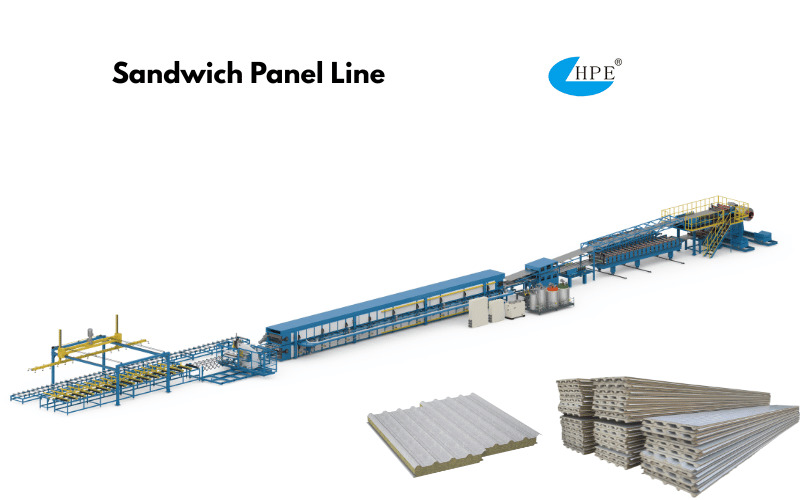
Sandwich panels have revolutionized the way modern structures are built, offering a perfect blend of strength and efficiency. These composite construction materials consist of a lightweight insulating core sandwiched between two rigid metal outer layers, typically steel or aluminum. This unique structure provides exceptional thermal insulation and structural integrity while keeping weight to a minimum. Sandwich panel production has become a cornerstone of energy-efficient construction, as insulated panels significantly reduce heating and cooling costs. As vital construction materials, they are adaptable to various climates and architectural styles, making them a preferred choice globally.
Industries relying on sandwich panels include:
- Construction: Residential, commercial, and industrial buildings.
- Refrigeration: Cold storage warehouses and walk-in freezers.
- Transportation: Refrigerated trucks and shipping containers.
- Agriculture: Poultry farms and agricultural storage facilities.
Before selecting a panel for your next project, it is crucial to look beyond just the general benefits. The core material defines the panel’s performance, from fire safety to thermal resistance. Understanding the nuances of different panel types allows builders and architects to make informed decisions that align with specific safety regulations and energy goals. The following section breaks down these variations to help you choose the right solution.
Definition and Types of Sandwich Panels
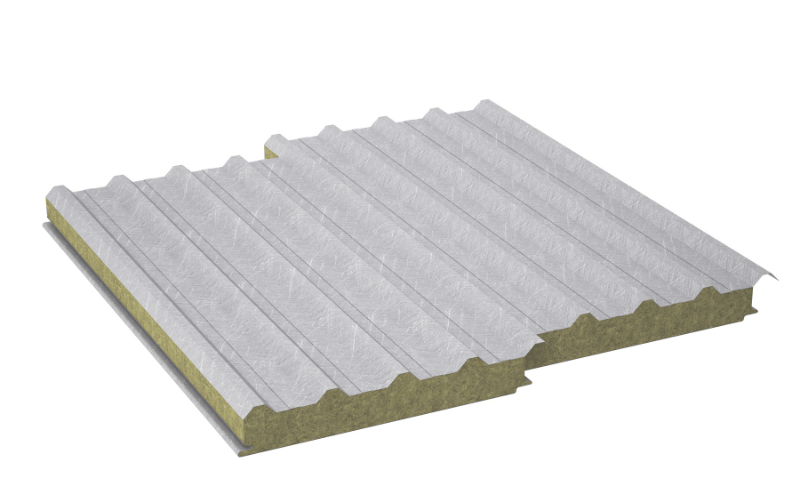
A sandwich panel is a prefabricated modular building component designed for thermal insulation and rapid assembly. The core material is the defining feature, determining the panel’s suitability for different environments. Understanding the types of sandwich panels available is essential for ensuring safety and efficiency. For instance, PU sandwich panels are renowned for insulation, while mineral wool excels in fire resistance.
|
Panel Type |
Insulation Properties |
Fire Resistance |
Key Applications |
|---|---|---|---|
|
PU (Polyurethane) |
Excellent thermal retention. |
Moderate. |
Cold storage, general roofing. |
|
PIR (Polyisocyanurate) |
Superior thermal performance. |
High. |
Industrial buildings, fire-safe zones. |
|
Mineral Wool |
Moderate thermal retention. |
Excellent (Non-combustible). |
Firewalls, acoustic barriers. |
|
EPS (Expanded Polystyrene) |
Good thermal retention. |
Low. |
Budget-friendly housing, partitions. |
Applications of Sandwich Panels in Construction
The versatility of sandwich panels makes them indispensable across the construction sector. They are not limited to just one part of a building but are used to create the entire envelope. Sandwich panels for roofing provide a durable, weather-resistant shield that also insulates the building from above. Insulated wall panels are equally critical, offering rapid enclosure of large industrial spaces while ensuring energy efficiency. Their lightweight nature reduces the load on the structural frame, allowing for cost savings on foundation and steelwork.
Key applications include:
- Roofing Systems: Providing weatherproofing and insulation for warehouses.
- External Wall Cladding: Creating aesthetic and functional facades.
- Internal Partitions: Dividing spaces in factories or offices.
- Cold Storage Facilities: Maintaining low temperatures in food processing plants.
- Clean Rooms: Creating sterile environments for pharmaceutical manufacturing.
Benefits of Using Sandwich Panels
The widespread adoption of sandwich panels is driven by their compelling advantages over traditional building methods. As energy-efficient construction materials, they significantly lower utility bills by minimizing heat transfer. Their prefabricated nature allows for rapid installation, often reducing construction time by up to 50% compared to brick or concrete. Furthermore, the lightweight design of these panels simplifies transportation and handling on-site.
Advantages of sandwich panels include:
- Superior Thermal Insulation: Keeps interiors cool in summer and warm in winter.
- Rapid Installation: Large panels cover vast areas quickly, speeding up project timelines.
- Cost-Effectiveness: Reduced labor costs and structural requirements.
- Aesthetic Versatility: Available in various colors and profiles to suit architectural designs.
- Durability: Resistant to corrosion and weather elements, ensuring long service life.
Understanding Sandwich Panel Production Lines
To fully appreciate the role of sandwich panel production lines, it’s essential to understand the processes and machinery that bring these versatile building materials to life. From the synchronized steps of production to the specialized equipment that ensures precision and quality, each element plays a critical role in delivering high-performance panels. Let’s dive into the production processes and the key components that make it all possible.
Overview of Sandwich Panel Production Processes
The sandwich panel manufacturing process is a highly synchronized operation that transforms raw materials into finished building components. It begins with the decoiling of metal sheets, which act as the outer facings. These sheets undergo roll forming to achieve the desired profile. Simultaneously, the core material—whether liquid foam or mineral wool slabs—is introduced between the metal layers. The assembly then passes through a double-belt laminator where curing and bonding occur under heat and pressure. Finally, the continuous panel is cut to length, stacked, and packaged. These panel production steps ensure uniformity and structural integrity.
Key Components of a Sandwich Panel Production Line
A robust production line relies on specialized machinery working in harmony. Sandwich panel production equipment must be precise to ensure the final product meets quality standards. Panel manufacturing components range from shaping tools to chemical dispensers.
|
Component |
Function |
Importance |
|---|---|---|
|
Decoiler |
Unwinds metal coils. |
Feeds the line continuously. |
|
Roll Former |
Shapes metal sheets. |
Creates the structural profile. |
|
Foam Dispenser |
Injects liquid core material. |
Ensures insulation continuity. |
|
Double Belt Laminator |
Presses and cures the panel. |
Bonds layers and ensures flatness. |
|
Cutting System |
Cuts panels to length. |
Provides final product dimensions. |
Importance of Continuous Production in Sandwich Panel Manufacturing
Continuous sandwich panel production is the industry standard for high-volume manufacturing. Unlike discontinuous methods, which produce one panel at a time, continuous lines run non-stop, significantly boosting throughput. This automated panel manufacturing approach ensures that every meter of panel produced has consistent insulation density and bonding strength. It minimizes raw material waste associated with line start-ups and shutdowns and allows manufacturers to fulfill large orders with short lead times, maximizing overall operational efficiency.
The Role of Sandwich Panel Machinery
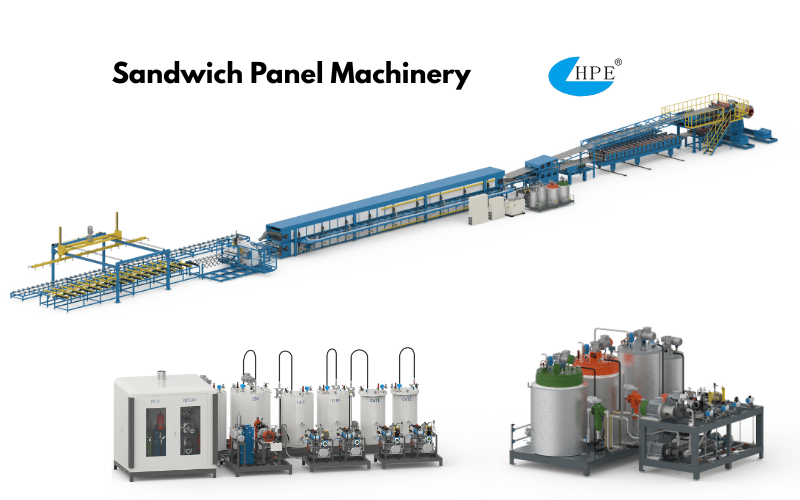
Sandwich panel machinery is the backbone of efficient and high-quality panel production. Each machine in the production line is designed to perform a specific function, from shaping metal sheets to injecting core materials and ensuring precise cutting. Understanding the types of machinery and their roles is essential for optimizing production and achieving consistent results. Let’s explore the key types of sandwich panel machines and their critical functionalities.
Types of Sandwich Panel Machines
Machinery selection depends on the specific type of panel being produced. The market offers various kinds of panel machines, each tailored to handle particular core materials. PU panel machinery is designed for liquid chemical injection, while mineral wool lines require systems to slice and orient fiber slabs.
Key machine types include:
- PU/PIR Sandwich Panel Lines: For foam-cored panels.
- Mineral Wool Sandwich Panel Lines: For rock wool or glass wool cores.
- Discontinuous Panel Presses: For low-volume or complex shapes, such as cam-lock panels.
- Roll Forming Machines: For profiling the metal skins.
- Flying Saws: For cutting panels without stopping the line.
Functionality of PU Sandwich Panel Machines
PU panel production relies on sophisticated chemical metering and mixing technology. Polyurethane panel machines feature a high-pressure foaming unit that mixes polyol and isocyanate. This mixture is sprayed evenly onto the moving lower metal sheet just before the upper sheet is applied. The machine’s double-belt laminator then controls the foam’s expansion as it rises and cures, ensuring the panel reaches the exact thickness and density required. Precision in this chemical reaction is critical for the panel’s thermal performance.
Integration of Roll Forming Machines in Production Lines
The roll forming technology integrated into the line is responsible for the panel’s structural strength and aesthetic appeal. These panel shaping machines use a series of roller stations to bend flat metal strips into corrugated or ribbed profiles gradually. This process happens continuously before the core material is added. The profile design not only affects the building’s appearance but also determines how the panels interlock (tongue-and-groove), which is vital for weatherproofing and installation speed.
Materials Used in Sandwich Panel Production
The choice of core materials plays a pivotal role in determining the performance and application of sandwich panels. From the superior insulation properties of polyurethane to the fire resistance of mineral wool and the advanced thermal efficiency of PIR, each material offers unique benefits tailored to specific construction needs. Let’s delve into the characteristics and advantages of these core materials used in sandwich panel production.
Polyurethane and Its Benefits for Sandwich Panels
Polyurethane (PU) is widely regarded as one of the most effective insulation materials available. PU sandwich panels offer an incredibly low thermal conductivity, meaning a thinner panel can provide the same insulation value as a much thicker wall of concrete or brick. Polyurethane insulation is also lightweight and has excellent adhesion, bonding naturally to metal skins without the need for additional adhesives. This creates a strong composite unit that adds structural rigidity to the building envelope.
Mineral Wool as an Insulation Core in Sandwich Panels
When fire safety is the primary concern, mineral wool panels are the top choice. Made from spun volcanic rock or glass fibers, this core material is non-combustible and can withstand temperatures exceeding 1000°C. Fire-resistant sandwich panels using mineral wool prevent the spread of flames, protecting lives and property. Additionally, the fibrous structure of mineral wool provides excellent sound absorption, making these panels ideal for factories or buildings in noisy environments that require acoustic insulation.
PIR (Polyisocyanurate) in Sandwich Panel Manufacturing
Polyisocyanurate (PIR) is an advancement over standard PU chemistry. PIR panels are produced similarly but with a different chemical ratio that enhances cross-linking. This results in polyisocyanurate insulation that chars rather than melts when exposed to fire, offering significantly better fire resistance and lower smoke emission compared to standard PU. Furthermore, PIR offers slightly better thermal efficiency, making it a premium choice for modern, energy-conscious, and safety-regulated construction projects.
Cutting Systems in Sandwich Panel Manufacturing
Cutting systems are the final yet critical step in sandwich panel manufacturing, ensuring each panel meets precise length and quality specifications. Advanced cutting technologies not only enhance accuracy but also maintain the efficiency of continuous production lines. Let’s explore the key cutting systems, their technologies, and strategies for optimizing their performance.
Overview of Cutting Systems in Production Lines
The final stage of the production line involves cutting the continuous composite stream into individual panels. Panel cutting systems must operate with extreme synchronization, matching the speed of the moving line to execute a cut without pausing production. Precision cutting technology ensures that panels are cut to the exact customer-specified lengths, minimizing on-site modifications and waste. Accuracy here is crucial, as even minor deviations can lead to installation issues and gaps in the building envelope.
Band Saw Technology for Precision Cutting
Band saw cutting is frequently employed for thick or mineral wool panels. This technology uses a continuous metal blade with teeth to slice through the metal skins and the core material. Precision panel cutting with band saws delivers a relatively clean edge and reduces dust generation compared to abrasive disc cutters. These saws are mounted on a moving carriage that clamps to the panel and travels with it during the cut, ensuring a perfectly square edge.
Optimizing Cutting Systems for Efficiency
To maintain high throughput, efficient panel cutting requires regular attention. Dull blades or misaligned carriages can slow down the line or damage the panel ends. Cutting system optimization involves implementing smart controls and routine maintenance schedules.
Optimization tips include:
- Automatic Blade Tensioning: Ensures consistent straightness of cuts.
- Dust Extraction Integration: Keeps the cutting area clean and sensors unobstructed.
- Predictive Maintenance: Replacing blades before they dull to prevent jagged edges.
- Speed Synchronization: Regularly calibrating the flying saw travel speed with the main line speed.
Future Trends in Sandwich Panel Production
Technological advancements, sustainability initiatives, and evolving market demands are shaping the future of sandwich panel production. From more innovative machinery to eco-friendly practices, manufacturers are adapting to meet the needs of modern construction while staying ahead of industry trends. Let’s explore the innovations, sustainability efforts, and market dynamics driving the next generation of sandwich panel production.
Innovations in Sandwich Panel Machinery
The industry is seeing a shift toward innovative panel machinery that leverages digital technology. Smart manufacturing technology now includes AI-driven quality control systems that scan panels for surface defects and void pockets in real time. IoT-enabled machines allow manufacturers to monitor energy consumption and production rates remotely, facilitating predictive maintenance and reducing downtime. These advancements are making production lines more intelligent, responsive, and efficient.
Sustainability in Sandwich Panel Production
As the construction industry pushes for net-zero goals, sustainable panel production is gaining traction. Manufacturers are increasingly using bio-based polyols derived from renewable resources instead of petrochemicals. Additionally, processes are being optimized to recycle scrap foam and metal offcuts. Green construction materials now also use blowing agents with zero ozone-depletion potential (ODP) and low global warming potential (GWP), aligning panel production with international environmental standards.
Market Trends and Demand for Sandwich Panels
The global demand for high-performance building envelopes is driving trends in the sandwich panel market. Stricter energy codes and the need for rapid infrastructure development are key factors increasing the demand for insulated panels.
Key drivers include:
- Cold Chain Expansion: Growing need for refrigerated storage and logistics hubs.
- Modular Construction: Rise in prefabricated housing and offices.
- Energy Retrofits: Upgrading older buildings with insulated cladding.
- Emerging Economies: Rapid industrialization requires quick-build factories.
Frequently Asked Questions
What is a polyurethane sandwich panel line, and how does it work?
A polyurethane sandwich panel line is a production system for continuous sandwich panels where a core structure made of polyurethane foam is sandwiched between steel coils or composite facings. The line typically includes a foam machine and foaming system, feeders for color steel or other facings, a double-belt conveyor for continuous production of sandwich panels, automated profiling and edge profiling to give the sandwich composite its final shape, curing stations, and cutting units to deliver finished panels.
What are the main components of a PU sandwich panel production line?
Key components include the polyurethane processing and foaming system, metering pumps, mixing head, conveyors (often a double belt conveyor) for continuous sandwich, curing ovens or tunnels, press and profiling units for edge and surface profiling, automation and control systems, and stations for handling steel coils, EPS or rock wool facings, depending on the design.
Can sandwich panels be made with different core materials, such as EPS, PIR, or rock wool?
Yes. While many lines focus on polyurethane sandwich panels, continuous sandwich panel lines can be configured for EPS, PIR, or rock wool sandwich panel production. Manufacturers often offer production of sandwich panels made of polyurethane or mineral wool, allowing selection of thermal insulation properties and fire performance.
How does the line ensure thermal insulation and fire performance?
The choice of core—polyurethane foam, EPS, PIR, or mineral wool—determines thermal insulation and fire resistance. Polyurethane and PIR provide excellent thermal insulation (low thermal conductivity), while rock wool or mineral wool panels improve fire performance. The foaming system, core density, and composite facing materials, like color steel, influence the overall thermal insulation and safety of finished panels.
What levels of automation and continuous production are available?
Modern polyurethane sandwich panel lines offer high levels of automation, from automated resin and isocyanate dosing to continuous PU operations with PLC control, conveyor synchronization, and automated trimming and stacking. Continuous sandwich production increases efficiency and allows long runs of finished panels with consistent quality and reduced manual intervention.
How flexible is the line in producing different sandwich panel types and profiles?
A well-designed line supports sandwich panels with different thicknesses, facings (color steel, galvanized steel, composite), and core structures made of polyurethane or mineral. Edge profiling gives the sandwich panels specific joint types, tongue-and-groove or male/female fittings. Profiling units and tooling changes enable the manufacture of sandwich panels tailored to customer needs.
What role do conveyors and double belt systems play in quality control?
Conveyor systems, especially double belt conveyors, ensure uniform pressure and heat distribution during continuous sandwich production, which is critical for consistent foam bonding and curing. Proper conveyor speed control and synchronized automation reduce defects, ensure even core expansion, and result in finished panels with reliable composite integrity.
How does a manufacturer choose between polyurethane and rock wool sandwich panel lines?
Selection depends on priorities: polyurethane sandwich panels offer superior thermal insulation and lighter weight for building envelopes. In contrast, rock wool (wool panel) lines produce panels with enhanced fire resistance and acoustic performance. Considerations include the intended use of sandwich panels, fire codes, cost, and production capabilities, such as foaming system specifics and equipment for handling mineral wool.
What maintenance and operational considerations are essential for continuous sandwich panel lines?
Regular maintenance of the foam machine, metering pumps, mixing head, conveyors, and profiling equipment is essential. Calibration of the foaming system and automation controls ensures consistent core density and panel quality. Proper handling and storage of raw materials like polyurethane components, EPS bead,s or rock wool, and maintenance of steel coils and color steel feeders reduce downtime and maintain the long-term performance of the production of sandwich panels.