Choosing the right foaming equipment shapes your output, your labor costs, and your ability to scale. For manufacturers producing molded polyurethane foam parts, the ground rail production line sits at the heart of that decision. It moves molds through a continuous, automated cycle to produce consistent foam products in steady volume. This guide explains what a ground rail production line is, how it works, where it fits, and how to choose the right setup—so you can invest with confidence and support your production goals for years to come.
What Is a Polyurethane Mold Foaming Ground Rail Production Line?
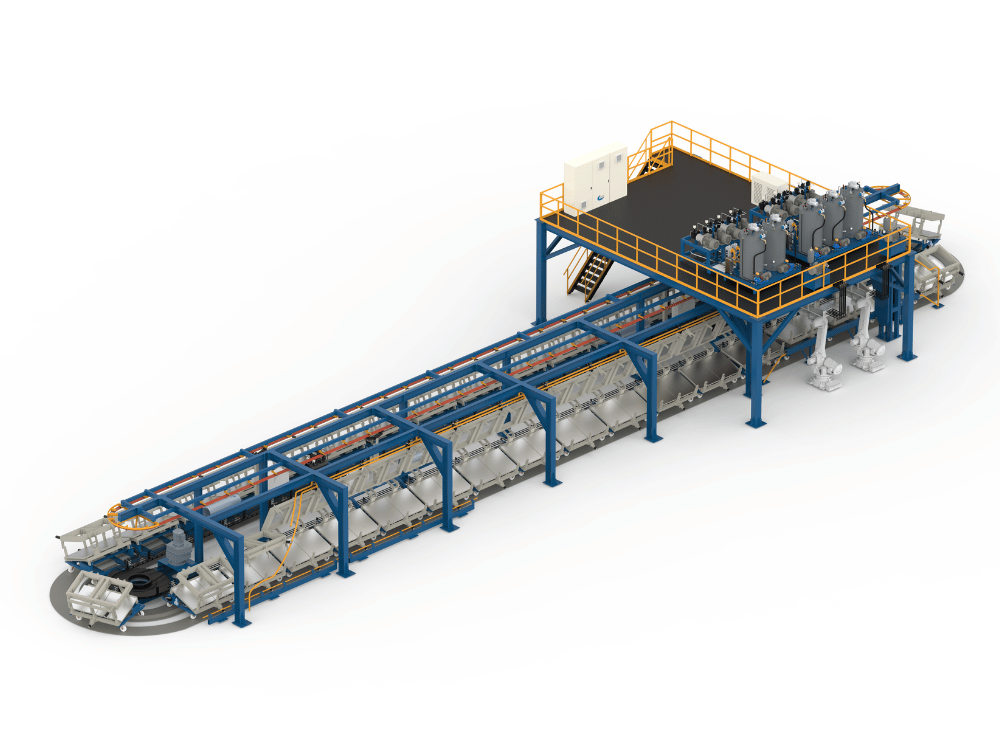
A polyurethane mold foaming ground rail production line—often called an oval line—is an automated system that produces molded PU foam parts in medium- to large-batch sizes. Molds sit on carrier trolleys that travel along a closed-loop ground rail conveyor, passing through each stage of the foaming cycle in sequence. Along the way, the system sprays a release agent, pours the polyurethane mix, closes and clamps the molds, heats and cures the foam, and then opens the molds to release the finished parts. Because the rail forms a continuous oval loop, molds automatically cycle back to the start, keeping production flowing without manual repositioning between stations.
This line matters to foam manufacturers because it directly shapes throughput, product consistency, labor cost, and floor space. Manual or batch foaming methods raise defect rates, slow output, and depend heavily on operator skill at every step. An oval line standardizes the process, precisely controls mold temperature, and automates repetitive work that drives variation. Understanding how a ground rail production line works, along with its main components and selection factors, helps your team decide whether and how to invest in your specific foam products and output targets.
Main Components of a Ground Rail Production Line
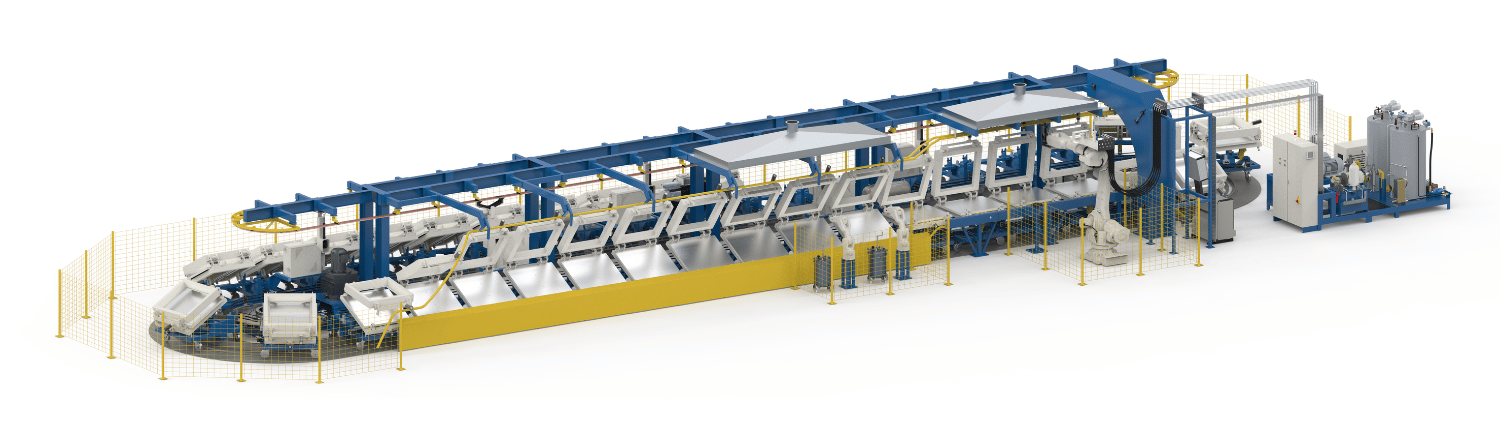
A complete ground rail production line combines several coordinated systems, each handling a specific part of the foaming cycle. Here are the core components and what each one contributes to finished foam parts.
Ground Rail Conveyor and Mold Carriers
The ground rail conveyor is the backbone of the line. A frequency-conversion motor drives the conveyor, moving mold carrier trolleys smoothly around the oval loop at a controlled, adjustable speed. Each carrier holds a mold and travels station to station in sequence.
Pneumatic mold carriers include a mold-closing device that secures the mold during pouring and curing. Air locks in the pneumatic struts hold the mold shut under pressure, so the foam expands cleanly inside a sealed cavity. Secure closing here is what protects the part shape and dimensional accuracy.
Polyurethane Foaming Machine and Pouring System
The polyurethane foaming machine meters and mixes the chemical components, then dispenses the precise amount of PU mix into each mold. Accurate metering and consistent mix ratios are critical, since they determine foam density, structure, and surface quality.
The pouring or dispensing system delivers that mix into the open mold at the right station in the cycle. Many lines use a mixing head positioned above the conveyor path, sometimes guided by a robot to ensure repeatable placement. Consistent pouring keeps every part uniform and reduces waste from over- or under-filling.
Mold Temperature Control and Curing System
A hot water mold temperature unit circulates heated water to keep molds at a steady, optimal temperature throughout the cycle. Stable mold temperature is one of the biggest drivers of quality. If it drifts, cure time and foam properties shift with it, and consistency suffers.
The curing process then sets the foam inside the closed mold as carriers travel along the rail. The combination of controlled heat and a sealed mold ensures each part cures fully and predictably, batch after batch. This temperature discipline is what separates a stable line from one that produces variable results.
PLC Control, Automation, and Auxiliary Units
A PLC control system ties the whole line together, sequencing and synchronizing every step. It coordinates release agent spraying, pouring, mold clamping, heating and curing, mold unlocking, and discharge—running the cycle automatically with minimal operator input.
Auxiliary units round out the system. These may include industrial robots for spraying or pouring, automated mold-opening and demolding mechanisms, and cleaning stations that prepare molds for the next cycle. Advanced setups can add monitoring and data logging, giving operators clear visibility into cycle timing, temperature, and output.
How Does a Ground Rail Production Line Work?
A ground rail production line works as a coordinated, station-by-station cycle that moves molds around an oval loop. Each step builds on the one before it, so foam parts come out consistent, and the line keeps flowing without interruption.
Mold Preparation and Release Agent Spraying
The cycle begins with mold preparation. As an empty mold enters the loop, the system sprays a release agent onto the mold surface. This coating lets the cured foam release cleanly later and protects both part quality and mold life.
Proper spraying, even, matters more than it looks. Too little release agent makes demolding difficult and risks tearing parts; too much can mar the surface. Automated or robotic spraying keeps the coating uniform across all molds, eliminating a common source of variation.
Closing, Pouring, and Rail Transfer
Next, the foaming machine pours the metered PU mix into the open mold at the pouring station. The mix flows into the cavity at low viscosity so it fills evenly before it begins to react and expand.
The pneumatic mold-closing device then secures the mold, locking it shut so the foam expands inside a sealed cavity. With the mold closed and clamped, the carrier moves along the ground rail conveyor toward the curing zone. This transfer happens automatically, so molds advance in a steady rhythm without manual handling between stations.
Heating, Curing, Demolding, and Cycle Reset
As the carrier travels, the hot-water temperature unit maintains the mold at its target temperature while the foam cures inside. Controlled heat and dwell time ensure the part sets fully and develops the right structure and firmness.
Once curing is complete, the mold unlocks and opens, and the finished foam part is demolded and discharged. The empty mold is then cleaned and prepared for the next round. Because the rail forms a closed oval, the carrier loops back to the spraying station, and the cycle repeats. This continuous flow is what gives the line its steady, high-volume output.
Main Applications of a PU Ground Rail Production Line
Ground rail production lines serve industries that need consistent, medium- to large-batch molded foam parts. Here are the key application areas and the value the line brings to each.
Automotive Seating and Interior Components
Automotive manufacturing is a core market. Oval lines produce seats, headrests, armrests, and sound-insulation components, all of which require consistent foam density and precise dimensions. Comfort, safety, and fit depend on that uniformity.
The continuous cycle and precise temperature control let suppliers deliver large volumes of identical parts to tight automotive standards. For Tier 1 and Tier 2 suppliers, repeatability is essential to meeting OEM quality requirements run after run.
Furniture, Bedding, and Comfort Products
Furniture and bedding makers rely on ground rail lines for pillows, sofa cushions, and ergonomic office chair components. These products need a consistent feel and shape across every unit, since customers quickly notice variation.
A ground rail line delivers that consistency at scale, producing comfortable, uniform foam parts batch after batch. For manufacturers serving the home and office market, the line supports both steady volume and dependable quality.
Packaging and Other Molded Foam Products
Protective foam packaging is another strong fit. The line molds custom foam inserts that cushion fragile goods during shipping, ensuring consistent density and shape that reliably protect products.
Beyond packaging, the same equipment handles a wide range of medium- to large-sized molded foam products. Wherever a business needs repeatable molded foam in volume, an oval line offers an efficient, automated path to production.
Types and Automation Options
Ground rail production lines vary by automation level and layout. Each configuration suits different production scales and budgets, so matching the type to your needs is an important early decision.
Semi-Automatic Ground Rail Lines
Semi-automatic lines combine automated conveyor movement and temperature control with operator input at certain stages, such as spraying, pouring, or demolding. This setup suits smaller volumes or businesses balancing investment against output.
It costs less upfront and offers flexibility, but it relies more on skilled operators and runs slower than a fully automated line. For companies starting out or producing a variety of products, it can be a practical entry point.
Fully Automatic Ground Rail Lines
Fully automatic lines link every station—spraying, pouring, clamping, curing, demolding, and cleaning—under PLC control with automated transfer. Robots often handle spraying and pouring for repeatable precision.
This configuration delivers high throughput, tight consistency, and low labor cost, making it ideal for large-scale production. The trade-off is a higher initial investment, but for steady, high-volume operations, the efficiency and repeatability quickly justify the spend.
Custom Layouts for Product and Capacity Needs
Many oval lines are configured to match specific products and capacity targets. Mold count, conveyor length, station layout, and the number of pouring or spraying points can all be tailored.
This flexibility lets manufacturers size the line to their actual output goals and product mix. A custom layout protects your investment, supports your product range, and leaves room to scale as demand grows.
Benefits and Practical Limitations
A ground rail production line offers strong advantages in productivity and consistency, but it also carries real trade-offs. Weighing both sides helps you invest wisely and avoid surprises.
Why Manufacturers Choose This Line
The benefits are compelling. A well-designed oval line delivers high productivity through continuous, automated cycling and consistent product quality across every batch. PLC control and hot water temperature management reduce variation and defects, while automation reduces the manual labor required by traditional foaming.
Precise material metering also improves yield, minimizing waste and lowering per-unit cost as volume grows. The result is reliable, repeatable foam production that meets demanding standards in automotive, furniture, and packaging markets—supporting steady delivery and a strong reputation for quality.
What Buyers Need to Watch Closely
The trade-offs are real. A ground rail production line requires meaningful upfront investment and significant floor space for the oval loop and supporting equipment. Maintenance can be involved, calling for skilled technicians to keep the conveyor, pneumatics, foaming machine, and temperature unit running smoothly.
The line also rewards steady, high-volume production. For very low volumes or frequent product changes, it may be over-specified. Commissioning, mold preparation, and operator training all add time and cost before the line reaches full productivity, so plan for that ramp-up.
How to Choose the Right Ground Rail Production Line
Choosing the right ground rail production line means weighing several key factors against your products, volume, and budget. A clear assessment of these points helps ensure long-term value and avoids costly missteps.
Product Size, Mold Count, and Output Goals
Start with what you make and how much. The size and shape of your foam products determine mold design, while your output targets drive the number of mold carriers and conveyor length you need. A line built around realistic mold count and cycle time keeps production flowing without bottlenecks. Define these requirements early so the line matches your actual demand rather than a rough estimate.
Automation, Temperature Control, and Process Stability
Match automation to your volume and precision needs. High, steady output favors a fully automatic line, while smaller or varied runs may suit a semi-automatic setup. Pay close attention to the hot water temperature control system, since stable mold temperature is central to consistent foam quality. A line with reliable temperature management and well-sequenced PLC control delivers the process stability that protects your yield and your reputation.
Maintenance, Floor Space, and Supplier Support
Evaluate your available floor space and how the oval loop will fit your facility. A line that crowds the workspace or disrupts material flow creates ongoing problems. Also, weigh ease of maintenance, spare parts availability, and supplier support, since these factors directly affect downtime and operating cost. A line that’s straightforward to service and backed by responsive support keeps production running and protects your investment over the long term.
Common Mistakes to Avoid
Even experienced buyers make avoidable mistakes when investing in a foaming line. Watching for these pitfalls helps you choose wisely and protect your budget.
Buying for Price Instead of Process Fit
Mistake: Focusing only on the lowest purchase price and overlooking how well the line fits your actual process.
Fix: Match the line to your products, output, and quality standards first. A cheaper line that can’t maintain temperature, sustain your cycle rate, or handle your mold count costs far more over time due to defects and slower output. Model the total cost of ownership—including installation, training, maintenance, spare parts, and downtime—across the line’s full service life so your decision reflects the complete picture.
Ignoring Mold Management and Cycle Balance
Mistake: Specifying the conveyor and equipment without planning mold count, cure time, and cycle balance together.
Fix: Treat molds and cycle timing as part of the system. Too few molds leave the line waiting; mismatched cure time creates bottlenecks at the curing zone. Balance mold count, conveyor speed, and curing duration so the cycle flows evenly. Getting this right early prevents the costly retrofits and lost capacity that trip up many first-time buyers.
Choosing the Right Ground Rail Line for Long-Term Production
A polyurethane mold foaming ground rail production line, or oval line, is an integrated system that turns metered PU mix into finished molded foam parts through a continuous, automated cycle of spraying, pouring, closing, curing, and demolding. It delivers the productivity, consistency, and labor savings that automotive, furniture, and packaging manufacturers need, while requiring meaningful investment, floor space, and skilled maintenance. The right choice depends on your product size, output goals, automation needs, and budget—and weighing those factors honestly leads to a decision that serves your business well.
Get Expert Guidance Before You Invest
Before you commit capital, consult production line specialists for a thorough needs assessment. They can confirm specifications against your products and output targets, help you balance mold count and cycle timing, and steer you clear of costly missteps. Request a tailored quote and compare configurations that fit your production goals, floor space, and growth plans—so your investment supports reliable, high-quality foam production for years to come.