
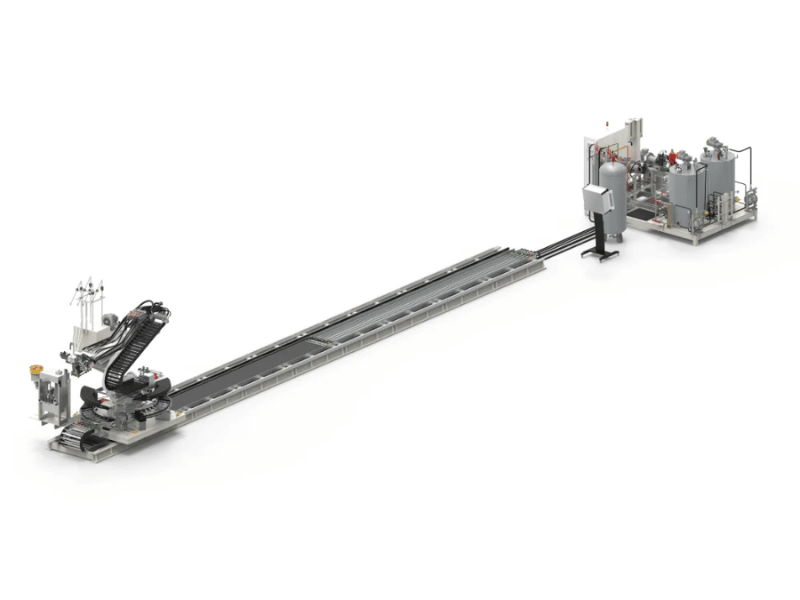
Most buyers turn to long-fiber injection because a part keeps failing. It cracks under load, warps in the field, or weighs too much for what it does. Long fiber injection (LFI) solves many of those problems by keeping reinforcing fibers long within the molded part. This guide walks through what it is, how it works, which fibers to choose, and how to design parts that actually get stronger from the fiber rather than fighting it.
View the Long Fiber Injection Molding (LFI) Solutions
Understanding Long Fiber Injection
Before we get into machines and molds, it helps to be clear about what makes long-fiber injection different from the reinforced plastics you may already run.
What Long Fiber Injection Really Means
Long-fiber injection molding produces thermoplastic parts in which the reinforcing fibers remain long, usually 10 to 25 mm, before processing. Compare that to standard short-fiber compounds, where fibers measure under 1 mm.
That length is the whole point. Long fibers overlap and tangle inside the part, forming a skeleton that carries the load. Short fibers act more like filler.
The plastic itself is a thermoplastic, often polypropylene or nylon. It melts, flows, and cools, so nothing chemically reacts the way it does in a thermoset process.
Why Manufacturers Use Long Fiber Reinforced Thermoplastics
The reason is simple: you get metal-like performance at plastic-like weight and cost. A long-fiber part can replace stamped steel or aluminum brackets and reduce weight by 30 to 50 percent.
You also gain toughness. Long fibers bridge cracks and resist impact far better than short-fiber grades. A part that would shatter holds together instead.
So the takeaway is this. If your part needs stiffness, impact resistance, and low weight all at once, long-fiber injection warrants a closer look.
Where Long Fiber Injection Fits Best
This process isn’t right for every part. It shines in specific places, and knowing where they are saves you money.
Typical Applications Across Industries
Automotive leads the field. Think instrument panel carriers, front-end modules, seat structures, and underbody shields. These parts take load and heat and need to stay light.
Outside of cars, you’ll see LFI in power tool housings, appliance frames, pallets, and structural enclosures. Anywhere a part must take abuse without adding weight, long fiber belongs in the conversation.
Sporting goods and agricultural equipment use it too, mostly for parts that flex hard and still need to survive years of rough handling.
When It Makes More Sense Than Standard Injection Molding
Reach for long fiber when stiffness and impact both matter, and short-fiber grades fall short. If your current part flexes too much or cracks at the corners, fiber length is often the fix.
It also makes sense when you want to consolidate parts. One molded long-fiber bracket can replace a steel assembly of three or four pieces, plus fasteners.
Skip it for thin cosmetic parts or simple low-load housings. There, the extra material and process care just add cost.
How the Long Fiber Injection Process Works
The molding looks familiar if you know injection molding, but a few details change everything. Here’s what actually happens.
From Pellets to Molded Part
Most shops run long fiber pellets, in which each pellet is a bundle of fibers, fully wetted with polymer, cut to length. These feed into the barrel like any other pellet.
The screw melts the plastic and moves it forward. The melt fills the mold under pressure, then cools and ejects. So far, standard stuff.
The trick is protecting fiber length through all of that. Every pinch point, sharp corner, and high shear zone chops fibers shorter. Your job is to keep them long.
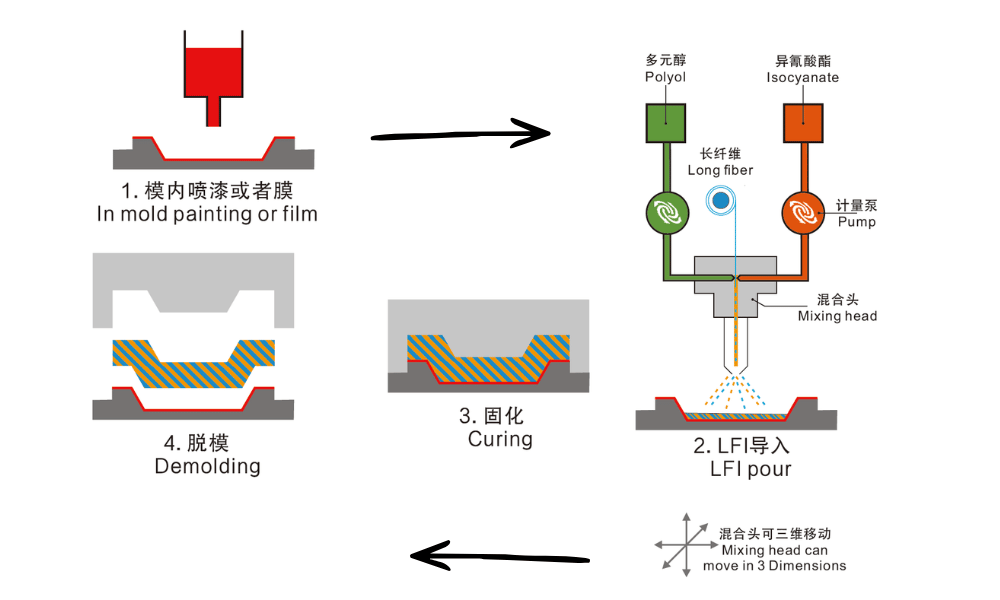
Long Fiber Injection vs. Traditional Injection Molding
Traditional molding uses short fibers or unfilled pellets and operates at high speed. Sharp screws, tight gates, and high shear are fine because there’s little fiber to protect.
Long fiber molding flips that mindset. You slow down, open things up, and treat the fibers gently. A standard high-shear screw will grind 25 mm fibers down to 2 mm, thereby wasting the whole benefit.
So the equipment is similar, but the settings and tooling are tuned for fiber survival rather than raw speed.
Process Steps That Need Tight Control
A few zones decide whether your part performs.
- Screw and barrel: Use a low-shear screw with a gentle compression ratio. This melts the plastic without shredding fibers.
- Gates and runners: Keep them generous and rounded. Narrow, sharp gates act like scissors on fiber.
- Injection speed: Run moderate, not maximum. Blasting the melt through the gate breaks fibers and creates flow lines.
- Back pressure: Keep it as low as the process allows. High back pressure is one of the biggest fiber-killers in the barrel.
Get these wrong, and you’ll mold a part that looks reinforced but performs like cheap, filled plastic.
Material Behavior That Engineers Need to Respect
The material doesn’t behave like neat plastic, and pretending it does leads to failed parts. Respect a few realities, and it rewards you.
Stiffness, Toughness, and Weight Savings
Long fibers raise stiffness sharply. A long-glass polypropylene can be three to four times stiffer than the unfilled grade.
Toughness is where long fiber really separates itself. The fibers bridge a forming crack and prevent it from propagating. That’s why these parts survive drops and impacts that snap short-fiber parts.
Weight savings come from doing more with less plastic. You can thin walls and still hit your stiffness target, which trims both mass and cycle time.
Fiber Choices: Glass, Carbon, and Others
Glass fiber is the default. It’s affordable, stiff, and tough, and it handles most automotive and industrial jobs without complaint.
Carbon fiber steps in when you need maximum stiffness at minimum weight. It costs far more, so it’s reserved for parts where weight savings pay for themselves.
Aramid and natural fibers show up in niche roles. Aramid adds impact and abrasion resistance; natural fibers serve cost- and sustainability-driven projects where peak performance isn’t the goal.
Carbon Fiber vs. Other Reinforcements
Carbon delivers the highest stiffness-to-weight ratio of the common fibers. For a stiff, light part, nothing else comes close.
But carbon is brittle in a way glass is not. It boosts stiffness more than it boosts impact toughness, so a glass part often survives a hard knock better than a carbon part.
Carbon also costs several times as much as glass. My honest advice: start with long glass, prove the part, and only move to carbon when weight targets force your hand.
Designing Parts and Tools for Long Fiber Success
Good material can’t save a bad design. The parts that perform are the ones engineered around how fibers behave.
Part Design Rules That Reduce Risk
Keep wall thickness even. Thick-to-thin transitions cause uneven cooling, warping, and fiber bunching.
Add generous radii at every corner. Sharp internal corners both concentrate stress and chop fibers as melt flows around them.
Watch your ribs. Ribs help with stiffness, but thick ribs create sink marks and trap fibers. Keep them at about 60-70% of the wall thickness.
Fiber Orientation and Its Effect on Stiffness
Here’s the part many engineers miss. Long fibers line up with the flow direction during filling. The part is stiffest along that flow and weaker across it.
That means gate placement controls strength. Put the gate where the flow runs along the main load path, and the fibers line up to help you.
Plan for it. If a part must carry load in two directions, you may need multiple gates or a redesign so flow and load agree. Ignore orientation, and you’ll get a part that’s strong in the wrong direction.
Mold Design and Processing Tips
Tooling choices make or break fiber length. A few practical moves help.
Use full-round or trapezoidal runners and fan or tab gates to ease the melt in gently. Avoid pin gates and submarine gates, which slice fibers.
Set the mold temperature on the warmer side for the resin. A warmer tool keeps the melt flowing longer, so fibers move smoothly rather than jamming or breaking.
Vent well. Long fiber melts trap air easily, and trapped air shows up as burns and weak spots. Good venting clears the path ahead of the flow.
So the takeaway is clear. Design the tool to protect fiber length and steer fiber direction, and the part will hit its numbers.
What’s Next for Long Fiber Injection
The fundamentals are stable, but the materials and methods continue to improve. Two or three shifts are worth watching.
Better Thermoplastics and Smarter Compounds
Resin suppliers continue to expand the range of long-fiber grades. Higher-temperature polymers like PPA and PPS now come in long-fiber form, opening up under-hood and electrical applications that used to require metal.
Compounders are also tuning fiber-to-resin bonding chemistry. Better coupling means more of the fiber’s strength actually reaches the part.
Sustainability Pressure and Material Recovery
Because these are thermoplastics, they can be reground and remolded, unlike thermoset composites. That’s a real advantage as recycling rules tighten.
The catch is that regrinding shortens fibers, so recycled content loses some performance. Smart shops blend a measured amount of regrind into non-critical parts and keep virgin material for structural ones.
Natural fiber and bio-based resin grades are also growing in popularity among buyers seeking lower carbon footprints.
New Applications Worth Watching
Electric vehicles are pushing demand fast. Battery trays, structural brackets, and enclosures all want light, stiff, tough parts, which is exactly LFI’s strength.
Beyond cars, watch construction, drone frames, and large industrial equipment. As long-fiber grades get tougher and cheaper, parts that once had to be made of metal keep moving to molded plastic.
Where to Go From Here
Long-fiber injection gives you stiffness, impact resistance, and weight savings in a single molded part, often at a lower cost than the metal assembly it replaces. The wins come when you protect fiber length through the process and design the part and tool around how fibers flow and orient.
Start by identifying one metal or short-fiber part that’s failing in terms of weight or durability. Run the numbers on a long glass grade first, place your gate along the main load path, and review your screw, gates, and back pressure for fiber survival. Walk through your specific part with a molding process specialist before cutting steel, and you’ll skip the costly trial-and-error that trips up most first projects.
Frequently Asked Questions
What is long-fiber injection molding, and how does long-fiber technology differ from short-fiber molding?
Long-fiber injection molding (LFI) is an injection molding process that uses pellets or granules containing long glass-fiber reinforcements to produce fiber-reinforced thermoplastic parts with superior strength and stiffness compared with conventional short-fiber molding. Unlike short fiber molding where fibers are typically <2 mm and tend to break into shorter lengths during melting and shear in the barrel, LFI preserves a significant fiber length—often several mm up to 12 mm or more—by using specialized feeders, lower shear profiles and modified injection molding machine components to keep the fiber length and therefore improve mechanical properties, impact resistance, and wear resistance.
How do compression and compression molding relate to long-fiber processes?
Compression and compression molding are used primarily for thermosetting materials such as SMC and sheet molding compounds, but the principles of compression also appear in some long-fiber hybrid processes. In compression molding, the material is placed in a mold cavity and shaped under low to high compression pressure; this can be combined with long glass fiber or prepreg feedstocks to create durable parts and body panels. For LFI, low-compression pressure variations during packing and controlled backpressure help maintain fiber integrity and allow the fibers’ structure to dissipate stress without sacrificing strength.
Can long-fiber molding produce body panels and complex parts with thin walls?
Yes. Long-fiber injection molding allows the creation of complex geometric structures, including body panels with thinner walls and added ribs and bosses. Long glass fiber and fiber compounds improve strength and stiffness, so parts can be made lighter with thinner walls while maintaining the material’s ability to withstand heavy or repeated impacts. The process also supports the addition of b-side geometry (such as ribs) and in-mold painting, enabling functional exterior panels and durable parts used in automotive injection molding applications.
What equipment considerations—such as the injection molding machine, nozzle, hopper, and barrel temperature—are important for processing long-fiber materials?
Processing long fiber compounds requires adjustments: the hopper and feeder must handle pellets or long fiber pre-dispersed compounds without causing fiber breakage; barrel temperature profiles should be optimized to melt the polymer resin without excessive shear; screw rpm and backpressure need to be reduced to keep the fiber length; and nozzle and mold cavity design must minimize additional fiber chopping. Lower shear screws, specialized dosing systems, and controlled barrel temperature zones help preserve mm-long fibers and maintain mechanical properties during the injection molding process.
How does fiber length (for example, 2 mm, 12 mm, or other lengths) affect mechanical properties such as strength, stiffness, and impact resistance?
Fiber length is one of the most significant variables controlling mechanical performance. Short fiber compounds (≈0.5–2 mm) offer moderate reinforcement, while long glass fibers (e.g., 12 mm or longer) provide much greater strength and stiffness because their longer length allows load transfer along the fiber and can create an internal skeleton within the polymer matrix. Longer fibers also improve impact resistance and wear resistance, helping materials withstand heavy or repeated impact without sacrificing strength. However, very long fibers require changes to the process and mold design to prevent fiber breakage and ensure proper flow in the mold cavity.
What are common defects in long-fiber molding related to shear, fiber breakage, and backpressure, and how can they be avoided?
Common defects include excessive fiber breakage from high shear and rpm, fiber separation or orientation issues, and poor filling due to high viscosity. High backpressure and aggressive screw designs shorten fiber length; excessive barrel temperature and shear degrade the polymer or resin. To avoid these issues, use low-shear screws or twin-screw feed systems designed for long-fiber pellets, reduce rpm and backpressure, optimize barrel temperature and nozzle design, and employ proper mold gating and venting to reduce flow-induced fiber breakage while achieving consistent fill of complex parts.
How do material choices—resin type, long glass fiber, fiber compounds, prepreg or SMC—affect LFI part performance and application?
The choice of polymer resin (PA, PPO, PP, PBT, etc.) combined with long glass fiber or other reinforcements determines final mechanical properties and processing conditions. Thermoplastics enable recyclability and in-mold painting; thermosetting materials such as SMC and prepreg sheets are used for high-temperature or structural compression molding. Long-fiber molding compounds offer higher strength and stiffness than conventional molding compounds, whereas short-fiber molding compounds are easier to process. Selecting the right resin and glass fiber content balances strength, impact resistance, wear resistance, and durability for specific injection molding applications.
Can long-fiber injection molding reduce labor costs and cycle times compared to alternatives such as manual layup or compression molding?
Yes. LFI can lower labor costs by automating the feeding of reinforced pellets into an injection molding machine and consolidating multiple operations into a single step—eliminating the manual layup required for prepreg or SMC. Cycle times depend on part geometry and cooling requirements, but are often shorter than compression molding for thermosets. LFI allows high-volume production of durable parts and LFT parts with consistent mechanical properties, making it an efficient choice when balancing production speed, material performance, and total cost of ownership.