
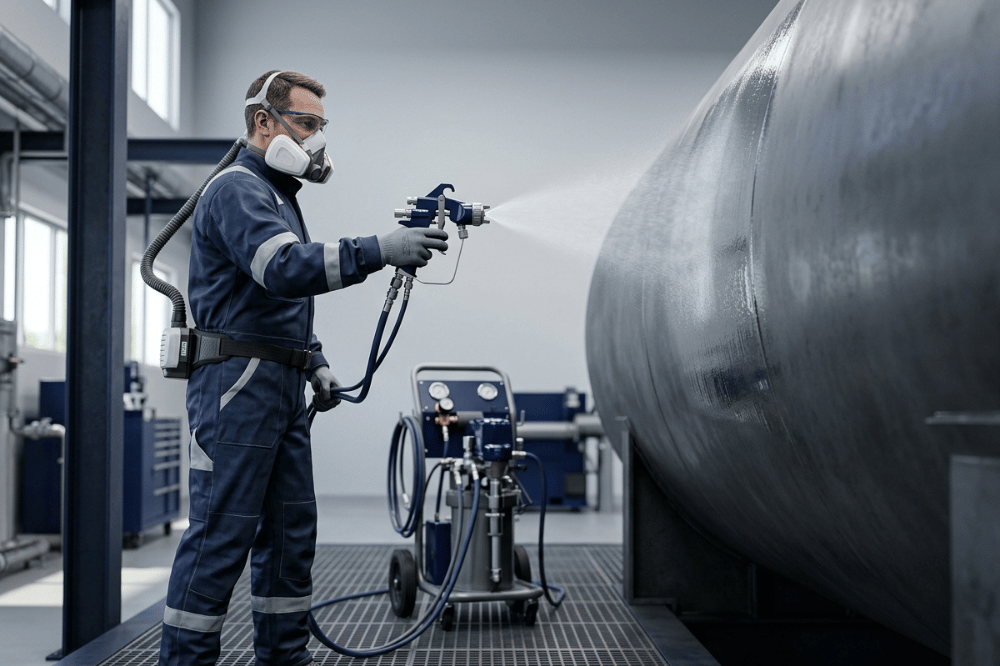
Polyurethane coatings resist moisture, chemicals, and abrasion better than most alternatives—but a durable finish depends on three things working together: the right chemistry (1K vs 2K, aromatic vs aliphatic), the right application equipment (plural-component proportioners, heated hoses, and the correct spray gun), and disciplined surface prep. Skip any one of them, and the coating fails early, no matter how good the material is. This guide walks through all three so you can spec a setup that actually holds up in the field.
Polyurethane coatings do one job exceptionally well: they take punishment. Forklift wheels, saltwater, UV, chemical splash—a properly applied polyurethane finish shrugs off conditions that strip other coatings down to bare substrate in a year or two.
But here’s the pattern anyone who spends time around this equipment learns fast: the chemistry gets most of the attention, while the equipment and the prep decide whether the job lasts decades or fails within months. A perfect coating sprayed through the wrong machine, at the wrong ratio, onto a dirty substrate is a failure waiting to happen.
This guide covers materials science, machinery, and the decision logic that ties them together. You’ll learn how to match chemistry to environment, which proportioning and spray equipment fits your workload, how to choose the right setup for your project, and how to avoid the prep mistakes that cause most coating failures.
What Are Polyurethane Coatings?
Polyurethane forms when an isocyanate reacts with a compound containing hydroxyl (–OH) groups, usually a polyol. That reaction builds long, cross-linked polymer chains, which give the cured film its toughness, flexibility, and chemical resistance.
How you deliver that reaction to the surface is where the practical choices start. The two biggest decisions are whether you run a one-component or two-component system and whether you need UV stability.
1K vs 2K Polyurethane Coatings
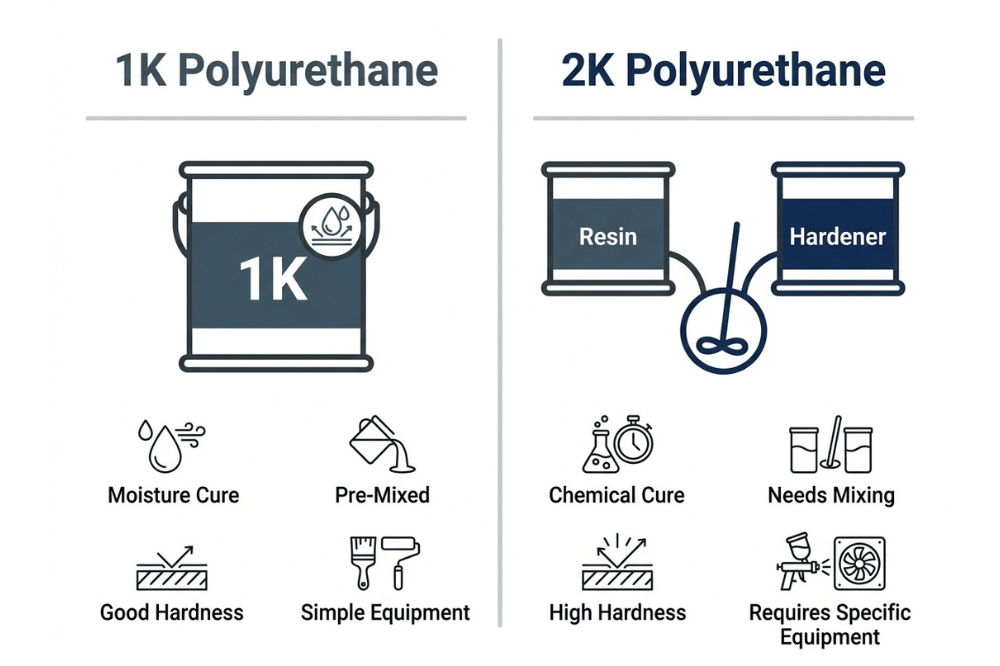
One-component (1K) polyurethanes come pre-mixed in a single container. They cure by reacting with airborne moisture or by solvent evaporation—no mixing, no ratio to manage. Two-component (2K) polyurethanes keep the resin and hardener separate until application, then cure via a chemical reaction. That yields a faster, harder, more chemically resistant film, but it requires precise mixing.
|
Factor |
1K Polyurethane |
2K Polyurethane |
|---|---|---|
|
Curing method |
Moisture or solvent evaporation |
Chemical reaction between resin and hardener |
|
Mixing required |
None—ready to use |
Precise ratio, mixed at application |
|
Cure speed |
Slower |
Faster |
|
Film hardness |
Moderate |
High |
|
Chemical resistance |
Good |
Excellent |
|
Equipment needs |
Airless or HVLP |
Plural-component proportioner |
|
Best for |
Low-volume work, simpler jobs |
Industrial and protective finishes |
For any serious industrial finish, 2K is the standard. The tradeoff is that you need equipment capable of holding the mix ratio precisely, batch after batch. Get the ratio wrong, and the coating stays tacky, cures brittle, or never fully hardens.
Choose 1K for simplicity and low volume; choose 2K when you need speed, hardness, and chemical resistance—and budget for the metering equipment it requires.
Aromatic vs Aliphatic: The UV Decision
This distinction matters more than most people expect, and it comes down to sun exposure.
Aromatic polyurethanes are cheaper and cure hard, but they aren’t UV-stable. Put them in sunlight, and they yellow and chalk within months. That makes them ideal for indoor work, base coats, and anything buried under a topcoat—such as truck bed liners, below-grade waterproofing, and primer layers.
Aliphatic polyurethanes hold their color and gloss under UV for years. They cost more, but they’re the correct choice for any exposed outdoor topcoat where appearance and long-term stability matter—bridges, exterior steel, architectural finishes.
A common real-world stack is an aromatic base for building and adhesion, topped with an aliphatic layer for weather resistance. You get the economy of one and the durability of the other.
There’s also a 1K variant worth knowing: moisture-cure polyurethanes use ambient humidity to trigger the reaction. They’re forgiving on damp substrates but cure faster in high humidity and slower in dry air—manageable in a controlled shop, something to plan around outdoors.
If it sees sunlight, spec aliphatic. If it’s indoors or buried, aromatic saves money without a performance penalty.
Where Polyurethane Coatings Work Best
The same base chemistry can be tuned for very different demands. The key is matching the coating type and equipment to the application. Here’s how the major uses line up.
|
Application |
Best Coating Type |
Typical Equipment |
Key Performance Need |
|---|---|---|---|
|
Industrial & architectural flooring |
2K polyurethane |
Plural-component proportioner + spray gun or roller |
Abrasion and chemical resistance |
|
Marine & offshore |
Aromatic base + aliphatic topcoat |
Heated plural-component system |
Corrosion and UV resistance |
|
Automotive & truck bed liners |
Fast-set 2K or hybrid |
High-pressure proportioner + purge gun |
Impact resistance, fast return to service |
|
Infrastructure (bridges, steel) |
Aliphatic topcoat system |
Airless or plural-component spray |
Weathering, long maintenance cycles |
|
Wood finishing |
1K or fine-finish 2K |
HVLP |
Smooth appearance, scratch resistance |
A quick note on infrastructure: recoating a bridge is expensive and disruptive, so a coating that pushes the maintenance cycle from 5 years to 15 or 20 pays for itself many times over. That long-cycle economics is exactly why aliphatic polyurethane dominates exposed structural steel.
Start with the environment and performance need, then let those drive both the coating chemistry and the equipment—not the other way around.
What Equipment Applies Polyurethane Coatings?
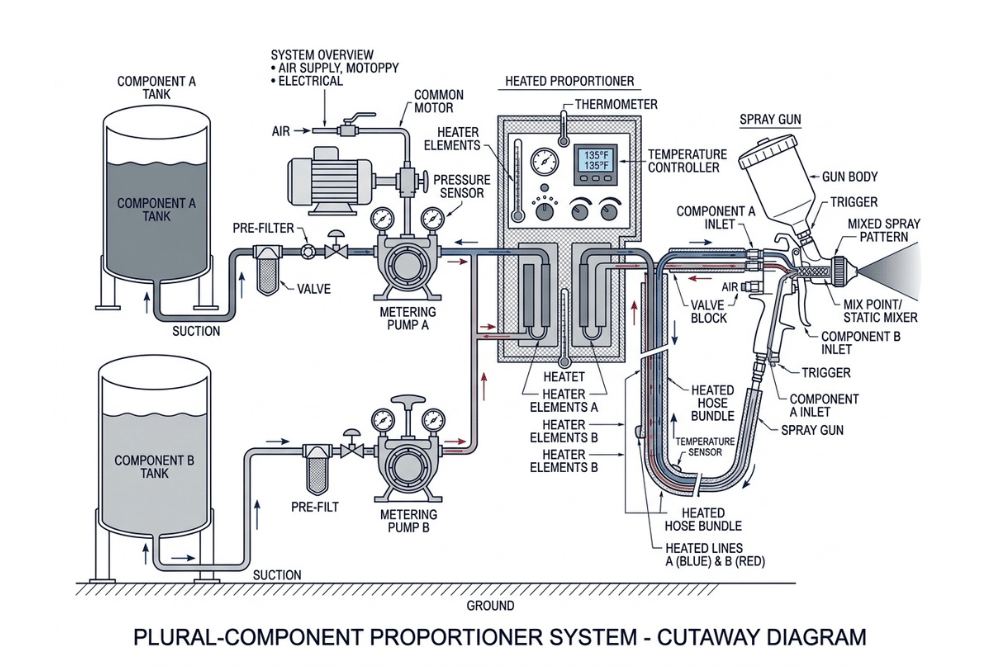
For fast-set 2K coatings, you can’t mix by hand. Some systems start reacting within seconds of the two components meeting, which means mixing has to happen at the gun, on demand, at a precise ratio. That’s the job of a plural-component proportioner and the system built around it.
Plural-Component Proportioners
A proportioner pumps the two components separately, measures them to an exact ratio, and combines them only at the point of application. This does two things at once: it keeps the material from reacting inside the lines, and it guarantees the ratio holds consistently from the first square foot to the last.
Ratio control is the single most important spec here. A 2K system rated at 1:1 or 2:1 needs to hold that ratio under real pressure and flow conditions, not just on paper. Drift off ratio and finished-product consistency fall apart—soft spots, uneven cure, failed adhesion.
Heated Proportioners
Most 2K coatings are too thick to atomize properly at room temperature. Heated proportioners warm each component to a target temperature, dropping viscosity into the right window for clean mixing and spraying.
Temperature control also stabilizes the process. When both components sit at the correct, consistent temperature, the ratio and reaction behave predictably. Cold material sprays heavily and mixes poorly; overheated material can react too early. The heater isn’t a convenience—it’s part of the ratio control system.
Metering Pumps
The metering pump is the heart of the machine. Whether it’s a positive-displacement piston or a gear-metering design, its job is to deliver a fixed volume per stroke or revolution so both components arrive at the mix point in the correct proportion.
Good metering holds the ratio even as pressure fluctuates during triggering. That’s what separates a machine that produces a consistent film from one that drifts as the operator works.
Heated Hoses
The material has to stay at the temperature all the way to the gun. Heated hoses maintain that temperature across the full run, preventing two failure modes: viscosity climbing back up (poor atomization and clogging) and—with reactive systems—material setting before it reaches the substrate. On long hose runs, hose temperature control is what keeps the spray pattern stable from machine to tip.
Spray Gun Types for Polyurethane Delivery
The gun you choose depends on the chemistry’s cure speed and the volume of the job.
- Air-purge guns. After each trigger release, a blast of compressed air clears mixed material from the chamber before it sets. Common for fast-set 2K coatings, where even a short pause would let the material cure inside the gun. Clean and reliable for stop-start work.
- Mechanical-purge guns. A physical rod pushes through the mixing chamber to clear it on each cycle. These handle very high output and suit continuous, high-volume production. Maintenance is a bit more involved, but the throughput justifies it.
- Airless sprayers. For simpler 1K polyurethanes, where you want a smooth, even finish. High-pressure forces material through a small tip to atomize it—good build rate, minimal overspray, no mixing complexity.
- HVLP systems. High-Volume Low-Pressure guns trade transfer speed for control and fine finish. The right tool for detail work, furniture, and cabinetry, where finish quality beats square footage per hour, with lower overspray and less wasted material.
Match the gun to cure speed and volume—purge guns for fast-set 2K, airless for smooth 1K, HVLP for precision finishing.
How to Choose the Right Setup
There’s no universal setup. An indoor warehouse floor and a salt-exposed bridge need different chemistry and different machinery, and treating them the same is how jobs fail early. Work through the decision in this order.
1. Match the chemistry to the environment
Exposed to the sun? Aliphatic topcoat. Indoor or buried? Aromatic will do. Need speed and hardness? Go 2K. Simpler, lower-volume job? 1K may be enough.
2. Size the pump to the job
Match the proportioner output and pump capacity to the square footage and cure speed of your material. A fast-set coating on a large floor requires sufficient throughput to maintain a wet edge. Undersize the pump, and you get lap marks and inconsistent film.
3. Match the gun to the cure speed
Fast-set 2K wants an air-purge or mechanical-purge gun. Smooth 1K finishes suit airless. Detail and furniture work call for HVLP.
4. Factor in heating and hose length
Thick 2K materials and long hose runs both demand heated components. If your material needs temperature control to atomize—and most 2K coatings do—the heater and heated hose are non-negotiable, not upgrades.
5. Account for the maintenance workload
A high-output, fast-set production line needs daily attention to seals, filters, and flushing. A lower-volume 1K airless setup is far lighter to maintain. Factor labor into your equipment decision, not just the purchase price.
Align chemistry, pump capacity, gun type, heating, and maintenance load, and you get a finish that lasts decades instead of years.
Surface Preparation: Where Most Failures Start
No coating and no machine can rescue a bad substrate. Most coating failures trace back to prep, not product.
- Abrasive blasting. Sandblasting or grit blasting creates the surface profile—the microscopic roughness that the coating grips. On steel, especially, profile depth is a spec, not a suggestion. Too smooth and the coating peels; correct profile, and it locks in.
- Concrete grinders and shot blasters. For floors, these open the concrete surface, remove laitance and old coatings, and create the texture polyurethane needs to bond. Shot blasters are standard for large floors—fast and consistent.
- Moisture meters. Polyurethane and trapped moisture don’t mix. Coating over a substrate that’s too wet leads to bubbling, blistering, and delamination. A moisture meter is cheap insurance against an expensive callback.
- Chemical cleaners and degreasers. Oil, grease, and silicone cause fish-eyes and delamination. On any surface that’s seen oil or hydraulic fluid, degreasing is non-negotiable.
Common failure causes to check before you spray
Most bond failures aren’t mysteries—they’re predictable. Watch for wrong profile depth, moisture in concrete, oil contamination, inadequate dust removal, coating applied outside the temperature window, and blown recoat intervals. Catch these upstream, and the vast majority of callbacks disappear.
Common Application Mistakes to Avoid
|
Mistake |
Why It Matters |
What to Do Instead |
|---|---|---|
|
Mixing 2K by hand or with the wrong machine |
Off-ratio material cures tacky or brittle |
Use a proportioner that holds ratio under real flow |
|
Spraying cold, thick material |
Poor atomization, heavy and uneven film |
Heat components and hoses to the target viscosity window |
|
Using aromatic coating on a sun-exposed topcoat |
Yellowing and chalking within months |
Spec aliphatic for any UV-exposed surface |
|
Coating over a wet or unprofiled substrate |
Bubbling, blistering, delamination |
Verify moisture and profile before committing |
|
Skipping degreasing on oily surfaces |
Fish-eyes and adhesion failure |
Degrease after blasting, before coating |
|
Undersizing the pump for the job |
Lap marks from losing the wet edge |
Match output to area and cure speed |
|
Neglecting flushing on 2K machines |
Cured material clogs lines and guns |
Flush on schedule with a compatible solvent |
Safety and Maintenance Requirements
Isocyanates demand respect. The equipment that protects your crew and keeps machines running is part of the job spec, not an add-on.
Safety essentials
Supplied-air respirators are standard for spraying isocyanate-containing materials—cartridge respirators aren’t adequate for many of these applications. Add chemical-resistant suits, gloves, and eye protection. Outdoors, containment systems and overspray screens keep material off vehicles and neighboring structures, helping you stay compliant. In confined spaces like tanks, hulls, and pits, you need forced ventilation to clear solvent vapor and explosion-proof lighting to remove ignition risk. This is life-safety equipment, full stop.
Maintenance that prevents downtime
Reactive materials are unforgiving to neglected equipment, but a little discipline prevents most problems.
- Throat seal liquid (TSL). Isocyanate crystallizes on exposed pump shafts. TSL keeps a wet barrier over the shaft, preventing the crystallization that scores seals and wrecks pumps. Keep the reservoir topped off—it’s the cheapest pump insurance there is.
- Solvent flushing. During downtime, flush the lines to clear reactive material before it sets. Skip this on a 2K machine, and you’ll be cutting cured polyurethane out of a hose.
- Filter checks and nozzle replacement. Clogged filters starve the pumps and throw off the ratio. Worn tips distort the spray pattern and waste material. Quick, regular checks prevent slow, hard-to-diagnose quality problems.
Also worth noting: dehumidifiers and climate control maintain the curing conditions the coating needs, preventing the blushing or hazing that humidity can cause—especially important in controlled-shop finishing.
Frequently Asked Questions
Can you spray 2K polyurethane with a standard airless sprayer?
Generally, no—not for fast-set 2K. A standard airless sprayer has no way to meter two components at a precise ratio or mix them at the gun, and the reactive material will cure inside the machine. Fast-set 2K needs a plural-component proportioner with a purge gun. Some slow-cure 2K systems can be batch-mixed and run through an airless setup within their pot life, but for production work and consistent results, a proportioner is the right tool.
What is the difference between a plural-component proportioner and a standard sprayer?
A standard sprayer pushes a single, pre-mixed material to the gun. A plural-component proportioner pumps two materials separately, measures them to an exact ratio, and combines them only at the point of application. That on-demand mixing is what makes fast-set 2K coatings possible—it prevents the components from reacting in the lines while ensuring ratio consistency throughout the job.
Do polyurethane coatings need heated hoses?
Most 2K polyurethanes do. They’re too thick to atomize cleanly at room temperature, and the material can cool and thicken on its way to the gun, especially on long hose runs. Heated hoses maintain the temperature—and viscosity—steady from the machine to the tip, keeping the spray pattern consistent. Simpler 1K coatings sprayed through airless equipment often don’t require them.
How do you choose the right spray gun for polyurethane?
Match the gun to the cure speed and volume. Fast-set 2K needs an air-purge or mechanical-purge gun so material can’t cure in the chamber between triggers. Smooth 1K finishes suit airless sprayers. Detail and finish work—furniture, cabinetry—call for HVLP, which trades speed for control and a fine finish with low overspray.
Is polyurethane more durable than epoxy for industrial floors?
It depends on the failure mode you care about. Epoxy is harder and often bonds aggressively, but it’s brittle and yellows badly under UV. Polyurethane is more flexible, more abrasion- and impact-resistant, and UV-stable. A very common approach is an epoxy base coat for build and adhesion with a polyurethane topcoat for wear and UV resistance—you get the strengths of both.
Why does polyurethane sometimes bubble or crater during application?
Usually moisture or contamination. When an isocyanate reacts with moisture in the substrate or air, it releases CO₂, which appears as bubbles or pinholes. Cratering and fish-eyes typically come from oil, silicone, or grease on the surface. The fix is upstream: dry substrate, clean surface, and controlled humidity during cure.
How long does industrial polyurethane take to reach full cure?
Most systems are tack-free in a few hours and walkable within a day, but full chemical cure—final hardness and chemical resistance—typically takes 5 to 7 days. Temperature and humidity shift that timeline. Don’t return a floor to heavy chemical or traffic service until it’s fully cured.
Getting the Whole System Right
Polyurethane coatings deliver decades of protection when three things line up: chemistry matched to the environment, equipment sized and heated for the material, and surface prep done without shortcuts. Miss any one and even the best coating fails early—which is why the equipment and prep deserve as much attention as the material itself.
The practical path is simple: spec the chemistry to the exposure, size the proportioner and gun to the job, verify the substrate before you spray, and build maintenance discipline into daily operations. Do that, and you spec a setup that produces consistent, long-lasting finishes instead of callbacks.
That consistency starts with the equipment. Foam and coatings only perform as well as the metering, heating, and dispensing systems delivering them—stable ratios, tight temperature control, and repeatable output run after run. If you’re planning a new line or upgrading your application setup, talk with our team about high-precision proportioning and dispensing equipment engineered for polyurethane systems. The right machinery is the difference between a finish that meets its spec for 20 years and one that quietly falls short.