
Most equipment decisions that go wrong in polyurethane processing don’t fail because the buyer chose a bad machine. They fail because the buyer chose the right machine for the wrong operation. Two systems can list nearly identical pressure ranges and output figures on paper, then produce completely different results once you push them through a real production shift. The gap lives in the details a quote never reveals: how metering pumps hold ratio under back-pressure, whether the mixing head design clogs or self-clears, how much cleaning downtime the system actually adds per cycle, and whether the supplier can get you critical replacement parts in days or in months.
This is not a guide about what polyurethane machines are. It’s about which one belongs in your plant, and why — and what separates a sound procurement decision from one that looks fine on paper until your first high-volume run.
What a Polyurethane Molding Machine Actually Does
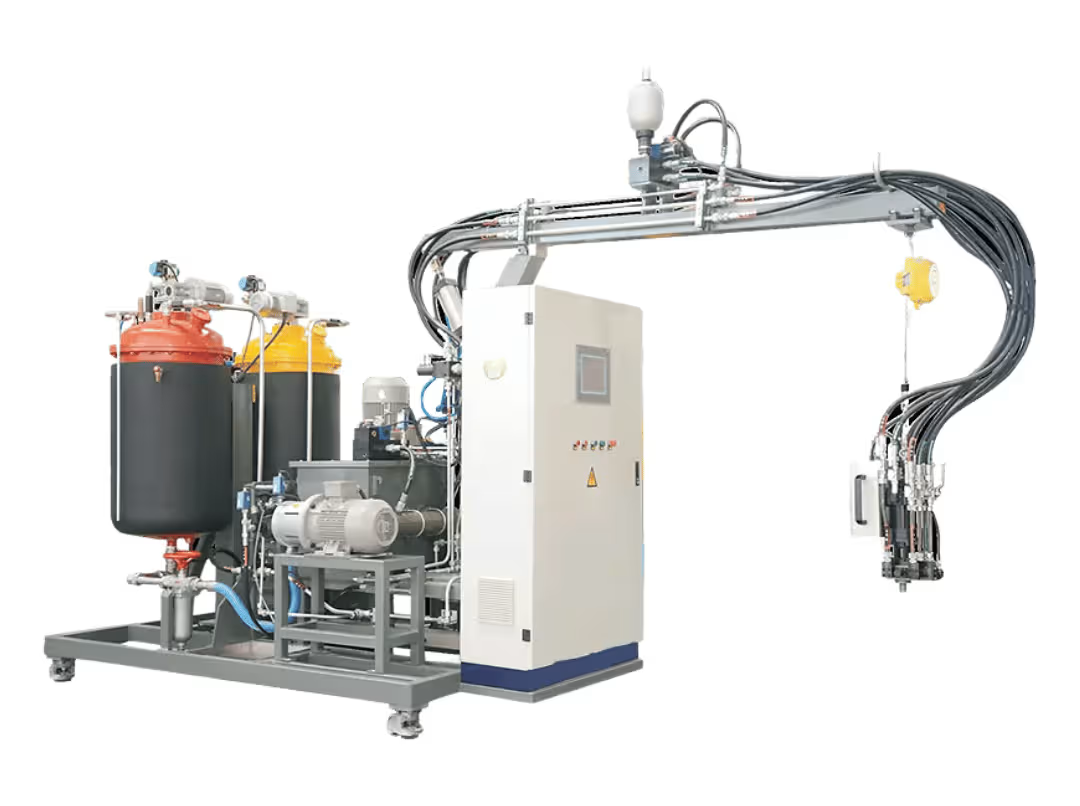
A polyurethane molding machine combines two reactive liquid chemicals — a polyol and an isocyanate — in a precisely controlled ratio, under set temperature and pressure conditions, and delivers the blended mixture into a mold or onto a surface before the reaction completes.
The job is not mixing in any general sense. The job is controlling the reaction with enough precision that the foam or elastomer produced on shot 5,000 is mechanically the same as the one produced on shot 5. Density, hardness, cell uniformity, and surface quality all flow directly from whether the machine holds its parameters consistently across a shift, a day, and a production run measured in thousands of cycles.
A ratio drift of a few percent doesn’t produce slightly different foam — it can shift seat hardness outside tolerance, leave voids in insulation panels, or cause skin-layer failures in integral skin parts. What looks like a quality problem is almost always a machine control problem. That’s the lens to bring to every spec comparison.
How the Process Works — and Where Cheaper Machines Cut Corners
The five stages of a polyurethane system form a chain where weakness at any point undermines everything downstream.
Component storage and temperature control
Polyol and isocyanate sit in separate, temperature-controlled tanks. This step matters more than most buyers appreciate. The viscosity of these chemicals shifts with temperature, and viscosity changes directly affect how accurately the metering pumps deliver each component. A machine with inadequate tank or line temperature control doesn’t need a malfunction to produce variable foam — the ambient temperature in your plant on a winter morning versus a summer afternoon is enough to create inconsistency if the system isn’t holding its setpoints tightly.
Metering and pumping
High-precision metering pumps draw each component from its tank and deliver it at the target ratio. This is the most consequential hardware in the system. The relevant question isn’t rated accuracy at ideal conditions — it’s how the pumps hold ratio accuracy as back-pressure varies and as chemical viscosity shifts across a shift. Cheaper machines compromise here specifically because pump quality is not visible in a demo and hard to compare without running real production.
Mixing
The accurately metered streams enter the mixing head and combine. In high-pressure systems, the two streams collide under impingement — high-velocity turbulence that achieves rapid, thorough blending without mechanical parts in the mix stream. In low-pressure systems, a mechanical stirrer does the work. The mixing step determines cell structure uniformity. Inconsistent mixing produces foam with variable density pockets, which shows up as scrap or customer returns on tight-tolerance products.
Dispensing
The reactive blend leaves the mixing head and enters a mold or moves onto a surface. The dispensing format — shot-based for discrete parts, continuous for insulation board or laminated panels — has to match your product type before any other machine comparison makes sense. A machine optimized for shot dispensing won’t serve a continuous pour line well, and vice versa.
Curing and demolding
The chemistry continues after dispensing. Foam expands and cures to its final form, then the part is demolded. Cure time depends on formulation and part geometry. A machine that meters and mixes perfectly still produces scrap if mold flow, venting, and cure parameters aren’t right — which is exactly why commissioning support from the supplier matters as much as the hardware specification. Dialing in a new machine on a new product in your actual plant environment requires expertise. If the supplier doesn’t provide meaningful commissioning, that expertise gap falls entirely on you.
High-Pressure vs Low-Pressure: The Decision That Shapes Everything Else
This comparison is often presented as a simple two-column table. In practice, it’s a set of trade-offs that have to be evaluated against your actual production conditions. The question isn’t which type is better — both are capable systems in the right context. The question is which one fits your operation right now, and which costs you more in the version of your business that actually exists.
Who should choose high-pressure
High-pressure systems use impingement mixing at 1,500–2,500 PSI. The result is a finer, more uniform blend than a mechanical stirrer can achieve, which produces tighter cell structure consistency across large runs. The mixing head self-purges after each shot, eliminating the need for solvent flushing and reducing cleaning-related downtime to near zero.
High-pressure is the correct choice when:
- You run high volumes and tight tolerances — automotive seating, integral skin components, high-specification flexible or rigid foam
- Your production is continuous or near-continuous, where cleaning cycles on a low-pressure system would interrupt throughput
- Your workforce can support a more sophisticated system, or you’re willing to invest in proper operator training
- The total cost of ownership matters more than the purchase price — at volume, the savings on cleaning time, solvent, and waste material typically justify the higher upfront cost
Who should choose low-pressure — and when that’s the smarter call
Low-pressure machines mix below 500 PSI using a mechanical stirrer. They cost less to buy and less to maintain. The mixing head requires solvent or air flushing after use, which generates chemical waste, adds a cleaning step to every cycle, and creates recurring downtime that most buyers underestimate when calculating operating cost.
Low-pressure is the correct choice when:
- Your volumes don’t justify the high-pressure investment — running a few hundred parts per week through a high-pressure system means you’re paying for capability you’re not using
- You’re in R&D, prototyping, or formulation development, where flexibility and low capital outlay matter more than throughput speed
- Your product tolerances are loose enough that minor batch-to-batch variation is acceptable
- You run filling, potting, and custom pours where the application itself doesn’t demand impingement mixing quality
- Your team has limited technical experience and a mechanically simpler system is more manageable
The mistake that costs plants the most is buying for the operation they intend to have rather than the one they’re actually running. A startup that commits to high-pressure equipment before building volume is locking up capital in capacity it can’t use. A growing manufacturer that stretches a low-pressure machine through 24-hour production runs into a bottleneck and pays for it in scrap and cleaning labor instead.
The hidden operating cost that changes the comparison
Cleaning downtime is real money that doesn’t appear on a spec sheet. A low-pressure machine running three shifts per day with a five-minute solvent flush per cycle, at 10 cycles per hour, accumulates a significant maintenance burden over a year — in labor time, solvent consumption, and waste disposal. High-pressure systems eliminate most of that. At volume, the cleaning differential alone can represent a total cost of ownership argument for high-pressure even when the purchase price difference seems hard to justify.
|
Factor |
High-Pressure |
Low-Pressure |
|---|---|---|
|
Operating pressure |
1,500–2,500 PSI |
Below 500 PSI |
|
Mixing method |
Impingement |
Mechanical stirrer |
|
Consistency over long runs |
Excellent |
Drifts over time |
|
Cleaning |
Self-purging |
Solvent/air flush required |
|
Chemical waste |
Minimal |
Higher |
|
Cycle speed |
Faster |
Slower |
|
Upfront cost |
Higher |
Lower |
|
Operator skill required |
Higher |
Lower |
|
Best fit |
Volume, tight tolerance, continuous |
Small batch, R&D, potting, varied formats |
Matching Machine Type to Your Products and Production Volume
The right machine for your plant comes from the intersection of what you make and how much of it you run — not from industry category labels.
High-volume, tight-tolerance parts. Automotive seat cushions, headrests, integral skin components, and high-specification upholstered foam all have rejection criteria that demand consistent mixing. A ratio drift that’s barely noticeable in a low-tolerance product means scrap on these. High-pressure systems with strong metering accuracy are not optional here — they’re the only format that protects you at scale.
Continuous-pour production. Insulation panels, laminated board, and pipe insulation are continuous-format products. High-pressure equipment designed for sustained output is the correct choice. A low-pressure system with flushing cycles can’t maintain the uninterrupted pour that continuous production requires.
Short runs, varied products, or contract manufacturing. A shop running five different specialty foam products across a week, or doing potting and filling work across varied formulations, often gets better value from a low-pressure machine. The upfront cost is lower, changeover doesn’t require high-pressure system re-commissioning, and acceptable consistency for variable runs is achievable.
Early-stage operations and R&D. Proving out formulations, testing demand, or developing new products — the right time to stay on low-pressure. You have flexibility, manageable capital exposure, and the ability to scale to high-pressure later when volume justifies it. Scaling up is a straightforward progression. Buying over-specced equipment and then having it sit at low utilization drains capital and generates maintenance costs without the production output to offset them.
The Components That Determine Whether Your Machine Earns Its Keep
Two machines at the same headline specification can produce very different foam under production conditions. The gap isn’t in the exterior or the control panel — it’s in these components.
Metering pumps — the ceiling on everything else
The metering pump system determines your ratio accuracy, and ratio accuracy determines the ceiling on foam quality. The question that matters isn’t the rated accuracy under ideal conditions — it’s how the pumps hold ratio as back-pressure changes when a mold partially fills, as chemical viscosity drifts across a temperature shift, and after months of continuous use. Cheaper machines routinely cut costs on pump quality because it’s invisible in a demonstration and doesn’t show up until you’re in full production. This is the single place most worth pressing a supplier on.
Mixing head design — where chemistry meets reliability
The mixing head is where the reaction starts. A well-designed high-pressure head delivers consistent impingement, self-clears reliably after each shot, and maintains its geometry through years of production. A poorly designed head clogs, produces uneven blends, or begins leaking at seals before you’ve reached the warranty period. Mixing head quality has more influence on foam cell uniformity than almost any other variable. Ask about head materials, internal geometry, expected service life under your production volume, and the cost and availability of replacement components.
Temperature control — the variable that undermines consistency invisibly
Chemical viscosity changes with temperature, and viscosity affects how accurately pumps deliver each component. A machine that can’t hold tank and line temperatures to tight setpoints will produce variable foam without any visible malfunction — the variation gets attributed to formulation or operator error when it’s actually an equipment limitation. Ask about the temperature control range, stability across a full shift, and behavior during summer and winter ambient conditions. This is a common source of “the machine was working fine last week” production problems.
PLC and automation — repeatability without relying on the operator
A capable PLC lets you store formulation recipes, lock control parameters, and repeat results independent of which operator is running the machine on which shift. For operations running multiple products, automation isn’t a luxury — it’s the mechanism that prevents recipe drift and changeover errors. When evaluating PLC systems, look at how easily recipes are stored and recalled, how parameter deviations are flagged, and whether the system supports remote monitoring or diagnostics.
Dosing accuracy — the output of everything working together
Dosing accuracy is what you get when pumps, temperature control, and mixing work in concert across a real production run. When evaluating any machine, ask to see consistency data over an extended run under representative production conditions — not a single ideal sample or a demonstration pour. Repeatability across volume is the only relevant measure.
Applications: What Each Industry Demands From the Machine
The value of looking at applications is not the list itself — it’s understanding how each production context changes what machine capability matters most.
Automotive. Tight tolerances, high volume, and demanding quality standards. Foam that falls outside hardness or density spec becomes scrap or a warranty issue at the OEM level. This sector nearly universally runs high-pressure, with strong metering accuracy, reliable automation, and close commissioning support. If you’re entering automotive supply, the machine spec is not a cost optimization question.
Furniture and bedding. High production volumes, consistency matters for comfort and long-term durability, but tolerances are typically wider than automotive. High-pressure systems dominate at volume. The specific configuration — shot-based for individual cushions, continuous for slab foam — depends on your product format more than the furniture category.
Construction insulation. Rigid foam boards and continuous insulation products demand uninterrupted pour and stable rigid-chemistry handling. High-pressure systems built for continuous output are the right match. Formulation chemistry for rigid foam differs from flexible applications, so confirm the machine handles your specific system before purchase.
Footwear. PU soles run at high volume with repeatable density and surface quality requirements. Shot-to-shot dosing accuracy matters on tooled molds where underfill or overfill creates rejection. High-pressure with reliable metering suits this application.
Appliances. Refrigerator and freezer insulation panels need consistent density fill to meet both thermal performance and structural requirements. Missed fills or variable density compromise the product. High-pressure precision is standard in this segment.
The pattern across most volume manufacturing is a pull toward high-pressure. Low-pressure holds its ground in specialty, prototype, and lower-volume work — but the decision should follow your product’s requirements, not the industry category label.
What to Verify Before Comparing Prices
There are questions that should be answered before you look at a single line-item cost. These establish whether a machine can do your job — everything after that is about whether the value matches the price.
Required output. Define your throughput in concrete terms — parts or kilograms per shift, per day. The machine should meet that number with margin, not at its rated limit. Equipment running at maximum capacity continuously fails faster and produces less consistent output.
Product type and dispensing format. Flexible foam, rigid foam, integral skin, elastomer — and shot-based or continuous pour. These two parameters together establish the machine category before anything else.
Formulation flexibility. If your product mix will expand, confirm the machine handles the range of formulations, additives, and pigments you plan to run. Compatibility with your planned future chemistry is worth verifying before purchase rather than discovering after.
Spare parts. Ask specifically about lead times for metering pump components, mixing head parts, and seals. A machine that goes down while you wait six weeks for a spare pump costs far more than the upfront price difference between a well-supported and a poorly-supported supplier. Regional parts availability matters.
Commissioning. What does the supplier actually do at installation — and how do they support startup on your specific product and formulation? A machine that isn’t properly commissioned for your application will produce unstable output from day one, and that’s not a machine problem — it’s a support gap.
After-sales coverage. Technical response time, remote diagnostics capability, and regional service coverage. This is the part of the purchase that determines your exposure over the machine’s operating life, and it rarely appears on any specification document.
Buyer Mistakes That Show Up in Plant Performance
These patterns appear consistently in purchases that didn’t work out.
Price as the primary filter. The lowest quote typically reflects trade-offs in pump quality, mixing head design, or support capability — trade-offs that appear as downtime, scrap, and maintenance cost rather than purchase price. Total cost of ownership over three to five years is a more honest comparison than the purchase order.
Underestimating cleaning downtime. Buyers running low-pressure machines through high-volume production consistently underestimate how much the flush-and-clean cycle adds to their operating cost across a year. Calculate it explicitly: cleaning time per cycle, cycles per day, solvent consumption, waste disposal. That number changes the low-pressure vs high-pressure comparison at volume.
Scrap from inconsistent mixing. Variable foam that’s just outside tolerance doesn’t always get caught at the machine — it shows up downstream, as reject parts, warranty returns, or customer complaints. Inconsistent mixing is frequently misidentified as a formulation or operator problem. If scrap rates are higher than expected and the formulation hasn’t changed, the machine is usually worth investigating first.
Overbuying specification. High-pressure, high-automation equipment purchased for production volumes that don’t justify it consumes capital without generating the throughput advantage those systems are designed to deliver. The machine sits underutilized, maintenance costs run against lower output, and the payback calculation that justified the purchase doesn’t materialize.
Skipping formulation compatibility. A machine proven on one formulation chemistry may need significant adjustment — or may be fundamentally unsuited — for another. If your product mix will change, get explicit confirmation of compatibility across every formulation you plan to run, not just the one shown in the demonstration.
Treating a demo as proof of production stability. Lab or demo conditions are controlled. Your floor, with your operators, your chemicals at your plant temperature, running your volume — that’s a different environment. Ask to see consistency data from an extended production run on comparable chemistry, and ask for references from customers running a similar application.
Questions That Separate Serious Suppliers From Everyone Else
- What ratio accuracy do the metering pumps hold under varying back-pressure and across the viscosity range of my formulations?
- How is the mixing head designed internally, and what is the expected service life under my target production volume?
- What is the temperature control stability across a full production shift and across seasonal ambient variation?
- Can the PLC store and lock multiple formulation recipes, and how are parameter deviations flagged?
- What is the realistic sustained output for my specific product type and dispensing format?
- Which formulation chemistries and additive systems has this machine been proven to run in production?
- What are the actual lead times on critical spare parts — metering pump components, mixing head elements, seals?
- What does commissioning include, and how does the supplier support startup on a new product or formulation?
- What after-sales response time and regional service coverage can I expect in practice?
- Can you provide consistency data from a production run on comparable chemistry, and references from customers in a similar application?
Pre-Purchase Buyer Checklist
- Required output volume defined in concrete terms and matched against machine capacity with margin
- Machine confirmed suited to your foam type and dispensing format (shot-based vs continuous)
- High-pressure vs low-pressure decision evaluated against volume, tolerance, operator skill, and total operating cost
- Metering pump ratio accuracy verified under varying back-pressure and viscosity — not just rated specs
- Mixing head design, materials, and expected service life confirmed
- Temperature control range and shift-to-shift stability confirmed
- PLC recipe storage, parameter locking, and deviation alerting reviewed against your product mix
- Formulation compatibility confirmed across all chemistries you plan to run
- Cleaning and changeover downtime calculated as part of operating cost comparison
- Spare parts lead times confirmed for critical components
- Commissioning scope agreed in writing, including startup on your specific product
- After-sales support, response time, and regional service coverage confirmed
- Consistency data over a production run and industry-relevant references reviewed
Any unchecked item is a conversation to finish before the contract is signed, not after a line goes down.
FAQ
What is the difference between a high-pressure and low-pressure polyurethane molding machine?
High-pressure machines mix polyol and isocyanate through impingement at 1,500–2,500 PSI, achieving a fine, uniform blend and self-purging the mixing head after each shot. Low-pressure machines use a mechanical stirrer below 500 PSI, cost less upfront, require solvent flushing between cycles, and show more consistency drift over long runs. High-pressure suits volume production and tight tolerances; low-pressure suits small batches, R&D, and applications where lower capital cost outweighs long-run efficiency.
Which system is right for high-volume manufacturing?
High-pressure systems. Faster cycle times, self-clearing mixing heads, and tighter consistency make them the correct choice for continuous or high-throughput production. The cleaning downtime eliminated by self-purging, combined with the consistency advantages at volume, typically justify the higher purchase price when the numbers are run across a full year of production.
Which components most determine polyurethane foam quality?
Metering pumps determine ratio accuracy, the mixing head determines blend uniformity and cell structure consistency, and temperature control keeps chemical viscosity stable across conditions. PLC automation translates those hardware capabilities into repeatable results across operators and shifts. These components matter more to actual output quality than any exterior feature or headline specification.
How do I determine the right machine size for my plant?
Start from your required output in parts or kilograms per shift, then choose a machine that meets that throughput with margin rather than at its rated limit. Buy for current demand plus a realistic near-term increase. Overbuying ties up capital without generating the output to justify it; underbuying creates a bottleneck that appears as either scrap or lost capacity.
Why does cleaning downtime matter so much when choosing a machine?
Low-pressure systems require a solvent or air flush after each use — that’s downtime, solvent cost, waste disposal, and labor added to every cycle. At high production volumes, the cumulative cost across a year is substantial. High-pressure self-purging heads avoid most of it. When buyers compare purchase prices without calculating this operating cost difference, they’re comparing incomplete numbers.
What should I confirm about after-sales support before committing?
Lead times on critical spare parts, technical support response time, regional service coverage, and what commissioning and operator training are actually included — not what the brochure implies but what is agreed in writing. A machine with slow parts supply or no meaningful commissioning support becomes expensive the first time it goes down or fails to produce stable output on a new product, regardless of its purchase price.
Before You Commit
Selecting a polyurethane molding machine is a production decision before it’s a purchasing decision. The system has to match your actual volume, your foam type, your product format, your operator capability, and your tolerance for cleaning downtime and maintenance complexity — not the machine you expect to need in a few years or the specification that looks most impressive in a comparison.
Get clear answers on ratio accuracy, mixing head design, temperature control, spare parts lead times, and commissioning support before you look at price. A supplier who answers those questions clearly and backs the answers with production data is a partner worth taking seriously. One who can’t — or won’t — has already told you what the relationship will look like when something goes wrong.