
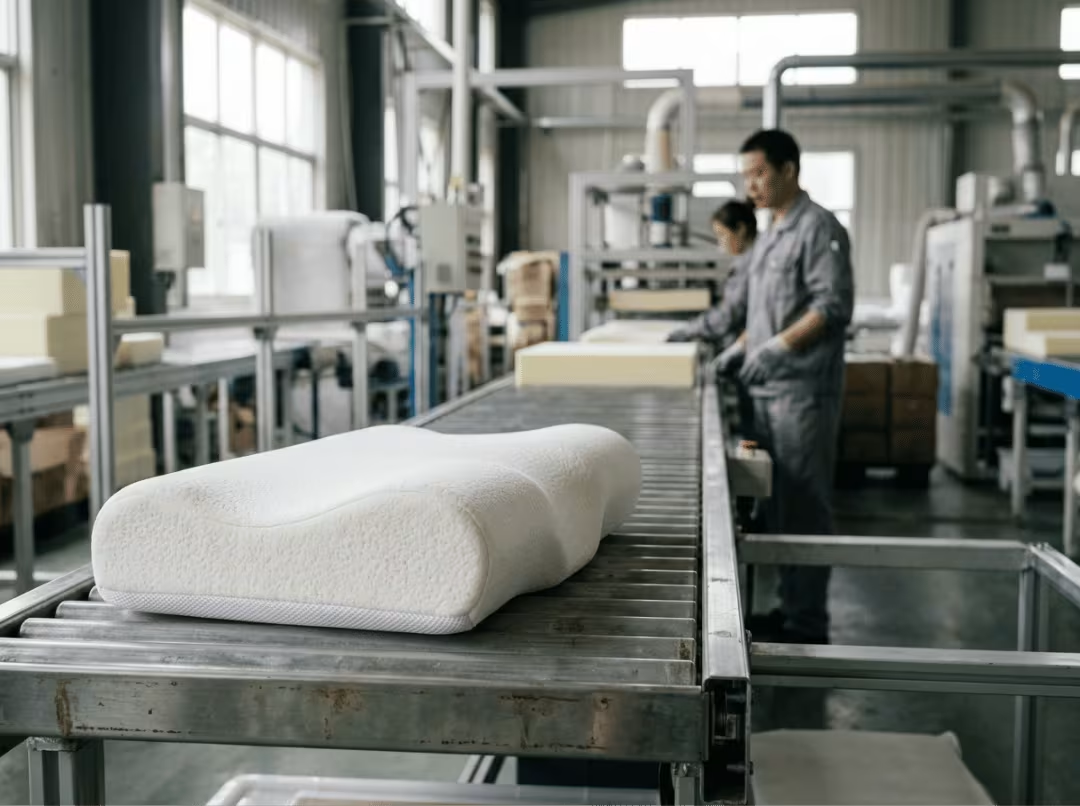
Most buyers decide on a memory foam pillow based on how it feels through the bag, or what a product page claims. Neither tells you much. The quality was fixed weeks earlier — in how the chemicals were mixed, how long the foam was given to cure, and whether the manufacturer tested density before sealing and shipping.
This article walks through that process in enough detail to make you a sharper buyer. Not a factory tour — a practical look at the steps that actually determine whether a pillow lasts two years or six.
What Goes Into Memory Foam
Memory foam is polyurethane foam made from two primary chemical components: polyols, which give the foam its softness and elasticity, and isocyanates, which govern its structural firmness. These are combined with additives — blowing agents that create the open-cell structure behind pressure relief, surfactants that regulate how evenly cells form, and catalysts that control reaction speed.
A few variants worth knowing:
- Plant-based or bio-based foam substitutes a portion of petroleum-derived polyols with soy or castor oil alternatives. The eco-friendly positioning is partly legitimate, but performance is still driven by density rather than feedstock.
- Gel-infused foam incorporates gel beads or swirled liquid gel to reduce heat retention. It helps with temperature regulation but doesn’t meaningfully change structural behavior.
- Colorants and fragrances are purely cosmetic and mostly irrelevant to performance — they matter mainly when cross-referencing certifications.
The polyol-to-isocyanate ratio, along with the additive mix, determines the foam’s final density and feel. That chemistry happens at the factory level, not at the store.

Molded vs. Shredded: The Decision That Actually Matters
This is the most consequential structural choice in memory foam pillow manufacturing — and the one most product pages gloss over.
Molded foam is formed as a single continuous piece. The liquid mixture is poured into a pillow-shaped or block mold, allowed to expand, and set. The result is a uniform foam body with consistent density from edge to edge.
Shredded foam is what it sounds like: offcuts and production scrap from molded foam runs, ground into chunks and packed into an outer shell. Often blended with latex or polyester fiber to adjust loft and feel.
The gap between the two is more visible over time than on day one. Molded foam holds its shape, maintains support consistency, and doesn’t clump or migrate with use. Shredded foam is more adjustable and typically more breathable — an advantage if you want to customize loft — but it compresses unevenly, and lower-quality fills collapse faster than most brands will admit.
If you’re evaluating a shredded foam pillow, the spec you need is the foam’s density, not the total fill weight. A listing that gives you the overall pillow weight without specifying foam density omits the only number that tells you how long it will hold up.

Mixing, Pouring, and the Gel Point
The molded manufacturing process begins with a mixing stage: polyols, isocyanates, and additives are blended under controlled temperature and humidity. The ratio matters more than most people realize. Small deviations — from a miscalibrated pump, a humidity spike, a temperature drop between shifts — alter the final foam’s density and tactile behavior in ways that won’t always show up in a brief inspection.
Once mixed, the liquid is poured into molds or onto a conveyor for block production. The foam begins expanding immediately through an exothermic chemical reaction. Manufacturers track the gel point: the moment the foam transitions from liquid to stable solid. That transition needs to happen under the right conditions. If it doesn’t, the result is internal voids and density inconsistencies that only reveal themselves after months of use.
Facilities without climate control are particularly prone to batch variation at this stage. The same factory can produce a good batch on Monday and a compromised one on Friday if ambient conditions aren’t managed.
This is also where the choice of polyurethane foaming machine matters in ways most buyers never see. High-pressure systems with precise metering control deliver more consistent polyol-to-isocyanate ratios and better mixing uniformity than low-cost alternatives — which directly affects foam density, cell structure, and long-term durability. The equipment behind the pillow shapes the pillow.

Curing and Cooling — and Why This Step Gets Skipped
Once the foam sets, it needs to cure. Typically 12 to 24 hours at controlled temperatures, sometimes in a heated chamber. This isn’t optional — it drives off residual reaction chemicals and allows the foam’s internal structure to fully stabilize.
It’s also the step most commonly shortened in low-cost production, because time and energy cost money. When curing is rushed, residual chemicals stay in the foam. That’s the primary cause of the sharp off-gassing smell some buyers encounter when they open a new pillow.
Cooling follows curing. Rushing it leads to warping and surface irregularities that affect support consistency over time.
A faint, brief odor on unboxing is normal and typically clears within 24 to 48 hours in a ventilated room. If you’re still getting a sharp chemical smell after 48 hours, that’s a signal worth taking seriously — and a reason to look more closely at the brand’s certifications and manufacturing claims.
What Quality Control Actually Tests
Factory QC for memory foam pillows focuses on two core measurements.
Density (lbs/ft³ or kg/m³) is the most reliable single predictor of durability. Consumer-grade memory foam pillows typically fall between 3 and 5 lbs/ft³. Below 3 lbs/ft³, the foam is likely to compress and lose its shape faster than the price tag implies. This is also the number most commonly absent from product listings — which is informative in itself.
IFD (Indentation Force Deflection) measures firmness as the force required to compress the foam 25% of its thickness. It’s the actual number behind “soft,” “medium,” and “firm” claims. A pillow described as medium firmness without an IFD value is using a marketing label instead of a measurable standard.
On safety, third-party certifications cover VOC emissions and restricted substance thresholds:
- CertiPUR-US covers polyurethane foam specifically, including limits on harmful chemicals, heavy metals, and VOCs. US-focused and widely recognized in bedding.
- OEKO-TEX Standard 100 applies to the full finished product, including covers and fill.
- GREENGUARD Gold sets tighter emission thresholds, making it most relevant for children’s products and chemically sensitive users.
Certification logos on packaging don’t always reflect current status. Both CertiPUR-US and OEKO-TEX maintain live, searchable registries. It takes under a minute to verify — and it’s worth doing before making a purchase decision based partly on certification claims.

Finishing, Covers, and Packaging
After QC, pillows are trimmed if needed and fitted with covers. A removable, washable cover isn’t a luxury feature — it protects the foam from oils and moisture that accelerate breakdown and meaningfully extends its useful life. A sewn-in, non-removable cover on an otherwise comparable product is worth noting.
Most memory foam pillows ship vacuum-compressed. This is standard and doesn’t damage the foam. Full re-expansion takes 24 to 72 hours at room temperature. If the pillow hasn’t reached its labeled loft after 72 hours, it’s worth following up with the seller — density or curing issues may be at play.
How to Use This When Buying
- Look for specs first. Density and IFD should appear on any listing from a manufacturer who’s confident in their product. If they’re absent, assume the numbers aren’t favorable. Ask, or shop elsewhere.
- Know what you’re comparing. Molded foam is structurally more stable over time — the better option if consistent, long-term support matters. Shredded foam can work if you want adjustable loft, but only consider products that specify the foam density in the fill, not just the total pillow weight.
- Run two quick tests at unboxing. Press the pillow firmly and release it. It should return to shape within 1 to 3 seconds. A five-second-or-slower return suggests low density or incomplete curing; an instant spring-back suggests a blended or low-grade fill. Then let it air out — a faint odor that clears in 48 hours is fine. Anything that lingers sharp past that point is grounds for a return.
Verify certifications directly. Don’t rely on the packaging. Check the CertiPUR-US and OEKO-TEX registries before purchase.
The Bottom Line
By the time a memory foam pillow appears on a product listing, every decision that determines its quality has already been made. The chemical ratios, the curing time, the foam density — none of it changes after the fact. What you can do is read listings critically, ask for the numbers that matter, and verify claims before purchase rather than after.
Density between 3 and 5 lbs/ft³. IFD specified, not just a firmness label. Certifications you can verify. A removable cover. Those aren’t luxury criteria — they’re the baseline for a pillow that won’t let you down six months in.
Frequently Asked Questions
What is a good density for a memory foam pillow?
Look for 3–5 lbs/ft³ for consumer-grade memory foam. Below 3 lbs/ft³, the foam tends to compress and lose its shape relatively quickly. Higher density (4–5 lbs/ft³) generally indicates better durability and support over time.
How long does off-gassing last, and is it harmful?
A faint odor on unboxing is expected and typically clears within 24–48 hours with adequate ventilation. A sharp chemical smell that persists past 48 hours may point to incomplete curing. Foams certified under CertiPUR-US or OEKO-TEX are tested for VOC emissions and considered safe for normal use.
Is molded or shredded memory foam better for side sleepers?
Molded foam generally provides more consistent loft and lateral support — useful for side sleepers who need reliable pressure relief at the shoulder and neck. Shredded foam can work if it’s high-density and the fill is adjustable, but it requires more active maintenance to stay even over time.
What does CertiPUR-US actually certify?
CertiPUR-US certifies polyurethane foam made without ozone depleters, PBDE flame retardants, heavy metals, and above-threshold VOC emissions. It covers the foam only — not pillow covers or other components.
How do I know if a memory foam pillow is low quality?
No density or IFD spec on the listing. A very slow or uneven rebound. A sharp odor after 48 hours. Noticeable flattening within weeks. No verifiable third-party certifications. Any one of these is a flag; several together are a clear answer.
Why hasn’t my pillow fully expanded after unboxing?
Most vacuum-compressed pillows re-expand fully within 24–72 hours at room temperature. If yours hasn’t reached its labeled dimensions after 72 hours, contact the seller. A manufacturer who stands behind their product should resolve it without friction.