
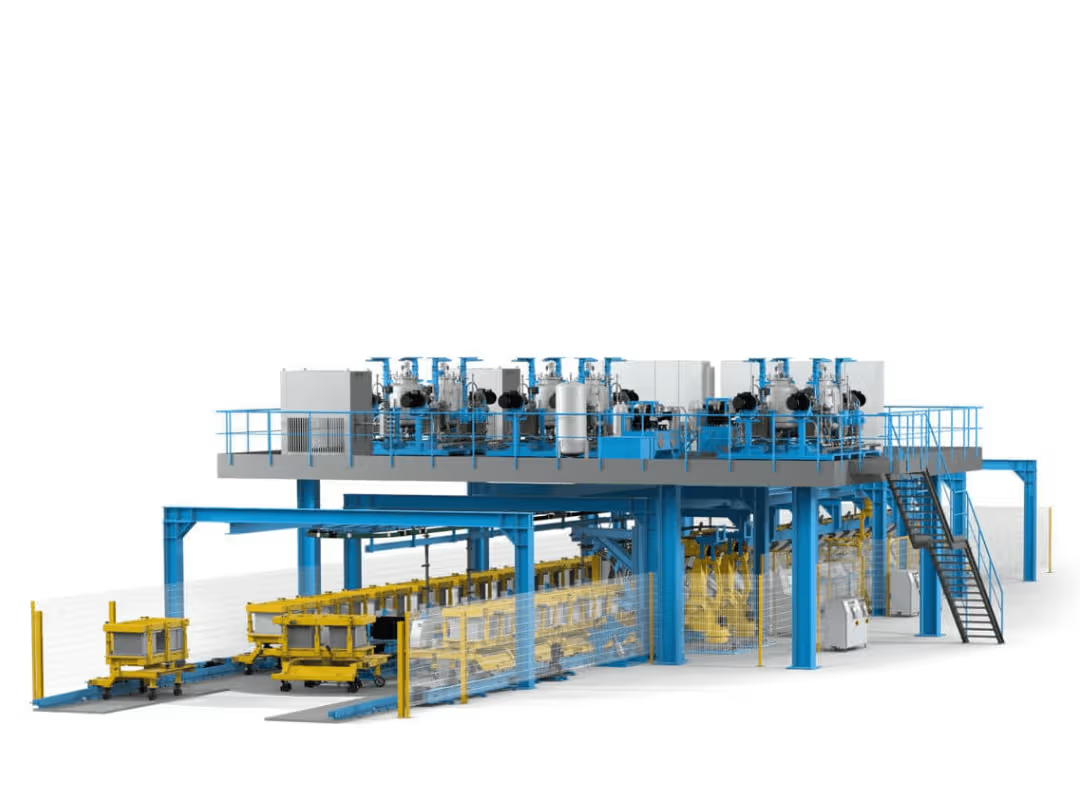
Most foam plants don’t plan their conveying. They react to whatever bottleneck is loudest that quarter — a belt to stop workers dragging blocks, a roller section because the cutting line keeps backing up. Piece by piece, they build a factory full of equipment that never quite flows. The blocks still get lifted too many times, the finishing area still floods, and nobody can tell exactly where the throughput is leaking.
The problem isn’t the conveyors. It’s that the conveyors were never designed as a system.
A foam conveying system is the logic that moves product from foaming all the way to packing — with the fewest hands on it, the least damage, and no station sitting idle waiting on the one before it. Get that logic right and the individual machines almost pick themselves. Get it wrong, and you can buy every conveyor in the catalog and still run a slow, damage-prone line.
This guide works through the reasoning in the order it matters: what the system actually does, where flow breaks down, which conveyor handles which job, and what costs money long after the equipment is installed.
What a Foam Conveying System Actually Does
Strip away the machine names and a foam conveying system does one thing: it carries product through every production stage in a controlled sequence, so each station receives its input at the right moment, in the right orientation, without a person lifting it.
That sounds simple until you trace what a foam block or mattress actually goes through. It leaves foaming, waits to cure, gets sheeted horizontally, gets sized vertically, sometimes gets profiled, then the pieces move to gluing, assembly, tape edge, and packing. Every one of those transitions is a place where the product changes direction, changes height, changes orientation, or waits. The conveying system governs all of them.
The real job isn’t moving foam — it’s sequencing. A good system holds flow steady even when stations run at different speeds: buffering where one machine is slower, feeding smoothly where another is faster, turning or flipping product so it arrives at each station already in the right position. Foam is light but bulky, easily marked, and easily deformed when dragged or crushed. The system that handles it well is the one that keeps hands off it and keeps it moving at a pace the whole line can sustain.
Judge a conveying system by three things, not by the number of conveyors it contains: how few times a person touches the product, how little product is damaged in transit, and how evenly work moves from the first stage to the last.
Why Manual Handling Caps Your Output
Every plant starts with people carrying foam. It works at low volume, and it keeps working just long enough to convince an owner that it’s fine. Then output climbs, and manual handling shifts from a minor cost to the thing capping the operation.
Consider what actually happens when two workers carry a foam block from cutting to gluing. They set down what they were doing, walk over, lift the block, navigate around equipment, place it, and walk back. That’s thirty to sixty seconds where neither of them produces anything — repeated dozens of times a shift. Multiply it across every transfer point in the plant and the lost hours are significant. But they never appear as a line item, because the workers are always busy. Busy and productive are not the same thing. Manual handling is exactly where that gap hides.
The damage cost is worse and harder to see. Every manual lift is a chance to compress a corner, drag a face across a rough surface, or drop a piece. On flexible foam and finished mattresses, that shows up downstream as marked surfaces, dented edges, and rejects — which then get blamed on foaming or cutting when the real cause was rough handling between stations. Plants chase a scrap problem inside the machines for weeks when the fault is entirely in how product moves between them.
Then there’s the flow problem. People don’t move at a constant rate. They bunch up, take breaks, prioritize whoever’s asking loudest. A line that depends on human transfer runs in surges — a pile-up at one station, a starved machine at the next. You can’t balance a line you can’t control. Automating the transfer isn’t only about saving labor — it’s about making flow predictable enough to balance in the first place.
The Conveyor Formats That Actually Matter
A foam or mattress plant uses a small set of conveyor types. What matters isn’t the full list — it’s knowing which production problem each one solves, so you can match it to the problems your line actually has.
Straight belt conveyors carry product on a continuous flat surface between stations. The belt supports the full footprint of a block or mattress, protecting the surface and keeping light or soft product stable. This is the default for general transfer where the product needs full support and the path is straight.
Roller conveyors move product across powered or free-spinning rollers. They handle heavier, denser blocks better than belt and take sustained weight without the wear a heavy block causes on a light belt. Powered rollers give speed control; gravity rollers are inexpensive for short downhill transfers but give up that control.
Right-angle transfer conveyors change product direction ninety degrees without anyone turning it by hand. They exist because real buildings have walls, columns, and existing equipment that force bends in the line. A right-angle transfer keeps the flow automated around the obstacle instead of handing it back to a person.
Upturn and flip conveyors rotate a mattress or block so the next operation reaches the correct face. Two-sided finishing, double-sided quilting, and inspection all need the product the right way up. Manual flipping is slow and one of the more common places surfaces get marked — mechanizing it protects both throughput and quality simultaneously.
Glue-integrated conveyors apply adhesive as the product moves, folding the bonding step into the transfer rather than stopping at a separate station. For laminated foam and layered mattress construction, this removes a stop from the flow and cuts footprint.
The point of understanding these formats is not to install one of each. It’s to recognize that each one solves a specific movement problem — and to match the solution to your actual problem, not to a catalog.
Belt, Roller, Turning, or Upturn: How the Choice Actually Breaks Down
Most of the conveyor selection mistakes in foam plants come from applying one format where another fits better. Here’s how the decision plays out on the floor.
Belt when surface matters. Soft flexible foam, finished mattresses, anything with a face you can’t afford to mark — these belong on a belt. The continuous surface spreads the load and leaves no gap for a soft product to sag into. If your rejects show edge damage or surface marking, belt transfer through the vulnerable stages is often the fix. The trade-off: belts wear, and running a very heavy block on a light belt shortens its life faster than the spec sheet suggests.
Roller when the product is heavy. Dense foam blocks, stacked loads, heavy raw stock — these ride better on rollers. Rollers shrug off weight that would drag on a belt, and they make accumulation straightforward: a block can sit on a powered roller buffer without deforming. The catch is roller pitch. Set rollers too far apart and a soft or small piece sags or catches between them. Roller pitch has to match the smallest product the line will carry, not just the heaviest.
Right-angle transfer when the building fights the flow. If a straight run would hit a wall, a support column, or an existing machine, a turning conveyor keeps the automation intact around the obstacle. The alternative — a worker lifting and turning product at the corner — reintroduces the manual handling you were trying to remove. This matters most in older buildings and tight footprints where you don’t get to design from scratch. Plants that automate the straight runs and leave corners to manual handling find that the corners become the new bottleneck.
Upturn or flip when orientation changes before a station. Finishing, quilting, and inspection all depend on the product arriving the right way up. Mechanized flipping is faster than hand-turning and far gentler, which protects the surface right before the stage where surface quality gets judged. If your line currently flips product manually before finishing, that’s almost always both a speed bottleneck and a surface risk in the same place.
Most real lines use several of these in sequence, each doing one job. The mistake is forcing one format across the whole line — running heavy blocks on a surface-protection belt, or saving money on a right-angle transfer and putting a person at the corner instead.
How the Product at Each Stage Dictates Conveying Requirements
The same plant moves very different things at different points in the process, and each state of the product asks something different from the conveying.
Raw foam block, post-cure. Heavy, sometimes still off-gassing slightly, and moving to cutting. Rollers or heavy-duty belt handle the weight. This stage almost always needs built-in buffering — cured blocks queuing for the saw should be held on the conveyor, not stacked by hand. The priority is load capacity and the ability to hold product without deforming it while it waits.
Slabs between cutting stages. Once a block is sheeted, the pieces are lighter but much easier to mark — and they’re passing through horizontal, vertical, and contour operations. Belt is the right surface here. Transitions between machines matter: a slab catching or folding at the gap between two conveyors is a quiet, common source of edge damage that rarely gets tracked back to the conveying.
Mattress through finishing. By this point the product has real commercial value and a surface customers will see and feel. Gentle belt transfer plus mechanized flipping protects that surface at exactly the moment it’s most exposed. Speed still matters, but not at the cost of marking a panel this close to the end of the line.
Through the adhesive stage. Laminated and layered construction needs product moving at a controlled, consistent pace through bonding. Too fast and the glue doesn’t set in position; too slow and it starts curing before assembly is complete. Glue-integrated conveying was built for this: the conveyor speed is matched to the adhesive’s working window as a design decision, not an operator judgment call.
Into packing. Finished and often compressed product moves to roll-packing and boxing. The conveying here has to sync with the packing machine’s cycle so product arrives as the machine is ready — not piling up ahead of it or arriving too slowly to keep it running. A short buffer section before packing absorbs the timing mismatches that would otherwise ripple back up the whole line.
The consistent pattern: raw and heavy product needs load capacity and buffering; light and finished product needs surface protection and gentle handling; every stage needs a speed that matches what comes next.
Where Conveying Connects to Cutting, Gluing, Finishing, and Packing
A conveying system earns its value at the handoffs between machines — the transitions where one process passes work to the next. Those handoffs are where lines slow down, and where the real difference between a designed system and a piecemeal one shows up.
At cutting, the conveyor feeds blocks at the rate the saw can take them and carries sheets away without letting them back up against the machine. Feed too slowly and the cutting machine idles; feed too quickly and slabs pile up and get damaged. The conveyor sets the rhythm the cutting station runs at. Matching its speed to the saw’s actual cycle time — not its rated maximum — is what makes that rhythm useful.
At gluing, the transfer has to hold a steady pace through the adhesive’s working window. This is where conveying and chemistry are genuinely inseparable: the glue dictates the speed, and the conveyor has to hold it without deviation. In-line gluing removes the separate bonding station entirely, which shortens the line and eliminates one more transfer point.
At finishing, product needs to arrive in the correct orientation and keep moving gently. The finishing stage is where surfaces get their final quality assessment, and it’s where a mishandled presentation from the conveying creates rework. Flip and belt conveyors do that presentation work so operators focus on finishing rather than positioning.
At packing, the conveyor has to sync with the packing machine’s rhythm. Roll-packing and boxing run at their own pace, and the conveying ahead of them has to deliver product just as the machine is ready. A buffer section before the packer absorbs the small timing variations that, without it, would stall the entire line back to cutting.
The pattern is the same at every stage: speed matching and buffering. A line moves at the pace of its slowest station. Conveying either smooths the variation between stations or amplifies it. A system designed as a whole smooths it. Equipment bought to fix isolated bottlenecks amplifies it — which is why plants that add conveyors reactively often run no faster after the investment.
The Layout Constraints That Shape Your Conveyor Choices
You rarely design a foam line into a building that was shaped for it. The layout is almost always a negotiation between the flow you want and the space you have — and that negotiation decides more about your conveyor choices than any equipment catalog does.
Buildings force direction changes. A straight production line is the easiest to run and the hardest to fit. Walls, columns, and existing equipment force bends, and every bend is a decision: automate it with a right-angle transfer, or leave it to manual handling. Narrow or awkward footprints push you toward turning conveyors and compact in-line operations like integrated gluing that save floor length. Map the actual flow against the actual building before buying anything. The walls are a more honest spec than the brochure.
Buffer zones are not optional. Stations never run at identical speeds, and the difference has to go somewhere. A buffer — a powered roller or accumulation section that holds a few units — absorbs the gap so a brief slowdown at one machine doesn’t immediately starve or flood the next. Plants that skip buffering to reduce cost end up with lines that stall constantly at whichever station is slowest that day. Buffers cost conveyor length; skipping them costs steady throughput.
Line speed has to be matched deliberately. The goal is every station working at close to the same effective rate. Conveyor speed is the main tool for achieving that after the process machines are fixed. Getting balance right usually means running some sections deliberately slower than they’re capable of — matched to the pace of the slowest critical station — which surprises buyers who assume faster conveying is always better.
Maintenance access gets ignored at design time. A conveyor that blocks reach to the machine it feeds turns every service call into a bigger job. Leave clearance to reach drives, belts, and rollers. Plan the layout so a failure in one section can be isolated without shutting the whole line. This is a decision that costs nothing at design time and is resented for the life of the plant if it’s skipped.
Growth should not require a redesign. The line you build now is rarely the line you’ll run in five years. Layouts with no room to extend a section, insert a station, or raise throughput force a full rebuild when volume climbs. Modular conveying that can be lengthened or reconfigured pays for its small premium the first time capacity needs to grow.
The Bottlenecks and Mistakes That Appear Over and Over
These are the patterns that show up in plants that added conveying equipment without designing conveying flow.
Speed mismatch between adjacent stations. A conveyor faster than the machine it feeds piles product against the machine; one slower starves it. Either way you lose the throughput the machine was purchased to deliver. The fix is matching speed to the real cycle time of each station — and being willing to run some sections deliberately slow.
Wrong surface for the product. Soft foam or finished mattresses on rollers spaced too wide, a belt too abrasive, or a rough transfer gap produces surface marking and edge damage that consistently gets misdiagnosed as a cutting or foaming fault. Chasing a quality problem inside the machines when the actual cause is between them wastes time and misdirects maintenance effort.
No buffering between stations. A line with no accumulation means every small hiccup propagates through the whole system. One machine pauses and everything else either backs up or runs dry. Buffers cost conveyor length. Skipping them costs predictable output.
Corners left to manual handling. Plants automate the straight runs, then leave workers to lift and turn product at every direction change and flip. Those points become the new bottleneck and the new source of surface damage — the automation moves the problem to the corners instead of removing it.
No allowance for expansion. A line designed to fit today’s volume exactly, with no room to extend or insert stations, becomes a constraint the moment demand increases. The cost of designing expansion room in at the start is small. The cost of a full rebuild because no room was left is not.
Buying process machines before designing the flow. The most expensive mistake in foam manufacturing capital expenditure is specifying all the cutting, gluing, and finishing equipment first, then figuring out how product moves between them second. The transfers are where flow lives or dies. A line planned around its conveying from the start runs better than one where the conveying was fitted around fixed machine positions after the fact.
Questions That Separate Genuine System Suppliers From Equipment Vendors
Ask these before you compare prices. The answers determine whether the system will actually fit your line — not just whether the conveyors will fit through the door.
- What load capacity does each section carry, matched against my heaviest raw block and largest finished product?
- What speed range does each section run, and can it be set to the actual cycle time of the machine it feeds?
- What belt or roller surface do you recommend at each stage of my line, and how does it protect soft foam and finished panels?
- What right-angle transfer options do you offer, and how tight a turn radius can they manage in my building?
- How is speed coordinated across the system — section by section, or integrated across the line?
- Where does your design build in buffering, and how many units does each buffer hold under my production volume?
- Is the system modular enough to extend or reconfigure as volume grows?
- What safety features are specified at transfer points, flip sections, and pinch points?
- What are the actual lead times on wear parts — belts, rollers, drive components — stocked in my region?
- What service response time can you commit to when a section stops and the line goes down?
Pre-Purchase Checklist
- Full product flow mapped from foaming through packing, every transfer point identified
- Load capacity confirmed for the heaviest block and largest finished product at each stage
- Conveyor speed set to each station’s real cycle time, not rated maximum
- Surface type chosen per stage to protect foam and finished panels
- All direction changes handled by turning conveyors, not manual handling
- Flip and orientation requirements mechanized before two-sided operations
- Buffer zones placed at stations most prone to speed mismatch
- Line balance verified — no station chronically starved or flooded
- Layout fitted to actual building, including columns and existing equipment positions
- Maintenance access confirmed at every machine the conveyor feeds
- Expansion room and modularity confirmed against realistic growth targets
- Speed control coordinated across the line, not left section-by-section
- Safety features specified at all transfer, flip, and pinch points
- Wear-part costs, replacement intervals, and regional stock confirmed
- Service response time committed in writing before signing
Anything still open here is a conversation to finish before the line starts, not after a section goes down on week one.
FAQ
What is the difference between a belt conveyor and a roller conveyor for foam?
A belt conveyor supports the full footprint of the product on a continuous surface, protecting soft foam and finished mattress faces from marking and preventing light product from sagging. A roller conveyor moves product across spaced rollers — better for heavy, dense blocks and easier to accumulate product on, but soft or small pieces can sag between rollers if the pitch is wrong. Belt for soft and finished product; rollers for heavy raw stock.
How do I reduce foam surface damage during transit?
Match the conveyor surface to the product state at each stage, keep the transfer gaps between adjacent conveyors small and smooth, and mechanize the flips and direction changes where manual handling is currently marking surfaces. Most transit damage traces to three things: the wrong surface under a soft product, a rough or wide gap between two conveyors, and manual lifting at corners. Address those three and surface rejects usually drop sharply.
Do I actually need buffer zones?
Yes, if your stations run at different speeds — and they always do. A buffer holds a few units so a brief slowdown at one machine doesn’t immediately starve or flood the next. Without buffering, every small variation ripples through the whole line. Buffers cost conveyor length. They pay it back in steady throughput.
How do I match conveyor speed to my line?
Set each section to the real cycle time of the machine it feeds, not the conveyor’s top speed or the machine’s rated maximum. A section running faster than its downstream machine piles product up; slower starves it. Balancing a line often means deliberately running some sections slow — matched to the pace of the slowest critical station — so the whole line moves at one steady rate.
Can a conveying system be retrofitted into an existing plant?
Yes, and most plants add conveying this way. The key is mapping real product flow and real building constraints first — columns, walls, existing machines — then selecting formats that fit the space, including right-angle transfers for direction changes you can’t straighten out. Modular systems are easier to retrofit and extend than fixed-length alternatives.
What should I check on after-sales support before buying?
Get actual lead times for belts, rollers, and drive components stocked in your region — not from a central warehouse. A section that stops the line while you wait three weeks for a replacement roller costs far more than the price difference between a well-supported and a cheap supplier. Confirm service response time in writing, not in a conversation.
Before You Commit
A foam conveying system is a flow decision before it’s a purchasing decision. Map how product actually moves through your plant — every lift, turn, flip, and wait between foaming and packing — and the right conveyor choices follow from that map. Buy sections to fix isolated bottlenecks and you get a plant full of equipment that still doesn’t flow. Plan the movement as one system and the whole line runs faster, cleaner, and with fewer hands on the product.
That’s where conveying becomes real leverage. When feed rates match the saws, pacing matches the adhesive, orientation is ready before finishing, and buffering absorbs the variation ahead of packing, the individual stages stop working against each other. A supplier who can look at your building, your product, and your actual volume and design that flow end to end is worth more than one quoting conveyor by the meter. The difference shows up every shift, in what gets produced and what doesn’t get damaged.