

Polyurethane shows up in your mattress, car seat, wall insulation, and running shoes. Buyers and engineers often ask me for its chemical formula. They expect one neat answer.
Polyurethane has no single fixed chemical formula. It is a family of polymers. Manufacturers make it by reacting polyols with isocyanates, and each recipe builds a different chain.
I work with these materials every day. The structure tells you far more than any formula. Once you understand it, you can predict how a part will bend, hold its shape, or insulate.
Does Polyurethane Have a Single Chemical Formula?
No. Polyurethane has no universal molecular formula. If a website gives you one, it shows a simplified example, not the full picture.
Polyurethane is a polymer family, not one compound. Water is always H₂O, but polyurethane changes with every recipe. Swap the polyol or the isocyanate, and you get a new repeating unit, a new chain, and a new material.
Every polyurethane does share one small bond, called the urethane linkage:
–NH–CO–O–
It forms when an isocyanate group (–NCO) reacts with a hydroxyl group (–OH) on a polyol. This bond acts like a hinge that ties the building blocks together. A simple linear polyurethane repeats like this:
–[CO–NH–R–NH–CO–O–R′–O]ₙ–
R comes from the isocyanate, and R′ comes from the polyol. Those two letters hide almost everything that matters.
When clients send me a spec sheet, I skip the formula and check four things:
- Polyol type: polyether or polyester, plus chain length
- Isocyanate type: usually MDI or TDI
- Segment balance: the ratio of hard, rigid blocks to soft, flexible ones
- Crosslinking: whether the chains stay linear or lock into a 3D network
These four factors tell you whether you have a soft cushion, a rigid insulation board, or a tough shoe sole. The formula only confirms that it’s polyurethane.
What Polyurethane Is Made Of
Every polyurethane starts with two main ingredients and a few helpers. Think of it like a recipe. Change one ingredient, and the whole result changes.
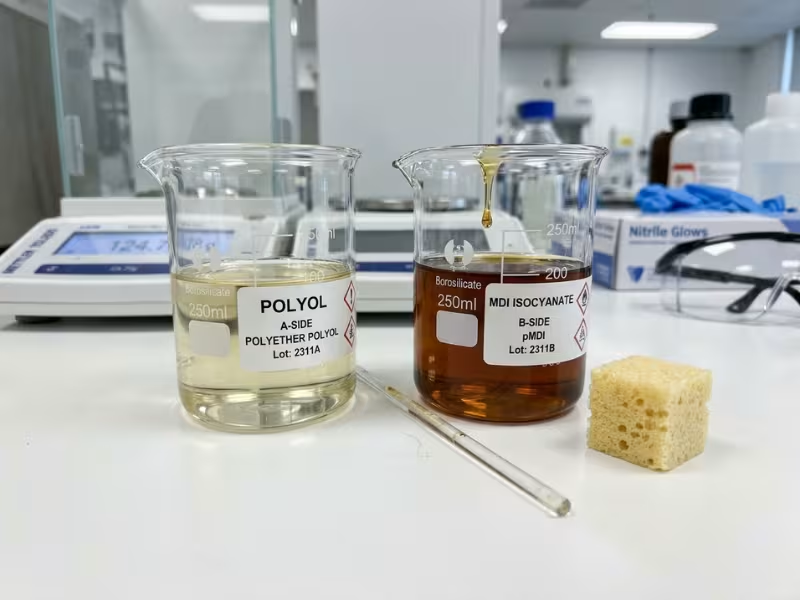
Polyols: The Part That Adds Flexibility
Polyols are compounds that carry several hydroxyl (–OH) groups. They form the long, soft stretches of the polymer chain.
Most polyols fall into two camps:
- Polyether polyols resist water and stay flexible in the cold. They suit mattress foam, seating, and parts that face humidity.
- Polyester polyols handle wear, oil, and tearing better. They fit shoe soles, coatings, and industrial rollers. Moisture, however, can slowly break them down.
Chain length matters too. Long polyol chains give you soft, bouncy foam. Short, branched chains push the material toward rigid boards.
Isocyanates: The Part That Builds Strength
Isocyanates react with polyols and form the tough, rigid blocks in the chain. Two types cover most of the market:
- TDI (toluene diisocyanate) reacts fast and works well in flexible foam for furniture and bedding.
- MDI (methylene diphenyl diisocyanate) builds harder, more heat-resistant structures. It leads in rigid insulation, elastomers, adhesives, and TPU. It also gives off less vapor, so plants generally find it easier to handle.
When a customer wants a harder part, I usually look at the MDI side first. For clear coatings that face sunlight, formulators often switch to aliphatic types like HDI. Aromatic MDI and TDI tend to yellow over time.
Additives and Chain Extenders
Some people call these minor ingredients. I disagree. They often decide whether a batch succeeds.
- Chain extenders, such as 1,4-butanediol, build hard segments and raise hardness.
- Catalysts control how fast foam rises and sets.
- Blowing agents create the gas bubbles that set foam density.
- Stabilizers keep cells even and protect against heat and UV.
- Flame retardants help parts meet fire codes.
Use the same polyol and isocyanate with different additives, and you get a completely different foam.
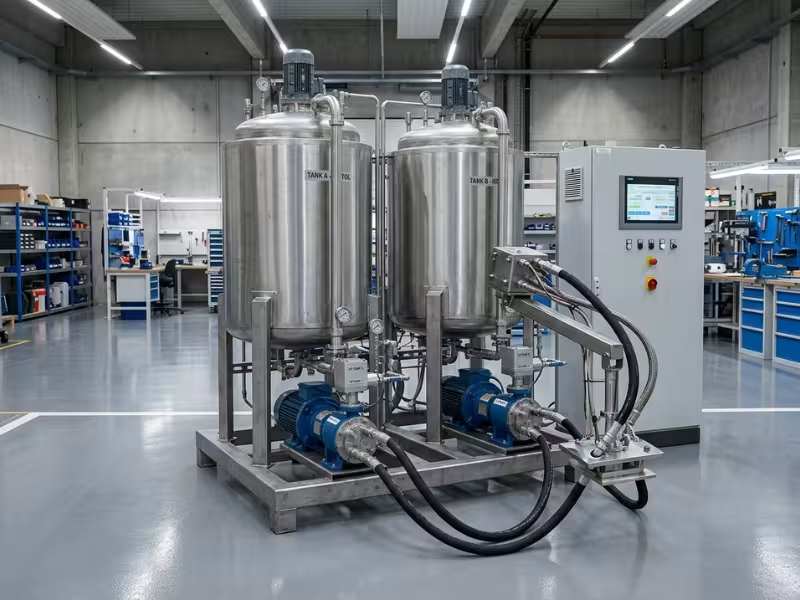
This recipe doesn’t stay on paper. On the factory floor, small shifts in ratio or temperature change how the mix reacts. An off-ratio shot can leave soft spots, uneven cells, or a brittle surface. That’s why producers pay close attention to metering accuracy and mixing quality in the polyurethane foaming machine they run. A good formula only works when every shot delivers it precisely.
How the Structure Controls Performance
This is where the formula starts to make sense. Three structural features decide how a polyurethane part behaves. Check all three before you settle on a grade.
Hard Segments vs. Soft Segments: The Push and Pull Inside Every Chain
A polyurethane chain isn’t uniform. It switches between two kinds of blocks that behave in very different ways.
Hard segments form where isocyanate meets a chain extender. These short, stiff blocks grip each other through hydrogen bonds and cluster into tiny rigid zones. They give the material strength, heat resistance, and the ability to carry a load.
Soft segments come from the long polyol chains. They coil loosely and stay rubbery well below room temperature. They let the material stretch, recover, and absorb impact.
The two blocks don’t mix well, so they separate on a microscopic scale. The hard zones act like anchors. The soft zones act like springs between them.
When a client needs a harder part, I raise the hard segment content. When they need more give, I shift the balance toward the soft side.
That balance is the whole trick. More springs give you a soft foam. More anchors give you a tough elastomer or a stiff board.
Crosslinking: Will It Melt or Hold Its Shape?
Segments explain how a chain behaves. Crosslinking explains how the chains connect to each other.
Linear chains create thermoplastic polyurethane (TPU). Mostly hydrogen bonds hold the chains together, and heat loosens those bonds. You can melt TPU, mold it, and reprocess the scrap. High molecular weight keeps it tough once it cools.
Crosslinked networks create thermosets. Polyols or isocyanates with three or more reactive groups tie the chains into a permanent 3D web. Once it cures, it won’t melt. It chars instead.
Crosslink density works like a dial:
- Higher density raises hardness, dimensional stability, and heat resistance.
- Lower density keeps the material flexible and resilient.
- Any true crosslinking rules out remelting, so you can’t fix a damaged part with heat.
Cell Structure: Why Two Foams With Similar Chemistry Perform Differently
Foam adds one more layer to the story: the bubbles.
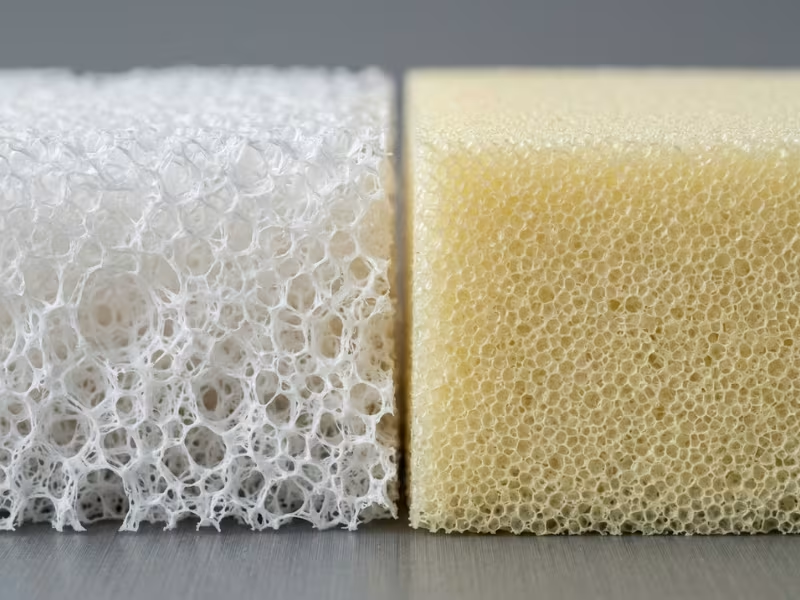
Open-cell foam has broken cell walls, so air moves freely through it. It feels soft, breathes well, and suits cushions. It also soaks up water.
Closed-cell foam traps gas inside sealed cells. It resists moisture, blocks air, and typically insulates close to twice as well per inch. That makes it the standard choice for roofs, walls, and cold storage.
Why Polyurethane Can Be Soft Foam, Rigid Foam, or TPU
You’ve seen the dials: segment balance, crosslinking, and cell structure. Turn them in different directions, and the same basic chemistry becomes three very different materials. Here’s how each form fits its job.
Flexible Foam: Built to Give and Bounce Back
Flexible foam uses long polyol chains, light crosslinking, and open cells. Air fills most of its volume. Seating and bedding foams typically run about 1.5 to 2.5 lb/ft³ (24–40 kg/m³).
When you sit down, air pushes out of the cells and the soft segments compress. When you stand up, they spring back.
That’s why this foam fills mattresses, sofa cushions, and car seats. When I review a mattress foam spec, I check density first. Higher density usually means the foam keeps its shape for more years.
Rigid Foam: Built to Hold Shape and Block Heat
Rigid foam flips the recipe. Short, branched polyols and MDI-based isocyanates build a tight, crosslinked network. In good systems, more than 90% of the cells stay closed, and they trap gas that moves heat poorly.
The result is stiff, light, and an excellent insulator. Closed-cell spray foam can reach about R-6 to R-7 per inch.
You’ll find it in sandwich panels, wall and roof spray foam, refrigerators, and cold-storage rooms. It also bonds to surfaces and adds strength to the structure around it.
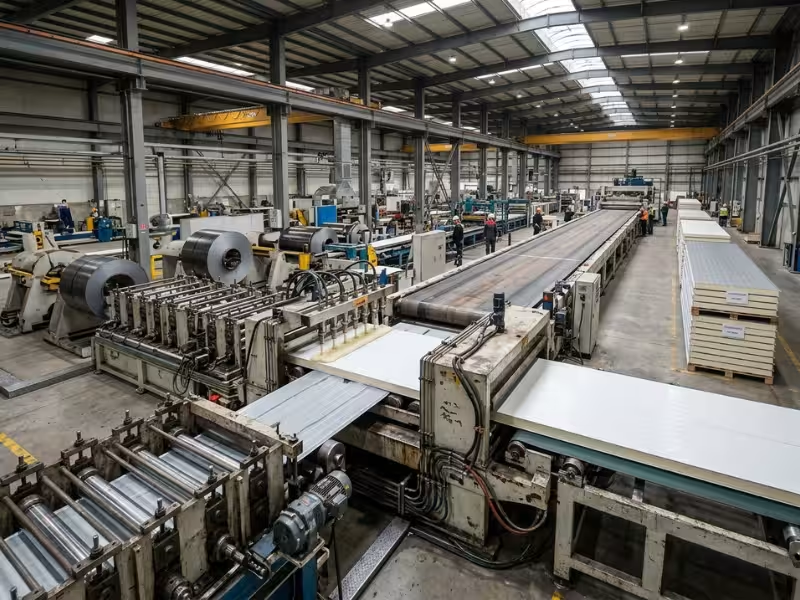
That bonding ability matters a lot in panel manufacturing. The foam fills the gap between two metal skins, cures in place, and locks them into one stiff board. To get even density and a uniform cell structure across long panels, many insulation producers rely on a continuous polyurethane sandwich panel production line rather than batch pouring.
TPU and Elastomers: Built to Take Abuse
TPU and cast elastomers skip the bubbles. They’re solid, so the hard-soft segment balance does all the work.
Hard segments resist cuts and tears. Soft segments let the part bend millions of times without cracking. Together, they give TPU abrasion resistance that often beats many common rubber grades.
Grades range roughly from soft, rubbery types near Shore 60A to stiff types above Shore 70D. That range explains why TPU shows up in cable jackets, hydraulic seals, shoe soles, conveyor belts, and mining screens.
For parts that rub or flex all day, ask suppliers for abrasion loss and tear strength data before you talk price. Those two numbers predict service life far better than the hardness number alone.
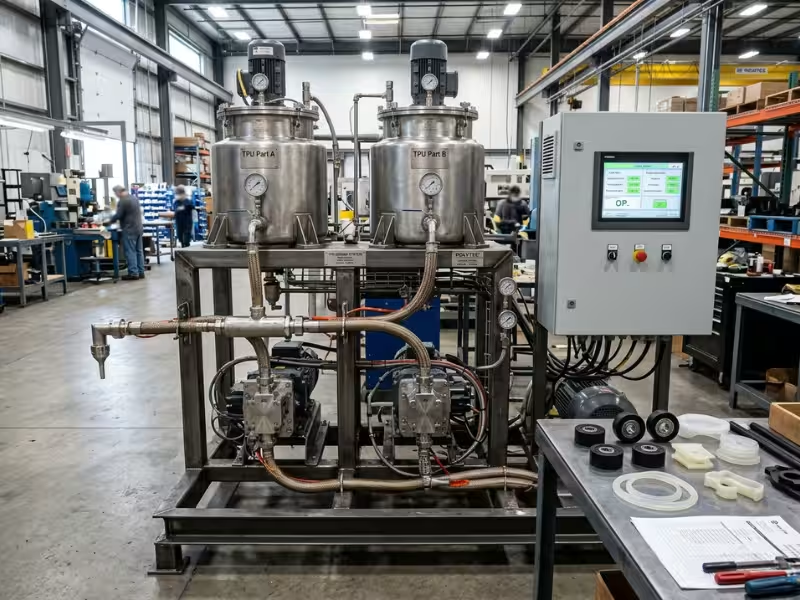
Processing matters here almost as much as formulation. TPU properties depend on stable feeding, accurate ratios, and tight temperature control. Even a great grade loses toughness if the dosing drifts. That’s why manufacturers making TPU parts focus on choosing the right TPU dosing machine for consistent output.
How to Tell Which Type of Polyurethane You Need
Most buyers don’t need a formula. They need a material that fits the job. I start every project with one question: what will this part face every day?
If Insulation Matters Most
Choose rigid, closed-cell polyurethane. Its sealed cells trap low-conductivity gas and keep moisture out.
Ask suppliers for three numbers: R-value per inch, closed-cell content, and density. For spray foam, a good target is closed-cell content above 90% and a density near 2 lb/ft³ (32 kg/m³).
Open-cell foam costs less. But it lets water vapor through and typically insulates about half as well.
If Comfort and Cushioning Matter Most
Pick flexible foam, and forget the formula. Two specs tell you more: density and resilience.
Density predicts how long the foam keeps its shape. For daily-use seating, I avoid anything under 1.8 lb/ft³ (29 kg/m³).
Resilience, or ball rebound, shows how fast the foam springs back. High-resilience (HR) foam typically scores around 60% or higher.
If Wear, Friction, or Repeated Bending Matters
Go with TPU or a cast elastomer grade. These solid materials handle rubbing, cutting, and flexing far better than foam.
Don’t choose on hardness alone. Ask for three data points:
- Abrasion loss (ISO 4649): Lower numbers mean longer life. Many high-performance TPU grades typically come in under about 30 mm³.
- Tear strength: This shows how well a small nick resists spreading.
- Shore hardness: Softer grades grip and seal. Harder grades resist cuts and deformation.
For wet sites, polyether-based grades usually make the safer pick because they resist hydrolysis.
If Repairability or Remelting Matters
Ask one question before you buy: is this part thermoplastic or thermoset?
TPU is thermoplastic. You can heat-weld a torn conveyor belt, reshape a seal, or regrind scrap into new parts.
Thermoset foams and cast elastomers won’t melt. Once they crack or wear out, you replace them. If downtime costs you money, that difference matters more than a small gap in price.
Common Questions About Polyurethane Structure and Safety
Once people understand the structure, they ask about safety and recycling next. These are the questions buyers and facility managers raise most often.
Is Polyurethane Toxic After Curing?
The real risk sits in the factory, not in your home. Liquid isocyanates can irritate the lungs and skin. Repeated exposure can also trigger asthma. That’s why spray crews wear supplied-air respirators and plants run strict ventilation.
Once the reaction finishes, the isocyanate groups get used up. Cured polyurethane is largely inert. For spray foam, homeowners should follow the installer’s re-entry time, which is commonly 24 hours or more.
Is Polyurethane Recyclable?
Yes, but not as easily as most people hope.
Mechanical recycling works best today. Plants shred flexible foam scrap into rebond carpet underlay. TPU scrap can be reground and molded again.
Chemical recycling breaks thermosets back down. Glycolysis, for example, turns old foam into recycled polyol for new batches.
The limits are practical. Collection is patchy, and mixed additives make sorting hard. Much post-consumer foam still ends up in landfill or energy recovery.
Is Polyurethane the Same as Plastic?
In a broad sense, yes. It’s a synthetic polymer, so it belongs to the plastics family. But that label hides a huge range. The same chemistry gives you a soft pillow, a rigid insulation board, or a seal that can outlast rubber. Judge it by its structure.
How Is TPU Different From Standard Polyurethane?
TPU is polyurethane, not a separate material. The difference lies in the chains. TPU stays linear, so heat softens it, and you can mold, weld, or recycle it. Most foams and cast elastomers crosslink into thermosets that won’t melt. They share the same urethane bond but have a different architecture.
Polyurethane vs. Other Materials: What Changes in Practice
Clients rarely ask about polyurethane alone. They ask whether it beats the material they already use. The answer depends on what the part has to survive.
Against PVC, the big difference is where the flexibility comes from. PVC is stiff by nature. Makers soften it with plasticizers, and those additives can migrate out over time. The part then hardens and cracks, especially in cold weather or under sunlight. Polyurethane builds flexibility into its soft segments, so it has no plasticizer to leach out. For hoses, cable jackets, and wear strips, that usually means a longer service life.
Against rubber, elasticity often ends in a tie. Natural rubber can still win on low heat buildup during fast, repeated stretching. But when parts rub, slide, or meet sharp material, polyurethane often lasts several times longer. It also handles oil and ozone better than many common rubbers. That’s why I often move customers to polyurethane for rollers, screens, and chute liners.
Against epoxy, the question is movement. Epoxy cures hard and strong, which suits rigid bonds and chemical-resistant floors. But it can crack when joints shift. Polyurethane flexes with thermal movement, vibration, and impact. For floor topcoats, sealants, and bonds between different materials, polyurethane is usually the better fit.
The rule stays simple: match the material to the stress it faces, not to the label.
Structure Tells You More Than the Formula
Polyurethane isn’t one substance with one formula. It’s a family of polymers built from polyols and isocyanates, and every recipe creates a different chain.
That tunable structure is its real value. Shift the hard-soft segment balance, adjust the crosslinking, or change the cell structure, and the same chemistry becomes a cushion, an insulation panel, or a seal that outlasts rubber.
For manufacturers, structure also points to the process. Flexible seating foam, rigid panel cores, and TPU parts each need different metering, mixing, and curing control.
So read the structure first. Then choose the material and the production method that can deliver it consistently.