
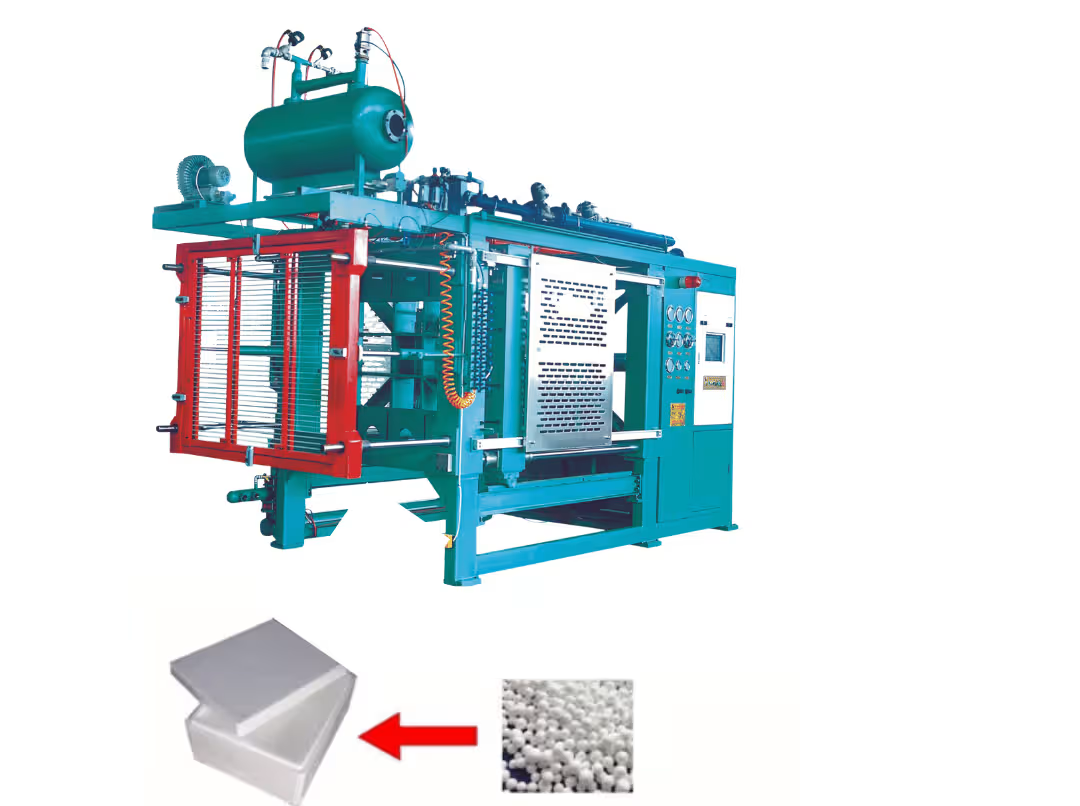
A cushion manufacturer wins a contract to supply 50,000 molded car seats per year. Their current process cuts shapes from foam blocks by hand—scrap piles up, dimensions drift between batches, and margins erode with every rejected unit. Meeting volume, precision, and cost targets at the same time requires a different process entirely.
That process is foam moulding. This guide is for factory owners, procurement managers, and production engineers who are evaluating whether to invest in a foam moulding machine—and if so, which type fits their operation. It covers how the equipment works, where buyers commonly go wrong, how to compare machine types, what drives cost over the machine’s life, and how to assess a supplier beyond the sales conversation.
What Is a Foam Moulding Machine?
A foam moulding machine—also written as foam molding machine in American English—is industrial equipment that produces finished foam parts by injecting liquid chemicals, typically polyurethane, into a closed mold. Once inside, the chemicals react, expand, and cure into the shape of the mold cavity.
The distinction from cutting is fundamental. Cutting removes material from a pre-made block to approach the shape you want. Moulding starts with liquid and forms the part directly in its final geometry. That means complex curves, variable-density zones, and embedded components—metal frames, wire inserts, plastic clips—can all come out of the mold without secondary bonding or significant scrap.
For manufacturers running repeatable, dimensionally tight parts at volume, that difference defines the economics of the entire production line.
Foam Moulding Machine vs. Foaming Machine vs. Foam Cutting Machine
This is where many buyers waste time and money before they’ve placed a single order. The three machines serve different stages of foam production and are not interchangeable.
|
Machine Type |
What It Does |
Output |
Best Suited For |
Waste |
|---|---|---|---|---|
|
Foaming Machine |
Mixes chemicals to produce raw foam in bulk |
Foam blocks or slabstock |
High-volume raw foam production |
Low |
|
Foam Cutting Machine |
Cuts finished shapes from cured foam blocks |
Cut parts from blocks |
Flexible shapes, prototyping, lower volumes |
Higher (offcuts) |
|
Foam Moulding Machine |
Injects chemicals directly into molds |
Final-shape parts |
Repeatable, complex parts at scale |
Near-zero |
The practical question is: which stage of production are you solving for?
If you need raw material—foam in block form that other processes will later cut or shape—you need a foaming machine. If your product mix changes frequently and mold investment isn’t justified, a cutting machine gives you the flexibility to respond. If you produce the same part consistently at volume and need tight dimensional control, a foam moulding machine is the right answer.
Many established foam factories run all three. The foaming machine produces slabstock; the moulding machine handles shaped components for automotive or furniture lines; the cutting machine covers custom dimensions or low-volume variations. The key is knowing which gap you’re filling before you start talking to suppliers.
How Does a Foam Moulding Machine Work?
The production sequence follows a consistent logic regardless of machine type or manufacturer.
Chemical storage and conditioning. Polyol and isocyanate are stored in separate tanks and held at precise temperatures. Stability here matters: chemicals that arrive at the mixing head outside their optimal temperature range produce inconsistent reactions, and the problem shows up as density variation or surface defects in the finished part.
Metering and mixing. The machine pumps both components through a mixing head at a controlled ratio. This is the most technically demanding step in the process. Ratio deviations of even a few percentage points alter the foam’s density, hardness, and cell structure. Quality metering systems hold ratio accuracy to within ±1% or better across the full operating range.
Injection. The blended liquid is dispensed into a preheated, release-coated mold. Injection speed has to be calibrated: too slow, and the material may start reacting before the cavity is full; too fast, and you get turbulence, voids, or short fills at the edges.
Expansion and cure. The chemical reaction causes the mixture to foam up and fill the mold. Cure time depends on formulation and part thickness—from under a minute for small components to several minutes for large, dense parts.
Demoulding. The mold opens and the finished part is removed. It may need trimming or assembly, but the geometry comes out of the mold ready.
Modern machines automate ratio control, injection timing, mold temperature, and cycle sequencing through PLC systems. This is what allows a production line to run thousands of identical parts with minimal operator intervention—and it’s also why control system quality is one of the first things to evaluate when comparing machines.
High-Pressure vs. Low-Pressure: Which Is Right for Your Operation?
This decision has more long-term impact than almost any other choice in the buying process, and it goes well beyond purchase price.
High-Pressure Machines
High-pressure systems mix polyol and isocyanate at 100–200 bar using impingement mixing—the two components collide at high velocity in the mixing head, achieving thorough homogenization without a mechanical agitator. The mixing head is self-cleaning: a hydraulic piston sweeps the chamber after each shot, eliminating chemical buildup and the need for solvent flushing between cycles.
The result is fast cycle times, minimal downtime between shots, low waste per cycle, and consistent output across long production runs. High-pressure machines are the industry standard for automotive seating, large-scale furniture components, and any application where throughput and part consistency are non-negotiable.
The trade-off is capital cost and maintenance complexity. High-pressure systems require more sophisticated upkeep and a higher level of technical competence from the maintenance team. For operations running two or three shifts daily on a single part design, that investment is recovered through lower per-part cost within two to three years. For a factory running short runs across many different products, the calculation is different.
Low-Pressure Machines
Low-pressure systems use mechanical mixing at lower operating pressures. Cleaning requires solvent flushing between runs or at end of shift, which adds consumable cost, cleaning time, and a small amount of chemical waste per cycle.
What low-pressure machines offer is flexibility and a lower entry point. Formulation changes are easier to accommodate, which matters for factories producing multiple foam grades or running product development work alongside regular production. For buyers who are new to foam moulding, or whose daily volumes are modest, low-pressure can be the appropriate starting point—with the option to step up to high-pressure as volume grows.
Making the Decision
The relevant calculation is not which machine is “better” in the abstract, but which fits your production profile.
For a factory producing one automotive component at high daily volume, the cleaning cycle time and solvent cost of a low-pressure machine compound into a meaningful throughput constraint across thousands of cycles per year. A high-pressure machine, despite the larger initial outlay, typically delivers a lower total cost per part within two to three years at that volume.
For a factory producing HR foam for furniture, memory foam for medical cushions, and rigid foam for packaging inserts—all on the same line, with regular changeovers—a low-pressure machine’s flexibility is a real operational advantage, not just a budget compromise.
|
Factor |
High-Pressure |
Low-Pressure |
|---|---|---|
|
Initial investment |
Higher |
Lower |
|
Cycle speed |
Fast |
Slower |
|
Cleaning method |
Self-cleaning mixing head |
Solvent flushing |
|
Waste per cycle |
Minimal |
Higher |
|
Chemical flexibility |
Moderate |
High |
|
Best fit |
High-volume, consistent production |
Mixed production, lower volumes |
|
Long-term cost per part |
Lower at scale |
Higher at scale |
If you are uncertain where your production sits, calculate your expected annual shot count and map the cumulative cleaning time and solvent cost of each system against that volume. The comparison usually makes the decision straightforward.
What Types of Foam Can a Foam Moulding Machine Produce?
The same machine can produce substantially different foam characteristics by adjusting the chemical formulation and machine parameters. This is one of the reasons moulding equipment is capable of serving multiple product lines within a single factory.
High Resilience (HR) Foam recovers quickly after compression and provides firm, durable support. It is the standard for premium seating in furniture and automotive applications.
Viscoelastic (Memory) Foam responds to heat and pressure, conforming to body shape before slowly returning to its original form. It is widely used in mattress toppers, pillows, and medical positioning products.
Rigid Polyurethane Foam does not compress under load and provides excellent thermal insulation. It is formed into panels and structural components for construction and refrigeration applications.
Integral Skin Foam forms a dense, smooth outer layer during the moulding process while the core remains cellular. The result is a part with a durable, leather-like surface and a light interior—without any secondary covering. Steering wheels, armrests, and gym equipment handles are typical applications.
|
Foam Type |
Key Characteristic |
Typical Products |
|---|---|---|
|
High Resilience (HR) |
Support, durability, fast recovery |
Furniture cushions, car seats |
|
Viscoelastic (Memory) |
Pressure relief, slow recovery |
Mattress toppers, medical cushions |
|
Rigid |
Structural strength, thermal insulation |
Insulation panels, refrigeration |
|
Integral Skin |
Dense surface, cellular core |
Steering wheels, armrests, handles |
Where Foam Moulding Machines Deliver Results
The machine earns its investment wherever consistent, complex foam parts are needed at volume. Several industries represent the core demand.
Automotive is the largest single market for polyurethane moulding. Seat cushions, backrests, headrests, armrests, and acoustic insulation mats are almost universally produced by moulding. The industry’s dimensional tolerances are measured in millimetres—a block-cutting process cannot meet those standards reliably at scale.
Furniture and bedding manufacturers use moulding for ergonomic chair seats, sofa cushions, and shaped pillow cores. Moulded parts hold their geometry over years of use more reliably than cut foam, which matters for premium product lines where returns are costly.
Medical applications—wheelchair seat cushions, postural supports, pressure-relief pads—require specific density targets and precise geometry. Moulding is the only practical method for producing these components to clinical specifications in production quantities.
Packaging for fragile electronics and precision instruments uses custom-moulded rigid or semi-rigid foam inserts. The fit is exact, the protection is superior to generic alternatives, and per-unit cost is competitive at sufficient volume.
Construction panels made from rigid polyurethane foam are moulded to precise dimensions and used as continuous insulation in wall assemblies, roofing systems, and refrigeration panels.
How to Choose the Right Foam Moulding Machine
Most purchasing mistakes in this category happen before the buyer contacts a single supplier. The evaluation should start internally.
Pin down your actual production volume. Not a projected number under optimistic conditions—your real current volume and a conservative 12-month estimate. This determines the cycle time requirement, which drives machine class and whether automation pays. A machine sized 30% below real demand becomes a production bottleneck within months; a machine significantly oversized runs inefficiently and ties up capital that could be deployed elsewhere.
Know your part geometry and insert requirements. A flat seat cushion makes different demands on the mold and injection system than a complex automotive backrest with embedded wire frames and clip attachments. Bring actual drawings or samples to supplier conversations before evaluating their recommendations. Suppliers who make recommendations without seeing your parts are guessing.
Assess how often your product mix changes. A factory running one part design continuously benefits from a different setup than one producing six or eight components on the same machine. Changeover time, mold storage space, and the number of chemical formulations in regular use all affect the machine specification that makes sense for your operation.
Decide how much automation fits your situation. Fully automated systems with robotic demoulding and mold release application reduce labor dependency and improve consistency, but they require higher capital and more capable maintenance. Semi-automatic systems are a practical middle ground for operations where trained labor is available. There is no universal right answer—it depends on your labor cost, production volume, and available floor space.
Check your facility constraints before issuing a specification. Power supply, compressed air capacity, floor area, and ventilation requirements all affect which machines are technically feasible at your site. Suppliers who do not ask about these factors early in the conversation are not doing their job.
Specify metering accuracy in writing. This is where many buyers accept vague claims. Ask for the guaranteed ratio accuracy across the full operating range of the machine—not just at nominal conditions—and ask how that accuracy degrades as components age or as chemical viscosity changes with temperature. The specificity of the answer tells you a great deal about the supplier’s technical depth.
Pre-purchase checklist:
- Annual and daily output targets confirmed against machine cycle time
- Shot size validated against your largest and most demanding part
- Automation level matched to labor plan and quality requirements
- Mold changeover time assessed against your product mix and shift structure
- Metering accuracy specified with tolerances, not marketing language
- Floor space and utility requirements verified against your facility
- Integration with existing conveyor, curing, or assembly equipment confirmed
Understanding Foam Moulding Machine Cost
Price ranges in this category span a very wide band, and the figure in an initial quote tells you little about what the machine will actually cost to run.
The main variables that move the purchase price are machine type, level of automation, maximum shot size, mixing head design, and the number of molds included in the package.
Beyond purchase price, the total cost of running a foam moulding machine over five to ten years includes mold fabrication and maintenance, chemical consumption and cleaning solvents, energy, maintenance labor and consumables, spare parts, and downtime. For a high-volume operation, downtime cost alone can exceed the annual maintenance budget if the machine or supplier support proves unreliable.
The most useful comparison metric is cost per part under realistic production assumptions. A machine that costs 30% more but runs 20% faster with 50% less scrap and a longer service interval will almost always produce a lower total cost per part over its working life than a cheaper alternative with higher operating costs. Suppliers who help you work through this calculation are the ones worth engaging seriously. Those who only quote price are not.
One cost that buyers consistently underestimate is mold investment. For complex parts, tooling can represent a significant portion of the total project cost. Ask about mold life expectancy, maintenance requirements, and whether the supplier manufactures molds in-house or through a third party—each option has implications for lead time, quality control, and long-term support.
Common Mistakes Buyers Make
These patterns appear consistently in purchases that underperform expectations.
Choosing on price alone. The cheapest machine in this category typically carries the highest total operating cost within three years. Metering accuracy, mixing head quality, and control system reliability are not reflected in a headline price but determine whether the machine produces good parts consistently across its working life.
Buying capacity based on optimistic projections. Oversized machines run inefficiently at lower throughput and tie up capital. Size the machine for real current demand and plan for additional capacity as it materializes.
Ignoring mold changeover time. A factory producing multiple products needs to know exactly how long a changeover takes and how that time affects net daily output. A machine that requires three to four hours to change molds is a fundamentally different production tool from one that can be changed over in under an hour.
Treating the machine and supplier as separate decisions. The machine is the hardware; the supplier is the service infrastructure behind it. A technically capable machine backed by poor parts availability and slow technical support will underperform a slightly less capable machine with strong after-sales coverage. Evaluate both together.
Not verifying metering accuracy under realistic conditions. Ratio accuracy at nominal operating conditions is one thing. Accuracy during the first hour of a cold shift, with aged chemical components, or immediately after a formulation changeover is another. Ask how the system performs under these scenarios, and ask for test data rather than claims.
Underestimating commissioning time. Installation, calibration, operator training, and process qualification take real time. Projects that compress this phase to get to production faster generate scrap, erode confidence in the equipment, and often require a second commissioning visit at additional cost.
How to Evaluate a Foam Moulding Machine Supplier
The supplier relationship matters for the entire working life of the machine. Evaluating a supplier properly requires looking well beyond the product specification.
Manufacturing experience and production scale. Suppliers who manufacture at meaningful volume have usually encountered and resolved the failure modes that less experienced manufacturers are still discovering. Ask how long they have been producing foam moulding equipment and what their current annual output is.
Pre-shipment testing protocol. Every machine should be run and tested before it leaves the factory, ideally with the chemical system loaded and producing actual test parts. Ask what the acceptance test includes and whether you can receive documentation or video. A supplier who cannot describe a clear testing protocol is a supplier who is not testing thoroughly.
Export track record and regional support capability. A supplier with consistent export history has dealt with international logistics, documentation, and the challenge of supporting customers across time zones and languages. Ask which regions they currently serve actively and how they handle urgent technical support outside business hours.
Spare parts lead times. Ask for the lead time on the twenty most commonly replaced components from the supplier’s warehouse. This answer is more informative than any general statement about after-sales service.
Customization depth. Standard configurations do not fit every production scenario. A supplier who can modify shot size, mold clamping force, automation level, or the chemical delivery system to match your requirements is more valuable than one who sells from a fixed catalogue.
References in your industry. Ask for contact details of two or three customers with a similar production profile. The willingness to provide names—and the quality of those conversations—tells you more than any brochure.
Questions to ask before committing:
- What is the lead time from order confirmation to delivery at our facility?
- What does the warranty cover, and for how long?
- Is installation and commissioning included, or quoted separately?
- Do you provide on-site operator training, and what does it cover?
- What is your average response time for technical support requests?
- Will spare parts for this machine model be available in ten years?
Frequently Asked Questions
What is a foam moulding machine used for?
It produces finished foam parts directly in their final geometry—car seats, cushions, insulation panels, armrests, medical supports, and similar components. The machine injects liquid polyurethane into a closed mold, where the material reacts, expands, and cures. The output is a dimensionally consistent part with near-zero material waste.
What is the difference between a foam moulding machine and a foam cutting machine?
A moulding machine forms parts in their final geometry from liquid chemicals. A cutting machine slices shapes from pre-made foam blocks, which produces offcuts and limits the geometric complexity achievable. Moulding suits high-volume production of consistent, complex parts. Cutting suits flexible, lower-volume applications where part designs change frequently and mold investment cannot be justified.
How do I decide between high-pressure and low-pressure?
The primary factors are daily production volume and the frequency of formulation or product changes. High-pressure systems are faster, self-cleaning, and more cost-efficient at sustained high volume. Low-pressure systems are more flexible, easier to manage across multiple chemical formulations, and lower in initial cost. Calculate your expected annual shot count and the cumulative cost of cleaning cycles for each system type—at sufficient volume, the math usually makes the answer clear.
How much does a foam moulding machine cost?
Purchase price varies widely by machine type, automation level, output capacity, and included tooling. More useful than any single number is evaluating total cost over five years—including molds, chemicals, energy, maintenance, and downtime. The machine with the lowest purchase price is rarely the lowest total cost option over its working life.
What types of foam can a PU foam moulding machine produce?
By adjusting the chemical formulation and machine parameters, the same machine can produce high resilience foam, memory foam, rigid foam, and integral skin foam. This versatility allows a single machine to serve multiple product lines within one factory without major equipment changes.
Is maintenance difficult?
Modern machines are designed for accessibility, with serviceable components and PLC diagnostics that flag developing issues before they cause stoppages. The more important variable is supplier support: access to technical expertise and rapid spare parts supply determines whether routine maintenance stays routine or escalates into a production crisis.
Conclusion
A foam moulding machine is a long-term production asset, and the decision of which machine to buy—and from whom—compounds over years of operation. Getting the machine type right, sizing it to real demand, understanding the full cost structure, and selecting a supplier with the depth to support the equipment through its working life are the decisions that determine the actual return on investment.
The manufacturers who get the best results from foam moulding equipment are the ones who did the analysis before issuing a purchase order. They knew their volumes, their part requirements, their changeover constraints, and the questions worth asking a supplier. Those who bought on price or specification alone often find themselves revisiting the decision within three years.
If you are evaluating options for your production line, the most productive starting point is sharing your product drawings, annual volume targets, and current production setup with a qualified supplier. That conversation—about a configuration matched to your requirements, not a product from a catalogue—is where the real evaluation begins.
To discuss your requirements, request a machine configuration recommendation, or receive a detailed quotation based on your production profile, contact the Henghui Machinery team directly by email, phone, or WhatsApp.