
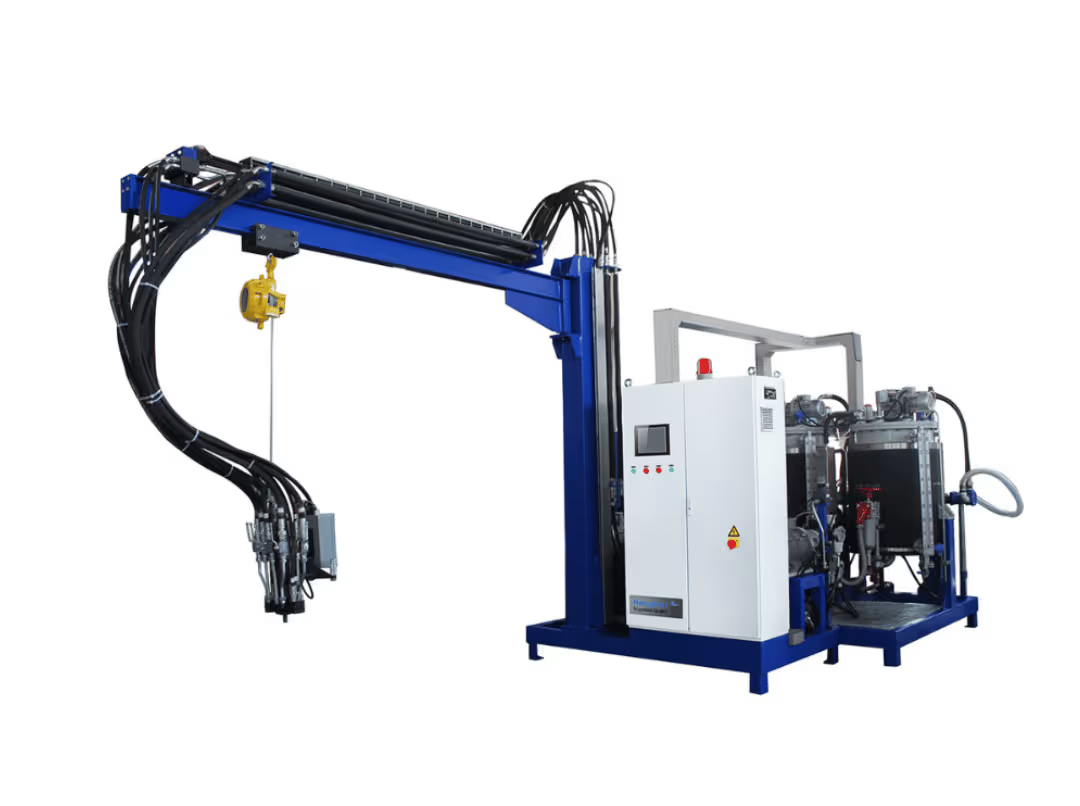
Most polyurethane molding machines get specified in the wrong order. The buyer picks a machine class first — often because a high-pressure RIM system looked impressive on a factory tour — and spends the next two years running parts on equipment that was never the right fit. The logic should run the other way: settle the part, then the chemistry, then the volume, and the machine class narrows down to one or two real candidates on its own.
This guide follows that sequence. It covers what the machine actually controls, how the products you make dictate which system belongs in your plant, where the high-pressure versus low-pressure line genuinely falls, and the operating costs that decide whether a purchase pays back or sits underused.
What a Polyurethane Molding Machine Actually Controls
A polyurethane molding machine meters, mixes, and dispenses two reactive liquids — polyol and isocyanate — into a mold at a precise ratio, then holds conditions steady while they react into a finished part.
Every real difference between machine classes comes back to how well they do that. Polyurethane isn’t melted and cooled like a thermoplastic — it’s a chemical reaction that starts the moment the two components meet, and it doesn’t hold for a slow operator. If the ratio drifts a few percent, the part comes out soft, brittle, or dimensionally wrong. If the mix is incomplete, you get streaks, voids, and weak zones that only appear after demold, usually in the customer’s hands.
The machine is, at its core, a chemistry control device wearing a mechanical body. Its metering pumps hold ratio shot after shot. Its mixing head brings both streams together completely in the fraction of a second before the reaction locks them. Its temperature system keeps viscosity inside the window the pumps and mixing head need to work.
The number that matters most isn’t rated shot size — it’s how tightly the machine holds ratio across a full production shift, not on a calibration run. A machine hitting its output target while drifting on ratio is producing scrap at full speed.
What You’re Making Tells You More Than Any Spec Sheet
The product family you’re running is a more reliable selection filter than any feature list. Polyurethane is chemically tunable across an enormous range, and different parts pull the machine in entirely different directions.
- Flexible foam parts — seat cushions, mattress cores, packaging inserts. Forgiving on mix pressure, but density consistency has to hold shot to shot.
- Rigid insulation and structural foam — refrigerator panels, insulated boards, structural housings with a dense skin over a foam core. Controlled expansion and temperature stability are non-negotiable.
- Shoe soles — fast cycles, high shot repeatability, often on rotary tables running many small molds simultaneously. Consistency across dozens of small shots matters more than raw shot size.
- Automotive elastomers and microcellular trim — bumper fascia, steering wheels, interior components. Dense, unforgiving parts that need thorough mix quality. This is where low-pressure starts to struggle.
- Seals, gaskets, and encapsulation — potting electronics, specialty gaskets, cast elastomers. Usually low-volume, precision-driven work that suits casting over injection.
The divide is already visible: soft, high-volume foam and dense, precise elastomers are asking fundamentally different things of a machine. That divide is the one the whole purchase decision turns on. Recognize which side your product lives on before you talk to a single supplier.
How the PU Molding Cycle Works — and Where It Goes Wrong
Every polyurethane molding cycle runs the same five stages. Each one is a place a machine can help you or fail you, and the weakest stage governs the whole.
Metering. Pumps deliver a set volume of polyol and isocyanate at a fixed ratio. Part quality is won or lost here. Ratio accuracy has to hold shot after shot — not just on the morning calibration, not just when the material is warm.
Mixing. The two streams combine into a homogenous blend before the reaction advances. How they combine — mechanical stirring at low pressure or high-velocity impingement — is the single biggest difference between machine classes and it drives everything downstream.
Injection. Mixed material enters the mold before the gel point. The working window between mix and gel is short, and it shrinks as the chemistry gets faster or the ambient temperature rises.
Cure. The part reacts and sets in the mold. Cure time — not machine speed — usually sets the real cycle time. A rated 60-shots-per-hour machine feeding a 90-second cure runs at 40.
Demold. The finished part is removed, the mold is cleaned or release-coated, and the cycle repeats.
The point is simple: an impressive machine specification doesn’t override a slow mold, an undertrained operator, or a chemistry window the machine can’t hold consistently. Rate the machine against your weakest stage, not against its own datasheet.
High-Pressure vs Low-Pressure: Where Most Buyers Make the Wrong Call
This is the fork the whole purchase hinges on. Competitors routinely flatten it into a two-row comparison table. It deserves more than that, because the two classes mix the components in fundamentally different ways, and that difference runs through every aspect of daily operation.
How Each One Mixes
Low-pressure machines mix mechanically. The two streams meet in a chamber with a rotating stirrer, at relatively modest pressure. The chamber needs flushing — usually with solvent — between shots to prevent material curing inside it.
High-pressure machines use impingement. The two streams are forced together at high pressure and collide with enough energy to mix completely on contact, with no moving part in the mix zone. The head flushes itself with each new shot rather than with solvent.
That one difference cascades through mix quality, cycle speed, maintenance demands, and per-part operating cost.
Where Each One Actually Wins
Low-pressure suits flexible and rigid foams, larger pour volumes, and small-to-medium batch sizes. It’s simpler to operate and cheaper to buy and maintain. The downside is the solvent flushing — consumable cost, disposal, and a few seconds of downtime per cycle that add up on a busy line.
High-pressure suits elastomers, microcellular parts, fast-reacting chemistries, and sustained high-volume runs. Self-cleaning heads run faster with less consumable cost per part. Mix quality is more thorough and more consistent, which matters on parts that expose any variation as scrap. The cost is higher capital and a mixing head that demands careful maintenance — worn sealing surfaces degrade mix quality before the problem shows up in part inspection.
The Three Questions That Actually Decide It
Go through these in order, and stop when one of them gives a clear answer:
1. What is the part? Dense solid elastomer or microcellular part → high-pressure. Flexible or rigid foam → low-pressure usually handles it.
2. What is the volume and run pattern? Steady, sustained high volume makes high-pressure pay back through faster cycles and lower per-shot consumable cost. Variable or low-to-medium volume rarely recovers the capital premium.
3. What mix quality does the part actually require? A soft cushion tolerates mix variation that a structural housing or sealing elastomer will fail on. Know which side your tolerance sits on.
When the three answers point the same direction, the choice is clear. When they conflict, the part usually wins. You can run foam acceptably on a well-specced low-pressure machine. You cannot substitute mix thoroughness on a demanding elastomer — that gap shows up in the parts, not the spec sheets.
When Vertical Casting or Automation Makes Sense
Two configurations sit outside the high-versus-low split. Both get purchased for the wrong reasons often enough that they’re worth addressing directly.
Vertical casting machines dispense downward into open or gently closing molds, often on a rotary table. They belong on encapsulation, precision potting, artistic reproduction, and cast elastomer parts — applications where the process is placing material carefully into a mold, not forcing it under injection pressure. If your parts include inserts to encapsulate or open cavities to fill, casting fits the process naturally. Forcing that work onto an injection-configured machine fights the chemistry at every cycle.
Fully automated cells — integrating the metering unit with robots for mold handling, release-agent application, and demold — pay back on genuine high-volume repetitive production: automotive interiors, appliance components, lights-out runs of the same part. The mistake is buying automation to handle variety. A cell running frequent product changes spends most of its time being reprogrammed and re-rigged. The robots that were supposed to reduce labor become a maintenance and changeover burden. Automation earns its cost on volume and repetition. Not on having the most capable-looking floor.
Product to Machine: The Matching Logic
This is where the selection actually resolves. Read across to your product, not down a feature list.
Flexible foam cushions and cores: Low-pressure metering, generous shot size, density consistency is the priority. High-pressure is overbuying — you pay for mix quality the part will never test.
Rigid insulation and structural foam: Low- or high-pressure depending on skin quality requirements and volume. Temperature control is the real non-negotiable here — expansion behavior is directly tied to it, and skimping on thermal management creates problems the machine spec can’t fix.
Shoe soles: Shot-to-shot repeatability and cycle speed, usually on a rotary table with many small molds. The machine needs to hold ratio consistently across dozens of small shots per shift, not just prove it can hit a large output number on a demo run.
Automotive elastomers and microcellular trim: High-pressure RIM. Mix quality and reaction speed determine whether the part is structurally sound. This is where low-pressure machines run out of headroom, and where buying down on machine class creates a scrap problem that compounds with volume.
Seals, gaskets, and encapsulation: Vertical casting, precision over throughput, gentle fill over injection force. Don’t put this work on an injection-configured machine because injection is what you know — the process fit matters more than equipment familiarity.
The pattern across all five: soft and high-volume rewards throughput and a forgiving mix window. Dense and structurally demanding rewards mix quality and process control. Low-volume and precision-driven rewards casting flexibility. Find where your product lands in that pattern and the machine class is no longer a guess.
The Costs That Don’t Show Up in the Quote
Purchase price is what everyone compares first and what matters least over a machine’s operating life. The real cost of ownership sits in the daily operation — and it’s rarely in the quote.
Mixing head maintenance. On high-pressure machines, the head is precision-critical. Worn sealing surfaces degrade mix quality gradually, and the scrap rate creeps up before anyone connects it to the head. Ask about rebuild intervals and replacement part costs for your specific head configuration, at your run volume.
Flushing and cleaning downtime. Low-pressure machines flush the mix chamber with solvent between shots. Across a full year on a busy line, the solvent consumption, disposal cost, and per-cycle downtime are real expenses that rarely appear in a capital comparison.
Ratio drift. Metering pumps drift with wear and temperature variation. A machine that isn’t regularly calibrated produces off-ratio shots that often pass visual inspection and fail in use. Calibration has to be a scheduled routine, not something that happens after a customer complaint.
Temperature instability. Component viscosity is temperature-dependent. Viscosity change shifts the volume the pumps actually deliver at a given setting. Plants that underspend on tank and line heating chase quality problems that trace directly to the cold start of a morning shift.
Off-ratio scrap. Every drifted shot wastes both components — expensive raw materials — plus the mold time and operator time behind it. On dense elastomers this is often the single largest operating cost, and it stays invisible until someone compares reject rate against material consumption. That comparison is usually a shock.
Operator training. These machines reward process discipline and punish improvisation. An untrained team on a sophisticated machine produces expensive scrap efficiently. Budget for commissioning training explicitly — not as an afterthought once the machine is on the floor.
Spare parts and service lead times. Get actual regional lead times on mix-head components, pump seals, and control parts — not availability from a central warehouse in another country. A metering pump waiting three weeks for a replacement part while the line is down costs more than the price gap between a well-supported supplier and a cheaper one.
What Gets Bought Wrong, Repeatedly
Specifying automation for work that changes constantly. A robotic cell running weekly product changes spends its life being reconfigured. The efficiency it was bought to deliver never materializes. Match automation level to how repetitive the work genuinely is — not to how capable the floor should look.
Treating the chemistry as a secondary decision. Machine specification around shot size and output rate while the polyurethane system is treated as something to sort out later. The chemistry — reactivity, viscosity, working window — is the primary constraint. It determines whether the machine can run your part at all, not whether it runs it well.
Buying high-pressure for foam that doesn’t need it. The machine that looked best on the supplier visit is not the right machine for a soft cushion production line. You carry mix-head maintenance costs for mix quality the part never tests, and you pay capital premium for capability that sits unused.
Running a demo as a substitute for a trial. Supplier demos use their formulation, their material temperatures, and their experienced operators. Your components, your ambient conditions, and your operators behave differently. A trial on your own polyurethane system on the actual machine you’re considering is a reasonable requirement. A supplier who won’t accommodate it is telling you something worth knowing before you sign.
Leaving utilities out of the capital plan. Three-phase power, compressed air at the right volume and pressure, chilling capacity, and tank heating are part of the installation, not line items to budget after delivery. Scope them before the purchase decision, not after.
Who Should Wait Before Buying
Not every operation is ready for dedicated polyurethane molding equipment, and buying ahead of readiness produces expensive machines running well below their capability.
Wait if your volume is genuinely low and your parts are still one-off or custom. The capital cost rarely pencils out at that scale, and a competent contract molder is usually cheaper and better until demand builds. Wait if your product specifications are still in flux. A machine configured for a spec that changes next quarter is a tool that immediately needs replacing. Wait if your team doesn’t have process discipline yet. These machines are unforgiving of casual operation, and without trained people the scrap rate absorbs the efficiency the machine was supposed to provide.
None of these are permanent states. Volume grows. Specs settle. Teams develop. The right time to buy is when the operation is genuinely ready to use the equipment well — not when buying the machine is expected to force the operation to catch up.
Questions to Ask Before You Commit
Ask these before you compare prices. The answers tell you whether a supplier understands your process or is moving a machine.
- Will you run a trial on my polyurethane system — my components, my target ratio, my actual part — before I order?
- Which machine class fits my product and volume, and what’s the honest case against the other option?
- What ratio accuracy does this machine hold across a full production shift — not a calibrated demo shot?
- What are the mixing head rebuild intervals and component costs for my configuration at my run volume?
- What solvent or flushing cost should I budget per cycle, and what does disposal require in my facility?
- What temperature control does my chemistry need, and is that scope included in the quote?
- What are the utility requirements — power, air supply, chilling — and are they in the contract?
- What training do you deliver at commissioning, and what operator skill level does the machine assume?
- What are actual in-region lead times on mix-head parts, pump seals, and control components?
- What service response time can you commit to in writing, for my location?
Pre-Purchase Checklist
- Part type and required physical properties defined across everything the machine will run
- Polyurethane system chemistry confirmed compatible with the machine class
- High-pressure vs low-pressure decided on part, volume, and mix quality — in that order
- Casting or automation either justified on the real product mix, or explicitly ruled out
- Ratio accuracy verified over a full-length production run, not a single shot
- Trial completed using your own components and your actual part geometry
- Mixing head rebuild intervals and replacement costs confirmed for your configuration
- Flushing, solvent, and cleaning costs estimated per cycle at your expected run length
- Temperature control scope confirmed for your material system
- Utility requirements — power, air, chilling — confirmed and budgeted before signing
- Operator training schedule and scope agreed at commissioning
- Off-ratio scrap cost estimated against your material spend
- Spare-part lead times confirmed for your region
- After-sales response commitment in writing
Anything still open when you’re ready to sign is a conversation to finish first.
FAQ
What is the difference between high-pressure and low-pressure polyurethane molding machines?
Low-pressure machines mix the components mechanically in a chamber and flush it with solvent between shots. High-pressure machines use impingement mixing — the streams collide at high velocity in a self-cleaning head that flushes with each shot rather than solvent. High-pressure delivers better mix quality and faster cycles for dense elastomers and sustained high volume. Low-pressure is simpler, cheaper to run, and well-suited to foams and smaller batches.
Which machine is right for flexible foam production?
A low-pressure metering machine handles flexible foam well. Foam formulations are forgiving on mix pressure, and what actually matters is density consistency and adequate shot capacity. High-pressure can run foam, but it’s overspecified for soft cushion and core production — you carry mix-head maintenance costs for mix quality the part never demands.
Do I need a fully automated production cell?
Only if your work is genuinely high-volume and repetitive on the same part family. Automated cells earn their cost on repetition — automotive interiors, appliance lines, lights-out production of consistent parts. If your product mix changes often, the cell spends more time being reconfigured than producing, and the automation becomes a bottleneck rather than an advantage.
What is the biggest hidden operating cost on a PU molding machine?
Off-ratio scrap. Every drifted shot wastes expensive polyol and isocyanate plus the mold time and labor behind it. On dense parts, this cost typically dwarfs any purchase-price difference between machines. It stays invisible until someone compares reject rates against material spend — which is exactly why ratio calibration and temperature management matter more than most buyers realize before installation.
Can one machine cover both foam and solid elastomer parts?
Not well from a single setup. Foam runs acceptably on low-pressure. Demanding solid elastomers need high-pressure mix quality to hold structural integrity. A high-pressure machine can run foam adequately if needed, but the reverse almost never works. If you genuinely need both, confirm it with a trial on both material systems on the actual machine before committing.
How important is a trial run before buying?
It’s the most useful thing you can do before signing. A supplier demo uses their formulation, their material temperatures, and their trained operators. Your system — your components, your ratio, your ambient conditions — behaves differently. A trial on your own material on the specific machine you’re considering tells you what the production reality will look like. A supplier who refuses that request has answered a useful question about what the support relationship will look like after installation.
Before You Commit
The sequence protects you: define the part and its properties, confirm the chemistry, let volume and mix-quality requirements narrow the machine class — and arrive at a machine name last. Get that order right and the high-pressure versus low-pressure question, the casting versus injection question, and the manual versus automated question all resolve from your production facts, not from a supplier’s pitch.
Run a trial on your own system. Push hard on ratio accuracy, mixing-head maintenance, flushing cost, and regional spare-part support before the price comparison starts. A supplier who will run your material, give you the honest case for and against each option, and back the equipment with real service coverage is worth more than the lowest sticker price. One who steers away from the trial and focuses on output claims has shown you what the relationship looks like once your production depends on it.