
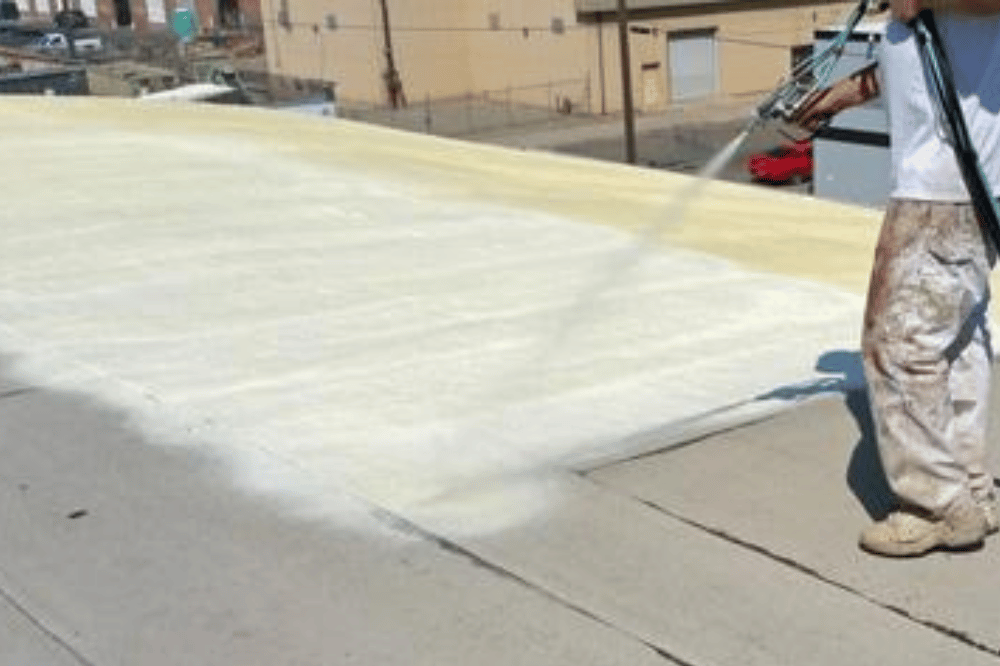
Spray polyurethane foam (SPF) roofing delivers energy savings through three compounding mechanisms: high thermal resistance (R-6.5 per inch), a seamless air barrier that eliminates infiltration, and a reflective topcoat that deflects solar heat. Together, these can reduce HVAC costs by 30–50%, with initial investment recouped in as little as 3–4 years. No other roofing system combines all three in a single application.
Most commercial roofs do one job: keep water out. They don’t insulate particularly well; they constantly leak air through seams and penetrations; and on a hot day, a dark membrane surface absorbs heat like a radiator pointed directly at your HVAC system.
Spray polyurethane foam roofing was engineered to fix all three of those problems simultaneously. From years spent working with polyurethane processing systems and foaming equipment across different production environments, one thing stands out about SPF as a roofing solution: the chemistry itself does what other systems try to approximate with layers of separate materials.
This post covers how SPF roofing delivers those energy savings in practice—the thermal physics, the air-sealing mechanics, the cool roof effect, and what it actually means for HVAC runtime and long-term operating costs. There’s also a plain-language FAQ and a realistic look at the financial picture over a 30-year lifecycle.
The Science of Thermal Resistance and R-Value
R-value measures how strongly a material resists heat flow. The higher the number, the more effective the insulation. Most roofing insulation products—rigid polyiso boards, mineral wool, fiberglass—land in the range of R-3 to R-4 per inch, depending on the product and temperature.
SPF delivers R-6.5 per inch. That’s the highest thermal resistance of any commercially available roofing insulation.
That gap matters at the equipment level. A higher R-value per inch means you can achieve a given thermal performance target with less material thickness, less added dead load, and less structural strain on the roof deck. For buildings where load is a constraint, this is a real advantage. SPF adds only about 0.5 to 0.75 pounds per square foot. Traditional built-up roofing can run as heavy as 6 pounds per square foot—an order of magnitude more.
For buildings transitioning from minimal or zero insulation to even 2–4 inches of foam, the thermal impact is immediate. According to data from West Roofing Systems, HVAC cost reductions of 15–30% are achievable in extreme climates when replacing an under-insulated roof with SPF.
The physics here are straightforward: less heat transferred through the roof means less heat the HVAC system has to compensate for. Smaller energy load, shorter runtimes, lower bills.
Eliminating Air Leaks with a Seamless Barrier
R-value is only part of the performance story. It measures resistance to conductive heat transfer—heat moving through a material. What it doesn’t measure is air movement, and that’s where many roofing systems quietly fail.
Research published in the journal Energy and Buildings estimates that up to 40% of energy loss in buildings is attributable to air infiltration. Seams, penetrations, joints around HVAC equipment curbs, and aging flashing details are all pathways for conditioned air to escape and unconditioned air to enter. These openings are often invisible and never get fixed because they’re not dramatic enough to notice—until you look at the utility bill.
SPF eliminates those pathways by the nature of how it applies. The material expands approximately 30 times its liquid volume after spraying, conforming to irregular surfaces, filling gaps around penetrations, and sealing every seam in a single monolithic layer. There’s no panel assembly, no cut edges that leave gaps, and no thermal bridging through fasteners.
The result is a roofing surface that functions simultaneously as insulation, an air barrier, and a waterproofing layer. Three systems in one application.
The EPA’s Energy Star program estimates that sealing air leaks alone saves an average of 15% on monthly heating and cooling costs. SPF roofing doesn’t just reduce air leakage—it effectively eliminates it at the roof plane. Spray foam insulation has also been shown to reduce HVAC sizing requirements by up to 35%, because the system no longer has to compensate for the constant air exchange that unsealed roofs allow.
Cool Roof Technology and Solar Reflectance
The third layer of SPF’s energy performance is solar reflectance. The foam itself is an excellent insulator, but the topcoat—typically a white silicone or acrylic elastomeric coating—handles what foam alone can’t: it reflects incoming solar radiation before it ever converts to heat.
A standard dark membrane roof absorbs roughly 90–95% of incident solar energy. On a hot summer day, that roof surface can reach 150–180°F. That heat conducts through the deck and into the building, directly increasing the cooling load.
A properly coated SPF roof achieves 85% or greater solar reflectance. According to data from West Roofing Systems, the surface of a reflective SPF roof can run 80°F cooler than a comparable dark membrane on the same day. The cooling load reduction from reflectance alone typically ranges from 10–20% in warm climates, in addition to the savings from insulation and air sealing.
This is what qualifies SPF systems as cool roof technology under programs such as ENERGY STAR and California’s Title 24. Buildings in warm climate zones can see the most pronounced benefit, particularly facilities that run air conditioning for extended periods of the year.
Reducing HVAC Strain and Maintenance Costs
Energy costs are the obvious metric. But the secondary benefit—reduced HVAC load—has its own financial implications that don’t always show up in the initial analysis.
Heating and cooling account for approximately 55% of energy use in buildings, according to Natural Resources Canada. The HVAC equipment serving that load runs in cycles: the more heat gain or loss through the roof, the more frequent those cycles, the more wear on compressors, fans, and controls.
When SPF reduces the thermal and air infiltration load, HVAC systems cycle less. They reach setpoint faster and hold it longer. Compressor runtime decreases. Maintenance intervals stretch. Equipment that might otherwise need replacement in 12–15 years runs well past that threshold.
This is a material consideration for facilities managers considering capital planning. A roofing decision that extends the life of HVAC equipment by several years is not a trivial secondary benefit—it’s a real reduction in future capital expenditures.
Research by Texas A&M University that tracked energy savings from foam roofing found that the initial cost of the SPF system was recovered through energy savings in an average of 3–4 years. After payback, the savings continue for the life of the roof.
Environmental Impact Beyond Electricity Bills
Energy savings reduce operating costs. They also reduce carbon output, and that connection is quantifiable.
The Spray Polyurethane Foam Alliance (SPFA) published a Life Cycle Assessment Use Phase Analysis in March 2021, comparing SPF insulation to fiberglass insulation across three U.S. climate zones: Houston, TX (hot-humid), Richmond, VA (mixed), and Minneapolis, MN (cold). The study evaluated cumulative energy demand and global warming potential over a 75-year period using a standard 2,512-square-foot home insulated to 2018 IECC code requirements.
The finding: switching from fiberglass to SPF insulation reduces carbon emissions equivalent to removing 14 to 23 automobiles from the road for an entire year, in a single home. For a commercial building, those numbers scale accordingly.
SPF’s air impermeability also contributes here. Fiberglass achieves its rated R-value in controlled lab conditions, but field performance degrades when air moves around or through the batt. SPF maintains its thermal and air performance year after year. The SPFA report acknowledges that SPF carries a higher initial environmental cost than fiberglass during manufacturing, but that difference is recovered relatively quickly through operational energy savings in all three climate zones studied.
There’s also the question of lifespan. Dr. Rene Dupuis of Structural Research Inc., commissioned by the National Roofing Foundation, inspected more than 300 SPF roofing systems and concluded that SPF roofs have an effective service life exceeding 30 years. With periodic recoating—typically every 15 to 20 years—that extends to 50 years or longer. Fewer roof replacements mean less material waste, less tear-off debris, and less energy spent producing and installing new systems.
Frequently Asked Questions
How does SPF roofing R-value compare to other roofing insulation materials?
SPF delivers R-6.5 per inch—the highest available for commercial roofing. Standard polyisocyanurate board typically rates R-5.7 to R-6.5 per inch under ideal conditions, but loses effective R-value at low temperatures. Fiberglass batts have an R-value of 3 to 3.8 per inch. More importantly, only SPF creates a seamless air barrier while insulating, preventing the performance gap that affects most other materials in real-world conditions.
Is polyurethane roofing a good choice for cold climates as well as hot ones?
Yes. The SPFA’s 2021 Life Cycle Assessment specifically modeled SPF performance in cold climate Zone 6 (Minneapolis, MN) alongside hot-humid and mixed zones. SPF outperformed fiberglass insulation in all three zones for annual energy savings and long-term global warming potential reduction. The seamless air barrier is particularly valuable in cold climates, where the stack effect drives warm air out through roof penetrations and cold air in through lower openings.
What is the typical payback period for SPF roofing?
Research from Texas A&M University found that energy savings from SPF foam roofing systems recover the initial installation cost within an average of 3–4 years. Actual payback depends on existing roof insulation levels, local energy costs, climate zone, and foam thickness applied. Buildings with little to no existing insulation in extreme climates recover costs fastest.
How does SPF roofing affect the lifespan of HVAC equipment?
By reducing the thermal and air infiltration load on a building, SPF allows HVAC systems to cycle less frequently and operate closer to their design efficiency. Less runtime means less mechanical wear on compressors, fans, and controls. The downstream effect is longer equipment service life and reduced capital expenditure on HVAC replacements—a benefit that compounds over the roof’s 30–50-year service life.
Can SPF roofing be applied over an existing roof without tear-off?
In most cases, yes. SPF roofing adds only 0.5 to 0.75 pounds per square foot to the roof structure, compared to approximately 6 pounds per square foot for traditional built-up roofing. That low added weight often allows direct application over structurally sound existing single-layer roofs, eliminating the cost and waste associated with tear-offs. A professional inspection of the existing substrate is required to confirm suitability.
How does the reflective topcoat contribute to energy savings?
The white silicone or elastomeric coating applied over cured SPF foam achieves 85% or higher solar reflectance. On a hot day, a reflective SPF roof surface runs approximately 80°F cooler than a dark membrane roof. That temperature difference translates into a 10–20% reduction in cooling load in warm climates, on top of the savings from insulation and air sealing. The combined effect can reduce total HVAC energy consumption by 30–50%.
What maintenance does an SPF roof require to maintain its energy performance?
The foam substrate itself changes very little with age—Dr. Dupuis’s research across 300+ inspected systems confirmed that the physical properties of foam remain largely stable over decades. Maintenance centers on the topcoat, which requires reapplication every approximately 15 years to maintain UV protection and reflectance. Regular inspection of the coating condition and any point damage from foot traffic or equipment is standard practice.
The Long-Term Financial and Operational Case
Energy savings are compelling. The lifecycle cost picture is even more so.
A life cycle cost analysis commissioned by the SPFA and conducted by Michelson Technology LLC compared SPF roofing to membrane roofing systems across six U.S. climate zones over a 30-year period. The updated 2019 analysis—using RS Means construction cost data validated by contractor surveys—found that SPF roofing systems cost between $103,800 and $139,800 over 30 years.
The lowest-cost uninsulated membrane system came in at $168,800 over the same period—21% higher than the most expensive SPF option. When insulation was factored in, membrane systems ranged from $220,400 to $340,200. Even the cheapest insulated membrane system ran 58% more than the SPF system on the same recoating schedule.
Those numbers don’t include energy savings, which the analysis intentionally excluded to isolate the pure installation and maintenance cost comparison. Add the 15–30% reduction in HVAC energy costs back in, and the gap widens further.
The argument for SPF roofing isn’t a close call when the full cost picture is on the table. The initial cost per square foot is higher than that of a basic membrane installation. But the combination of superior thermal performance, seamless air sealing, cool roof reflectance, reduced HVAC load, minimal maintenance, and a service life that can exceed 50 years with proper recoating produces a lifecycle cost that conventional roofing systems consistently can’t match.
For facilities that pay their own energy bills—commercial, industrial, and institutional—polyurethane roofing is one of the few building-envelope investments that demonstrably pay for themselves on a documented timeline and continue generating returns for decades afterward.