
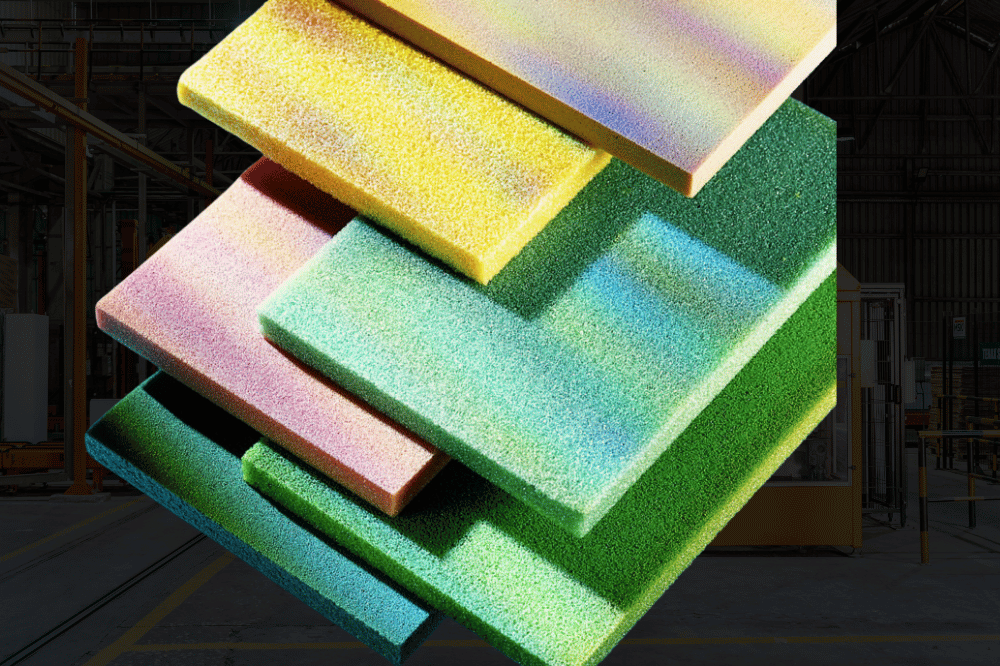
Structural foam molding is a low-pressure injection molding process that blends a thermoplastic resin with a foaming agent—usually nitrogen—to form a rigid outer skin around a cellular core. That sandwich structure cuts part weight by 10–30% while holding or improving stiffness, dimensional stability, and impact resistance. It shines on large, thick-section parts in logistics, medical, automotive, and utility applications where solid plastic or metal adds unnecessary cost, weight, or complexity. It’s not the answer for thin walls, high-gloss cosmetic surfaces, or multi-million-cycle commodity runs. This guide helps you decide when it fits your program—and when it doesn’t.
Spend enough time on a manufacturing floor, and a pattern emerges. The parts causing the most trouble—warped large panels, overweight pallets, cracked equipment housings, steel assemblies that corrode or conduct current where they shouldn’t—often share a single root cause. They were designed around a material that was never the right fit.
Structural foam molding has been around since the 1960s, but adoption is accelerating. That’s not hype—it’s driven by real production pressures: EV weight budgets, medical equipment certification demands, supply chain cost-cutting, and a genuine shift toward recyclable thermoplastics. Engineers and procurement leads who cut their teeth on solid resins are now taking structural foam seriously, often for the first time.
This guide is written for them. You’ll learn how the process works, where it performs best, how it stacks up against conventional injection molding, and how to tell quickly whether it fits your part.
Structural Foam at a Glance
Before we get into the engineering, here’s the whole decision in one view.
|
Question |
Short Answer |
|---|---|
|
What is it? |
A low-pressure molding process that forms solid skins around a cellular foam core |
|
Best for |
Large, thick-section parts that need stiffness at a lower weight |
|
Main benefits |
Weight reduction, lower tooling cost, dimensional stability, part consolidation |
|
Main trade-offs |
Swirl surface finish, thicker walls, slower cycles, not for Class A cosmetics |
|
Common materials |
HDPE, PP, ABS, PC, modified PPO |
|
Poor fit for |
Thin walls, high-gloss surfaces, micro-tolerance parts, multi-million-cycle runs |
Keep this table in mind as you read. Every section below expands on one row—and they all point back to the same idea: structural foam is a process choice, not a default. Match it to the right part, and it wins decisively.
How Structural Foam Molding Works
Structural foam is a low-pressure process, and that distinction matters more than it might at first appear.
In conventional injection molding, molten resin is forced into a steel mold at high pressure—often thousands of PSI. That pressure packs material into every corner of the cavity, but it also drives up tooling cost, machine tonnage, and internal part stress.
Structural foam changes the math by adding a foaming agent to the melt before injection. The most common approach blends a chemical blowing agent into the base resin in pellet form. As the material heats in the barrel, the blowing agent decomposes, releasing gas—almost always nitrogen. The result is a gas-charged polymer melt that doesn’t need high mechanical pressure to fill the mold. The expanding gas does most of the packing work.
When that charged melt hits the cooler mold walls, the surface cells collapse and freeze into a dense, smooth outer skin. The interior keeps foaming. As the mold fills and cools, the core develops a cellular, honeycomb-like structure—rigid, lightweight, and well-bonded to the solid skins. That sandwich construction—solid skin, cellular core, solid skin—is the source of every mechanical advantage that follows.
Low-pressure vs. high-pressure structural foam
Some processors use a high-pressure variant that injects rapidly and relies on mold breathing—the mold opens slightly after injection to allow foaming. Low-pressure structural foam, the more common industrial route, relies on short-shot injection and blowing agent expansion. Both produce similar sandwich structures, but low-pressure systems pair well with aluminum tooling and large-format parts, where most industrial opportunities are found.
Why can tooling be aluminum?
Because cavity pressure is far lower than in conventional molding—often fractions of a ton per square inch rather than thousands of PSI—molds can be machined from aluminum rather than tool steel. Aluminum costs less, machines faster, and transfers heat more efficiently, which can shorten cycle times on large parts. Tooling build typically runs 12 to 16 weeks. The trade-off is durability: aluminum molds aren’t built for multi-million-cycle production.
The surface finish reality
Structural foam parts carry a characteristic swirl pattern caused by gas movement during injection. For non-cosmetic parts—enclosures, pallets, utility housings—that’s irrelevant. For parts that get painted or textured, the swirl is masked in post-processing. Parts needing high-gloss A-surfaces aren’t good candidates for standard structural foam without added steps.
Key Advantages of Structural Foam
The cellular core isn’t a defect. It’s an engineered feature, and understanding how it works mechanically is key to applying it well.
- Weight reduction of 10–30%. Structural foam parts weigh 10–30% less than equivalent solid molded parts, depending on wall thickness, material, and blowing agent concentration—and that comes without sacrificing stiffness.
- Stiffness through sandwich geometry. The structure works like an I-beam: the solid skins carry bending loads while the cellular core resists shear and keeps the skins separated. For large-format parts, which deliver higher effective stiffness per unit of mass than solid walls of the same thickness.
- Dimensional stability. Low-pressure fill means less molded-in stress. Conventional high-pressure molding packs material under stress, which then relieves over time, causing warpage and tolerance drift—especially in large parts. Structural foam maintains its geometry better under temperature and humidity fluctuations, which matters for outdoor enclosures, logistics equipment, and medical devices moving between climate-controlled and ambient environments.
- Part consolidation. The low-pressure process molds complex geometry—including integrated bosses, ribs, hinge provisions, and snap features—in a single shot. Fewer part numbers mean lower assembly labor, simpler supply chains, and fewer failure points.
- Corrosion resistance and non-conductivity. Thermoplastic parts don’t corrode like metal and don’t conduct current, which opens doors in electrical enclosures, underground utility boxes, and MRI environments where metal is excluded by definition.
- Vibration dampening and thermal insulation. The cellular core absorbs energy, attenuating vibration and heat transfer better than solid plastic of comparable thickness. Rarely the primary driver, but valuable near rotating machinery or in insulated container systems.
When Structural Foam Is a Good Fit—and When It Isn’t
Being honest about the boundaries is what makes a process decision sound. Structural foam is excellent in the right place and a poor choice in the wrong one.
Good fit:
- Large-format parts where solid walls would add too much weight
- Thick sections (roughly 0.180″ to 0.500″) that sink or void in conventional molding
- Load-bearing, non-cosmetic housings and enclosures
- Parts that benefit from consolidating multiple components into one molded piece
- Corrosion-prone or electrically sensitive environments
- Weight-sensitive applications where every pound matters
Poor fit:
- Thin-wall parts (below ~0.180″), where conventional injection molding is stronger
- High-gloss, Class A cosmetic surfaces that can’t tolerate a swirl finish or post-processing
- Micro parts needing ultra-tight tolerances
- Multi-million-cycle commodity production, where steel tooling and fast thin-wall cycles win
- Parts requiring optical clarity or transparency
A quick screen: if the part is large, thick, structural, and non-cosmetic—or headed for paint anyway—structural foam is worth a serious look. If it’s thin, glossy, tiny, or produced in the tens of millions, look elsewhere first.
Structural Foam vs. Traditional Injection Molding
This comparison comes up early in nearly every conversation about structural foam. Here’s the direct side-by-side.
|
Factor |
Structural Foam |
Traditional Injection Molding |
|---|---|---|
|
Cavity pressure |
Low (fractions of a ton/in²) |
High (thousands of PSI) |
|
Tooling |
Often aluminum |
Usually tool steel |
|
Wall thickness |
Thick sections work well (0.180″–0.500″) |
Best for thin, uniform walls (0.060″–0.120″) |
|
Surface finish |
Matte with swirl pattern |
Smoother, glossier |
|
Part size |
Large-format favored |
Small to medium favored |
|
Internal stress |
Lower |
Higher |
|
Weight |
Lower (10–30% less) |
Higher |
|
Cycle time |
Slower on thick sections |
Faster on thin walls |
The takeaways: aluminum tooling for large structural foam parts can mean a meaningful reduction in capital relative to equivalent steel tooling. Structural foam handles thick walls without the sink marks and voids that plague thick-wall conventional molding. And because it runs at low pressure, it requires far less clamp tonnage—a part that would conventionally demand a 3,000-ton press may run on a much smaller structural foam press, lowering operating costs and adding flexibility. Conventional molding still wins on thin-wall speed and Class A finish.
Common Materials Used in Structural Foam
Material choice drives both cost and performance. These are the workhorses.
- HDPE (high-density polyethylene). The go-to for industrial and logistics parts—cost-effective, recyclable, chemically resistant, and tough. Ideal for pallets, containers, and utility enclosures.
- Polypropylene (PP). Similar strengths to HDPE, with good chemical resistance and low density. Common in logistics and general industrial housings.
- ABS. Chosen where you need a tougher impact profile or better aesthetics than the polyolefins offer.
- Polycarbonate (PC). Steps in when you need higher heat resistance, dimensional precision at elevated temperatures, or flame retardancy—especially in medical and electrical applications.
- Modified PPO. Used for demanding medical and electrical parts requiring heat resistance and dimensional stability in large-format cabinetry.
Wall thickness in structural foam typically ranges from 0.180″ (4.5 mm) to 0.500″ (12.7 mm), with 0.250″ (6.35 mm) often cited as the practical sweet spot balancing flow, strength, and cycle time.
Applications Across Industries
Structural foam earns its place wherever weight, stiffness, corrosion, and cost pressures collide. Here’s how it plays out across four sectors.
Logistics and Heavy Industry
- The problem: Wood pallets absorb moisture, splinter, and harbor bacteria. Metal alternatives add weight and cost to every return cycle. Both struggle in demanding supply chains.
- Why structural foam fits: HDPE and PP structural foam parts carry heavy static loads, hold their geometry, resist a wide range of chemicals, and don’t absorb moisture or bacteria—well-suited to food and pharmaceutical logistics. UV-stabilized grades hold up outdoors on docks and in yards.
- Part examples: Plastic pallets rated to static loads up to 2,000 lbs, bulk containers, collapsible totes, storage bins, underground utility enclosures, and electrical junction boxes.
- Remaining trade-offs: Upfront tooling and part costs are higher than with wood, so the case rests on durability and lifecycle savings over many return trips.
Medical and Scientific Infrastructure
- The problem: Large imaging equipment needs housings that are non-magnetic, non-conductive, dimensionally stable, and cleanable. Metal is excluded from MRI environments outright.
- Why structural foam fits: PC and modified PPO structural foam provide the stiffness and heat resistance needed for large equipment cabinetry without introducing conductivity or magnetic interference. Minimal thermal expansion keeps geometry stable across cold storage and heated lab spaces.
- Part examples: MRI helmets for brain imaging, CT and densitometry housings, blood analyzer casings, kidney dialysis components, electrical hospital bed frames, lab equipment casings, and cart structures.
- Remaining trade-offs: Medical parts often require secondary painting or surface treatment to meet cosmetic and cleanability standards—a standard step, but one to plan for in the program timeline.
Automotive and Transportation
- The problem: Weight is a direct driver of EV range and payload capacity, yet many parts still rely on solid molding or metal fabrication, which adds unnecessary mass.
- Why structural foam fits: The stiffness-to-weight ratio suits parts that need dimensional integrity but don’t carry chassis loads. The cellular core cushions impact, the resin is non-conductive and chemical-resistant, and single-shot molding consolidates complex geometry that would otherwise require metal fabrication and welding.
- Part examples: Fan shrouds and air management components; EV battery module covers and protective cases; cargo load floors; interior storage components; and heavy truck and agricultural panels such as fenders, access doors, and hood components.
- Remaining trade-offs: Thick sections cool more slowly, so cycle times are longer than for thin-wall parts—though still competitive with rotational molding or thermoforming for large components.
Utility and Electrical
- The problem: Underground and outdoor enclosures face fluctuating soil moisture and temperature, installation impacts, and—in electrical use—a hard requirement for non-conductivity. Metal corrodes and conducts; concrete is heavy.
- Why structural foam fits: Thermoplastic structural foam delivers dimensional stability in soil environments, strong impact resistance during installation, and non-conductivity—without the weight of concrete or the corrosion risk of metal. Flame-retardant grades meet UL 94 V-0 where required.
- Part examples: Underground utility enclosures, electrical junction boxes, and data center equipment housings.
- Remaining trade-offs: Flame-retardant applications require close coordination between the resin supplier and the molder to ensure that blowing agent compatibility doesn’t compromise FR performance.
Sustainability and Lifecycle Efficiency
The environmental case for structural foam has strengthened as recyclability and lifecycle analysis have entered purchasing decisions—and much of it ties directly to cost.
- Less resin per part. By replacing 10–30% of the material volume with a gas-generated cellular structure, structural foam reduces resin consumption per part. Across thousands of units, that adds up on both the carbon and cost ledgers.
- Recyclable materials. HDPE and PP—the most common structural foam resins—are among the most widely recycled thermoplastics. Parts can be ground and re-pelletized back into resin streams at the end of life. Some manufacturers already produce structural foam pallets and containers from 100% recycled HDPE that are themselves 100% recyclable—a closed-loop system increasingly relevant to supply chain commitments.
- Lighter shipping and service loads. A pallet, enclosure, or vehicle component that’s 20% lighter uses proportionally less energy to move—whether through a supply chain or in service. Over an operational life, that efficiency compounds.
- Longer service life. Structural foam components in logistics routinely outlast wood or thin-wall plastic by significant margins. Longer life means fewer replacement parts made, fewer end-of-life units to manage, and lower total lifecycle cost.
Frequently Asked Questions
How is structural foam different from EPS (expanded polystyrene)?
EPS is a low-density foam made by expanding polystyrene beads in a mold, used mainly for packaging, cushioning, and insulation. It carries very little structural load. Structural foam molding is an injection molding process that produces a rigid thermoplastic part with a solid skin and a cellular core that carries structural loads and resists impact and chemical exposure. They share “foam” in the name but serve entirely different functions.
Can structural foam replace metal in load-bearing housings?
In many cases, yes. The sandwich structure delivers a high stiffness-to-weight ratio, and thermoplastic resins avoid corrosion and conductivity issues that plague metals. It’s well-proven in load-bearing enclosures, utility boxes, and equipment cabinetry. The key is matching load requirements to the right resin and wall section—structural foam won’t match steel’s absolute strength, but for many housings it delivers the needed performance at far lower weight, without corrosion or welding.
When should I choose structural foam over thermoforming or rotational molding?
Choose structural foam when you need molded-in detail—ribs, bosses, snap features—consolidated into a single part with good dimensional stability and thick-section strength. Thermoforming suits large, simple shells with less detail and lower tooling cost. Rotational molding is well-suited to hollow parts and very large, simple geometries. Structural foam wins when part complexity, integrated features, and consistent wall performance matter more than the lowest possible tooling cost.
What part sizes are best suited to structural foam?
Large-format parts are where structural foam is strongest. The low-pressure fill and aluminum tooling make big, thick-section parts economical—the exact parts where conventional molding struggles with sink, warpage, and tonnage. Small, thin, high-tolerance parts are generally better served by conventional injection molding.
Can the swirled surface finish be eliminated?
Not entirely through molding alone—the swirl is inherent to how gas-charged material contacts the mold wall. Process optimization and specific blowing agent selection can minimize it, but painting, texturing, or coating is the standard fix when the swirl is unacceptable. Many applications simply treat the surface as non-cosmetic and leave it as-molded.
Can structural foam parts be flame-retardant?
Yes. Flame-retardant grades of HDPE, PP, ABS, and PC are available, and UL 94 V-0 rated materials can be processed for electrical enclosures, data center equipment, and medical devices. FR applications require close coordination between the resin supplier and the molder to confirm that the blowing agent doesn’t compromise FR performance.
Is structural foam recyclable at the end of life?
Yes, for HDPE and PP-based parts. These thermoplastics are mechanically recyclable—parts can be ground, re-pelletized, and returned to production. Recycling stream acceptance depends on local infrastructure and part contamination. Parts used in closed-loop supply chains, such as returnable pallets and reusable containers, are especially well-suited for end-of-life recovery.
Are structural foam parts suitable for food-contact applications?
Yes, with the right material selection. HDPE and PP both carry established FDA food-contact approvals, and structural foam pallets and containers made from them are widely used in food and pharmaceutical logistics. Confirm the specific resin grade, colorant, and blowing agent for food-contact compliance on a per-application basis.
Making the Right Process Call
The shift toward structural foam isn’t a trend in search of applications. It’s a process that has quietly solved real production problems for decades, now reaching more industries as engineers look harder at weight, cost, and material lifecycle.
The parts that benefit most share a clear profile: large format, thick section, real structural load, exposure to chemical or temperature variability, and design complexity that’s hard to hit in metal fabrication. If you’re evaluating structural foam for a new program, start with four factors—load requirements, environmental exposure, surface finish tolerance, and production volume. Those will tell you fast whether it fits. When it does, the combination of tooling cost, part weight, recyclability, and design flexibility usually makes a compelling case.
One thing to keep in mind: the process is only as consistent as the equipment running it. Precision in gas injection and blowing agent dosing is where part quality is won or lost—consistent cell structure, repeatable weight reduction, and stable skin formation all trace back to how accurately the melt is charged and delivered shot after shot.
If you’re planning a structural foam program—or upgrading an existing line—your dispensing and dosing equipment sets the ceiling on part quality. Our team engineers precision metering, mixing, and blowing-agent dosing systems built for consistent gas charging, stable fill, and repeatable output throughout full production runs. If you want structural foam parts that hit spec every shot—with less scrap and less variation—let’s talk about equipment matched to your materials, part size, and volume.