
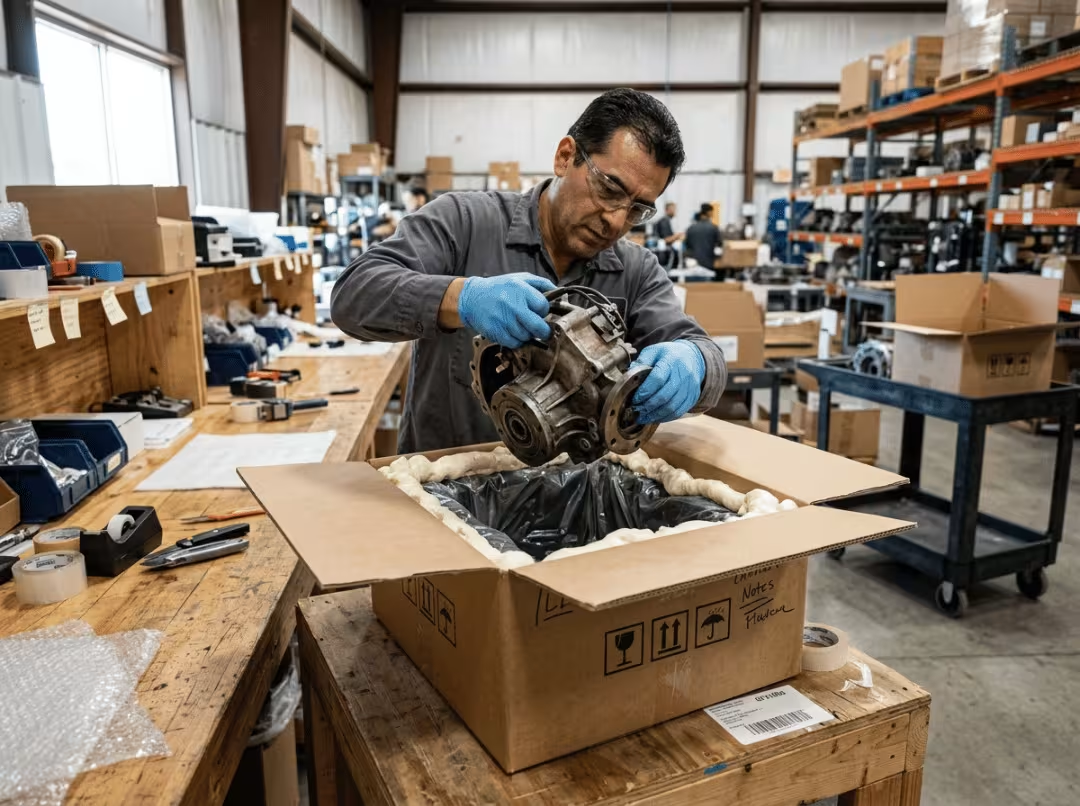
Some products don’t fit the standard protective packaging playbook. They’re heavy, oddly shaped, or fragile in ways that loose fill simply can’t address reliably. Peanuts settle. Paper shifts. And somewhere between the dock and the destination, the product finds the one weak spot you didn’t account for.
Foam-in-place packaging was designed for exactly those situations. Instead of surrounding a product with generic material and hoping for the best, it forms a firm, custom cushion around the item during packing — shaped to the product, not to a standard mold.
This guide explains what foam-in-place packaging is, why companies use it, when it makes sense, how to run the process correctly, and what separates a reliable pack from one that fails in transit. If you’re evaluating it for your operation, this is where to start.
What Is Foam in Place Packaging?
Foam-in-place packaging is a protective packaging method that generates a custom polyurethane foam cushion directly around a product at the time of packing. Two liquid chemical components — an isocyanate and a polyol blend — are dispensed through a polyurethane foaming machine and react on contact. The mixture expands rapidly inside a plastic film or bag, conforming to the product’s exact contours as it rises.
Within a few minutes, the result is a firm, product-specific cushion that absorbs shock and keeps the item fixed in position.
What separates this from standard fill materials isn’t the foam itself — it’s the fit. Packing peanuts, air pillows, and paper fill empty space but don’t lock anything in place. Foam-in-place wraps the product and holds it in place. That’s the mechanical difference, and it’s why this method handles irregular shapes and heavier loads better than most alternatives.
Because every cushion is made on-demand, a one-foam-in-place system can serve many different products without requiring a separate insert or mold for each. For operations that ship a wide range of SKUs, that flexibility alone is often worth the investment.

Why Do Companies Use Foam in Place Packaging?
Most companies don’t arrive at foam-in-place packaging by default. They get there because something else stopped working.
Standard void fill works well for lightweight, simple shipments. But once a product becomes heavier, more fragile, or harder to brace — a medical device with exposed connectors, an industrial controller with sharp housing edges, a glass component with an odd aspect ratio — generic materials start to produce inconsistent results. Inconsistent protection means damage claims, replacement shipments, and eroded customer confidence.
The other common route is through pre-formed inserts. Molded foam provides good protection, but it locks you into one shape per product. Add a new SKU, change a product’s dimensions, or run a short-run order, and you’re either reordering tooling or improvising. Foam in place sidesteps that problem. One system adapts to whatever product you’re packing today.
In practical terms, teams that switch often report fewer damage claims, less warehouse space consumed by packaging inventory, and fewer packaging SKUs to manage. Packing time also improves when a product receives a fitted cushion in a single step, rather than requiring several layers of material to be placed by hand.
The industries where this method is most prevalent are electronics, industrial controls, medical devices, automotive parts, aerospace components, and precision instruments. The common factor isn’t the sector — it’s the combination of value, fragility, and irregular geometry that makes a custom-fit cushion worth the effort.
When Foam in Place Packaging Makes Sense — and When It Doesn’t
Foam in place isn’t a universal solution, and treating it that way leads to mismatched expectations. The more useful question is where it genuinely outperforms alternatives — and where it doesn’t.
Best-Fit Scenarios
The method performs best when the product is difficult to protect reliably with off-the-shelf materials. That typically means heavy items, fragile items, or products with protrusions, sharp edges, or uneven weight distribution — the ones that always seem to find a gap in standard fill and arrive damaged.
It’s also the right fit when SKU variety makes dedicated inserts impractical. In low-to-medium-volume runs, or when product specs change regularly, foam-in-place offers flexibility that pre-made inserts simply can’t match. You’re not cutting a new mold every time the product changes.
Where it truly excels is immobilization — not just filling the box, but locking the product in position so it can’t shift during transit. If damage rates are climbing on your highest-value or most awkward products, that’s a clear signal to run a trial.
When Other Methods May Be Better
There are real situations where foam in place isn’t the right call.
If you ship the same product at very high volume and specifications rarely change, molded inserts will likely win on long-term economics. The tooling cost gets distributed across thousands of units, and the speed advantage compounds over time.
If the item is light, durable, and inexpensive to replace, simpler materials may be all it needs. There’s no good reason to build a precision cushion around a product that handles rough handling without damage and costs very little to replace.
Recyclability requirements can also push the decision toward other materials. Polyurethane foam isn’t easily recyclable in most municipal systems, and if material recovery is a hard requirement for your operation or your customers, that matters.
The right question isn’t whether foam-in-place is a more advanced option. It’s whether the protection and flexibility it provides solve a problem your operation actually has.
How Foam in Place Packaging Works: The Basic Process
Before getting into individual steps, it helps to understand the overall flow — because the core sequence stays the same regardless of which equipment brand you’re using.
The operator prepares the workstation with film, carton, and dispenser within reach. A first foam charge is dispensed to form the bottom cushion. The product is placed on that cushion, oriented so the foam supports the right areas. The film is folded over, and the foam is left to expand around the product undisturbed. If the product needs top protection, a second charge is dispensed before the carton is closed and inspected.
What determines success isn’t the machine itself. It’s the sequence: the right setup, the right foam volume, the right product positioning, and enough time for the foam to rise without interference. Get those right consistently and the method becomes highly repeatable across operators and shifts.

Step-by-Step: How to Pack a Product with Foam in Place
Each step below covers what to do, why it matters, and where operators typically run into trouble.
1. Prepare the Workstation and Carton
Arrange the film, dispenser, carton, and sealing materials so everything is within arm’s reach before you start. The foam’s working window is short. A disorganized station doesn’t just slow you down — it forces improvisation in the middle of a timed chemical reaction.
Confirm the carton size matches the product and the planned cushion volume. An oversized box wastes foam and leaves the product under-supported. An undersized one compresses the cushion before it can cure properly.
Ventilation should be running before the first charge, and the equipment should be fully warmed up. These aren’t optional checklist items — they directly affect both operator safety and foam consistency.
2. Choose the Right Film Size and Foam Amount
This is a judgment call, and one of the most consequential ones in the whole process.
The film needs to be sufficiently thick to allow full expansion without bursting or forming dangerously thin sections around the product’s edges. A practical starting rule: add enough length and width beyond the product dimensions for the foam to wrap around the sides.
The foam charge has to match the product’s size, weight, and fragility. Polyurethane foam expands to many times its dispensed liquid volume, so a modest charge fills a substantial cavity — but that also means an underfill leaves real gaps, and an overfill wastes material and can apply pressure to sensitive surfaces.
In most operations, inconsistent foam volume is the leading cause of inconsistent pack quality. Getting this right early — and documenting the correct charge for each product — prevents most downstream problems.
3. Create the Bottom Cushion
The bottom cushion does the hardest work. It supports the product’s weight, absorbs the initial impact of drops, and provides the foundation for everything above it.
Dispense the first charge before placing the product, and move the dispenser in a slow, even pattern across the bag rather than depositing the foam in one spot. A concentrated lump creates a hard pressure point. Even distribution creates a stable, consistent base.
A poor bottom cushion is hard to compensate for later. The top may look complete, the product may appear well-supported, and the pack will still fail under load.
4. Position the Product Correctly
Product placement is where packaging knowledge matters most — and where most guides skip past the important detail.
The goal isn’t to center the product in the foam. It’s to orient it so the foam supports the highest-stress zones: the heaviest sections, the most fragile edges, the points most likely to concentrate impact energy during a drop.
Think through center of gravity, exposed connectors, glass faces, protruding fasteners, and sharp housing corners before you set the product down. Tilt or angle it if needed so the densest part of the bottom cushion ends up where the load is highest.
A correctly positioned product with a moderate foam charge will outperform a poorly positioned product surrounded by twice the foam. The cushion can only help if it’s in the right place.

5. Fold, Contain, and Let the Foam Expand
Fold the film or bag over the product to guide the expanding foam around it, rather than letting it escape sideways. Move with purpose — you need to stay inside the working time — but don’t rush to the point of shifting the product during enclosure.
Once the pack is folded or sealed, leave it alone. This is a rule experienced operators don’t break: do not press, compress, or reposition the pack during the rise phase. Any pressure applied while the foam is still expanding creates thin zones — invisible from the outside — that reduce cushioning performance where it matters most.
Cream time is a matter of seconds. Full rise takes a few minutes. The surface becomes tack-free shortly after. Until then, hands off.
6. Add the Top Cushion and Immobilize the Load
Most products need top protection too, not just a base layer.
Dispense a second charge over the product or onto the inner carton flaps before closing. The purpose of the top cushion isn’t aesthetic — it’s to prevent upward movement, lateral bounce, and rebound during transit. A well-executed two-cushion pack holds the product in a fixed position from all directions.
A common error is judging a pack by how tightly packed it looks. A pack can look full and still allow meaningful product movement if the foam is in the wrong areas or the top layer is too thin. The measure of a good pack is whether the product stays still — not whether the box looks stuffed.
7. Close the Carton and Inspect the Package
Before sealing, take a few seconds to confirm the basics: no major unsupported gaps, no punctured film, no lopsided foam that leaves one side of the product with nothing underneath it.
Gently shake the closed carton. Noticeable product movement means the cushion needs attention, not more tape. Most packages can be safely sealed and shipped once the foam surface is dry to the touch, even though full chemical cure takes around 24 hours.
This inspection step is simple, but it’s the difference between a packaging process and a packaging gamble.
The Most Common Mistakes in Foam in Place Packaging
Most foam-in-place failures aren’t caused by bad foam. They’re caused by poor process discipline. Fix these five problems, and you’ll eliminate most packaging failures without changing a single material.
1. Estimating foam volume instead of controlling it. When operators rely on feel rather than a documented charge weight or dispense time, results vary from shift to shift and operator to operator. Standardize the charge for each product and record it.
2. Placing the product without thinking about support zones. Volume of foam is not the same as quality of support. If the foam is in the wrong place relative to the product’s weight distribution and fragile areas, more foam doesn’t help. Teach operators to orient the product deliberately before setting it down.
3. Using film that isn’t rated for the load. Thin film suits light parts. For products with sharp housing edges, heavy sections, or a meaningful drop risk, they puncture or overstretch under expansion pressure or during handling. Match film thickness to the product, not to habit.
4. Operating outside the recommended temperature range. Cold chemicals or a cold workspace slow the reaction, change the foam’s rise behavior, and can produce a cushion with lower density and structural integrity than intended. This is especially common in unheated warehouses during winter months.
5. Touching or compressing the pack during the rise phase. Any pressure on the foam while it’s expanding creates local thin zones. The cushion looks fine on the outside. It fails from the inside.
Most operations that address these five points see better packaging performance immediately — without any change to materials or equipment.
What Affects Foam Quality and Packaging Performance?
Even with good technique, foam-in-place results can drift if process variables aren’t managed. These are the main factors that determine whether each cushion comes out consistent.
Temperature and humidity. Foam chemistry is temperature-sensitive. Cold slows the reaction and can produce under-expanded, lower-density foam. Heat accelerates it. The recommended operating range for most systems is roughly 65–85°F for both the chemicals and the workspace. High humidity can leave the foam surface tacky and may reduce finished density.
Mix ratio and equipment calibration. The two components are formulated to react at a specific ratio — commonly 1:1 by volume. If the metering equipment drifts off that ratio, the foam cures poorly: too weak, too sticky, or with a surface that never fully firms up. Regular calibration checks keep this under control. The precision requirements differ meaningfully between high-pressure foaming machines, which use impingement mixing for superior consistency, and low-pressure foaming machines, which rely on mechanical agitation and are better suited to smaller-scale or more specialized operations.
Film thickness and bag sizing. The film has to withstand both expansion pressure and handling after the pack is formed. Too thin and it punctures; too small and the foam can’t expand fully before hitting the bag walls. Size the film and bag to the product, not to whatever’s most convenient.
Foam amount. The dispensed volume is the most direct lever operators have over cushion quality. Over time, most experienced packaging teams develop documented charges for each product — not as a formality, but because consistent results depend on it.
Product geometry. The same foam charge behaves differently under a flat rectangular base than under an uneven housing with protruding hardware. Account for how each specific product distributes its weight and stress, and the cushion will perform accordingly.
Repeatability is what distinguishes a reliable packaging line from a hit-or-miss one. The goal is a process in which every operator, on every shift, produces the same-quality cushion for the same product.
Foam in Place vs Other Packaging Methods
Choosing a protective packaging method is a business decision, not a technical one. The right answer depends on product characteristics, shipping risk, operational volume, and how much flexibility the line requires.
|
Factor |
Foam in Place |
Packing Peanuts |
Bubble Wrap / Paper |
Molded Foam Inserts |
|---|---|---|---|---|
|
Protection for fragile/odd shapes |
High — cushion conforms to the product |
Low — shifts and settles in transit |
Moderate — depends heavily on operator technique |
High — but only for the exact shape it was molded for |
|
Flexibility across SKUs |
High — one system, many shapes |
High |
Moderate |
Low — one mold per product |
|
Labor time per package |
Low — single-step process |
Low but generates mess |
Higher — requires manual layering |
Very low at high volume |
|
Storage footprint |
Small — film roll and chemical drums |
Large — bulky bins |
Moderate |
Large — stored insert inventory |
|
Upfront investment |
Moderate to high |
Very low |
Low |
High — tooling cost per product |
|
Best-fit use case |
Heavy, fragile, irregular, or varied SKUs |
Inexpensive, lightweight, low-risk shipments |
Light items needing surface protection |
Standardized product at very high volume |
The table shows the trade-offs, but the real decision comes down to what you’re optimizing for.
Foam in place is strongest when protection and flexibility must coexist — when the product mix changes, shapes are awkward, or the cost of damage is high. Packing peanuts are cheap and fast to start with, but they settle in transit and generate static, dust, and cleanup on the packing floor. Bubble wrap and paper work well for lighter items but require more manual handling per pack. Molded inserts are hard to beat at very high standardized volume, but they fall apart as a strategy the moment the product changes.
The right method is whichever one actually solves your dominant packaging problem — not the most technically sophisticated one.

Cost Considerations: Where the Real ROI Comes From
Evaluating foam-in-place packaging purely on material cost is the most common reason companies either dismiss it too quickly or adopt it and feel burned.
The complete picture includes equipment investment, consumable cost per pack, labor time, packaging storage space, and — most importantly — the cost of shipping damage. A method that costs more per unit but eliminates high damage rates on expensive products can easily be cheaper in total.
Upfront and per-pack costs. Entry-level handheld dispensing systems are relatively accessible. Fully automated bench systems with film feeds and heated hoses run considerably higher. Per-pack material cost depends heavily on dispense precision — the less waste per cycle, the more favorable the cost is relative to alternatives.
Operational savings. When a product gets a fitted cushion in one step rather than three or four manually placed layers, packing time drops. When one chemical supply replaces bins of peanuts and shelves of pre-formed blocks, storage space opens up. Fewer packaging SKUs also mean fewer reorder cycles and less supplier management overhead.
The cost that matters most. In most operations handling fragile or high-value products, the real cost driver isn’t packaging materials — it’s damaged shipments. Returns, replacements, freight claims, and the downstream effects on customer relationships add up to costs that dwarf any material line item. If foam in place materially reduces that damage rate, the ROI case tends to be straightforward.
For some products and operations, foam-in-place costs more than it saves. But the strongest business cases consistently show up where product risk, SKU complexity, or manual packing inefficiency are already creating costs that don’t appear on a packaging budget report.
Safety Basics for Operators
Foam-in-place involves reactive chemistry, which requires consistent handling discipline — not occasional caution.
The isocyanate component is the primary concern. It releases vapors during mixing that can irritate the respiratory tract and eyes, and repeated exposure can cause sensitization. Operators should wear nitrile gloves, safety glasses, and a respirator rated for isocyanate vapors whenever the liquid components are handled — not just when something goes wrong.
Work areas must be properly ventilated. Chemical drums should be stored in dry, temperature-controlled conditions away from direct sunlight and ignition sources. Skin and eye contact protocols should be clearly posted and rehearsed: rinse thoroughly with water and seek medical attention, because sensitization reactions can develop from cumulative exposure even at low levels.
Daily equipment maintenance is part of the safety routine. Purge the mixers, inspect hose connections and gun tips, and check for chemical leaks before each shift. Well-maintained equipment is also safer equipment.
Follow your equipment manufacturer’s specific guidance and your site’s own safety procedures. The points above are operational fundamentals, not a substitute for site-specific training.
Is Foam in Place Packaging Sustainable?
The honest answer is: it depends on how you’re measuring sustainability, and what you’re comparing it against.
Polyurethane foam is not biodegradable or compostable. In most regions, it can’t go into standard recycling streams without a dedicated take-back or post-industrial regrind program. Any sustainability assessment that ignores this is incomplete.
That said, a per-material view misses a lot. Precise dosing means less material is used per pack than alternatives that require generous overfilling to compensate for inconsistency. Fewer damaged shipments means fewer replacement units manufactured, packaged, and transported. A consolidated packaging system with fewer SKUs reduces overall material complexity. Newer low-emission formulations also reduce VOC emissions during dispensing and reaction, which matters for both operator health and site-level environmental compliance.
The most defensible sustainability assessment considers the entire packaging system — materials, damage rates, transportation efficiency, and end-of-life options — rather than assigning a single label based on a single attribute. Foam in place may or may not be the right choice depending on how that full picture looks for your specific operation.
Frequently Asked Questions
How long does foam in place packaging take to cure?
The foam rises within minutes and becomes tack-free shortly after that. Most packages can be sealed and shipped once the surface is dry to the touch. Full chemical cure takes approximately 24 hours, but that level of cure isn’t required before shipment in most standard applications.
Does the foam contact the product directly?
In standard foam-in-place applications, no. The foam expands inside a plastic film or bag, so the film acts as a barrier between the foam and the product surface. This is one reason the method works across such a wide range of products, including those with painted finishes or sensitive surfaces.
Can foam-in-place packaging protect very heavy products?
Yes, provided the full system is sized for the load. That means the right foam density, appropriate film thickness, a cushion design that accounts for weight distribution, and a carton rated for the total package weight. Heavy items don’t disqualify the method — they just require more deliberate specification of each component.
How much training does a new operator need?
The physical mechanics — dispense, position, fold, seal — can be taught in a short time. Getting consistently good results takes longer because it requires judgment about foam volume, product orientation, and timing, which comes from repetition and feedback rather than instruction alone. A new operator producing reliable packs independently typically needs a few weeks of supervised practice on representative products.
What happens if the chemicals are stored at the wrong temperature?
Temperature significantly affects how the two components react. Too cold, and the reaction slows or stalls, producing foam that is under-expanded, softer than intended, or structurally inconsistent. Too hot, and the reaction can accelerate unpredictably. Storing drums within the manufacturer’s recommended range — typically verified before each shift — is a basic but essential process control.
Conclusion
Foam in place packaging earns its place when a product genuinely needs more than generic void fill can provide. The method’s real value isn’t the foam itself — it’s the ability to build controlled, product-specific support for items that are heavy, fragile, irregularly shaped, or simply too variable for a one-size-fits-all insert to handle.
It isn’t the right answer for every packaging line. For standardized, high-volume shipments of durable goods, other methods will often be faster or more economical. But for operations involving complex products, varied SKUs, or damage rates that standard fill hasn’t addressed, foam-in-place is frequently the most practical path forward.
Success depends less on buying the right system and more on running it with discipline — knowing your foam volumes, deliberately positioning products, controlling the operating environment, and inspecting every pack before it closes.
If you’re considering a switch, skip the theoretical comparison. Pick three or four products that represent your hardest packaging challenges, run a proper trial, and measure cycle time, material use, and shipping damage against your current method. The numbers will tell you more than any analysis.