Polyurethane coating is one of the most widely specified protective finishes across industrial, commercial, and architectural work — valued for a combination of toughness, flexibility, and resistance to abrasion, UV, and chemical attack that few other systems can match across such a broad range of environments.
Here’s what most application guides skip: field failures are rarely a product problem. They’re almost always a chemistry mismatch, an equipment mismatch, or both. That distinction changes where you focus — not on which brand to buy, but on whether the specified system and application method actually suit the job in front of you.
This article covers the chemistry fundamentals behind every application decision, the environments where PU coatings are most commonly specified and why, and the equipment used to apply them — with the deepest treatment given to plural component systems for 2K applications, where the most consequential decisions and the most avoidable errors tend to cluster.
What Is Polyurethane Coating?
Polyurethane coating is a polymer-based protective finish formed by the reaction of polyols and isocyanates. The resulting film combines toughness with flexibility — which is why it works across environments as different as factory floors, marine topsides, and exterior facades.
Two chemistry types define most of the market:
- 1-component (1K): Moisture-cured, straightforward to apply, appropriate for smaller jobs and less demanding exposures. The tradeoff is a lower performance ceiling — chemical resistance and film hardness fall short of what a correctly applied 2K system delivers.
- 2-component (2K): Requires mixing a resin (Part A) and a hardener (Part B) before application. The resulting cross-linked film is denser and tougher, with significantly better chemical and abrasion resistance. For industrial and heavy-duty applications, 2K is the standard — not a premium option.
The aromatic vs. aliphatic distinction matters just as much:
- Aromatic PU coatings offer strong adhesion and mechanical resistance at lower cost. The limitation is UV stability: the aromatic ring structure absorbs UV energy and oxidizes over time, producing yellowing and surface chalking. Right for interior or non-UV-exposed surfaces where protection matters more than appearance.
- Aliphatic PU coatings are UV-stable and color-retentive under sustained exterior exposure. Wherever gloss retention, color accuracy, or long-term weathering resistance is part of the spec — automotive topcoats, exterior facades, marine topsides — aliphatic chemistry is the correct choice.
Chemistry selection doesn’t just determine performance. It determines which application method is technically viable. That connection runs through every equipment decision that follows.

Polyurethane Coating Applications by Industry
Industrial and Manufacturing Facilities
Factory floors, machinery housings, and structural steel sit among the most demanding coating environments in everyday practice. 2K aromatic PU coatings are the go-to specification here, primarily for abrasion resistance and chemical protection.
Consider a manufacturing plant floor under sustained forklift traffic with regular solvent spills. Epoxy alone often cracks or delaminates under that combination of mechanical wear and chemical exposure. A 2K aromatic PU coating handles both — and its flexibility under thermal cycling, the expansion and contraction that comes with shift changes, heating systems, and seasonal variation, reduces the adhesion failures that rigid coatings tend to accumulate over time.
For industrial operations that also process polyurethane at scale, Henghui’s Polyurethane Foaming Machine covers a range of precision metering and dispensing solutions for high-volume PU applications.

Commercial Flooring
Warehouses, retail spaces, and hospitals rely on PU flooring systems for seamless, durable surfaces that handle foot and wheeled traffic while staying easy to clean. Aliphatic topcoats are common even indoors — UV-lit environments and artificial lighting can degrade aromatic coatings visually over time, making color stability a practical concern even without direct sunlight.
Application method has a real impact on large floor areas. Roller application is manageable on small surfaces, but across a 5,000-plus sq ft warehouse floor, maintaining consistent film thickness by hand introduces variation that shows up in cure uniformity and final appearance. More on that in the equipment section.
Automotive and Transportation
Aliphatic 2K PU coatings are the standard for vehicle refinishing and OEM topcoats — gloss retention, color stability, and chip resistance are non-negotiable at this performance level.
A fleet maintenance contractor refinishing heavy trucks is a useful case: UV stability and film hardness matter as much as application throughput. Equipment choice between HVLP and airless spray directly affects overspray, material consumption, and finish quality. At fleet scale, getting it wrong has measurable cost consequences in wasted material and rework.
Marine and Offshore
Saltwater immersion, sustained UV exposure, and moisture cycling impose exceptional demands on adhesion and hydrolytic stability. 2K aliphatic PU topcoats are widely specified for topsides and superstructures — their UV stability and low water absorption make them the practical choice for surfaces under continuous environmental stress.
Surface preparation here isn’t a preliminary step — it’s a core deliverable. The relationship between substrate profile and long-term adhesion is direct and unforgiving. On large vessel recoating projects where pot life and batch-to-batch consistency are operational constraints, plural component equipment has become increasingly standard rather than exceptional.
Architectural and Building Envelope
Exterior facades, metal roofing, concrete structures, and cladding systems use aliphatic PU coatings for sustained weather resistance and long-term gloss retention.
Consider a contractor applying a clear aliphatic topcoat to a curtain wall system. Color retention under UV exposure and adhesion over previously coated substrates are the primary technical concerns. Equipment selection directly affects film uniformity on irregular vertical and overhead surfaces — on high-rise or large-format facade work, inconsistent film build is visible and expensive to correct.
Consumer and Specialty Products
1K and 2K PU coatings appear in wood finishing, sporting goods, and various specialty consumer products. For facility managers, industrial contractors, and maintenance teams — the core audience for this guide — this segment has limited operational relevance. The same chemistry selection and surface preparation principles apply; the scale and equipment demands are simply smaller.
Polyurethane Coating Equipment: Types and Use Cases
Surface Preparation Equipment
Coating performance is determined before the first coat goes down. Surface preparation is not a step to move through quickly — it’s the single most consequential variable in the entire application process, and cutting corners here undermines everything that follows.
Abrasive blasting, mechanical grinding, and power tool cleaning — angle grinders, scarifiers, needle guns — are the primary methods. The correct standard depends on the coating system and exposure environment:
- Steel substrates with 2K coatings typically require Sa 2.5 (near-white blast) per ISO 8501-1
- Concrete substrates for high-build systems commonly specify a CSP 3–4 surface profile
The consequences of skipping this are predictable, not theoretical. A rusty steel substrate coated with a marine PU topcoat without proper blast cleaning will delaminate within months. That’s not a coating failure — the substrate was never prepared to receive it. Getting the sequence right here is the correct order of priority.
Brush and Roller Application
Brush and roller makes sense for touch-ups, small maintenance areas, stripe coats over edges and welds, and confined spaces where spray equipment isn’t practical.
The limitations are real: inconsistent film thickness on large surfaces, slow build rates, poor compatibility with 2K systems that have short pot lives. For 1K systems and low-viscosity 2K products on manageable surfaces, it’s a practical choice. Beyond that scope, the limitations outweigh the convenience.
Conventional Air Spray
Conventional air spray atomizes coating with compressed air at the gun tip, producing good atomization quality. The significant drawback is overspray loss — commonly 30–50% — which limits use to controlled environments like enclosed booths.
Smaller automotive refinishing and furniture finishing booths remain appropriate applications, where finish quality takes precedence over material efficiency. For large-scale industrial PU coating work, the material waste and containment requirements make conventional air spray hard to justify.
Airless Spray
Airless spray uses hydraulic pressure — typically 1,500–3,500 psi — to atomize coating without compressed air. That means faster application, higher transfer efficiency, and the ability to handle high-viscosity, high-build coatings that conventional air spray can’t manage.
For large industrial surfaces, structural steel, pipelines, marine hulls, and commercial flooring, airless spray is the established workhorse. A maintenance team recoating a warehouse steel structure can apply high-build coatings in fewer passes, cutting labor time significantly across a project measured in thousands of square feet. At that scale, the material savings over conventional spray are real.
The limitation worth noting: coarser atomization makes airless spray unsuitable where film smoothness and finish appearance are primary requirements.

Air-Assisted Airless (AAA) and HVLP
Air-assisted airless (AAA) combines hydraulic pressure with supplemental air at the gun tip — finer atomization than standard airless, lower overspray than conventional air spray. A practical middle ground for industrial work where some improvement in finish quality is worth having without a major throughput penalty.
HVLP (high volume, low pressure) optimizes for transfer efficiency — commonly 65–80% — fine atomization, and reduced overspray. It’s standard for automotive refinishing, architectural coatings, and any situation where material cost, VOC compliance, or proximity to sensitive surfaces is a meaningful constraint.
A concrete example: a contractor applying an aliphatic PU topcoat to a building facade adjacent to glazing. HVLP reduces overspray drift and material waste compared to standard airless — a practical and regulatory consideration on any urban project with neighboring structures.

Plural Component Equipment
Plural component equipment is the critical category for 2K polyurethane coating at scale. It’s also where the most frequent misunderstandings and consequential specification errors occur — which is why it warrants the most detailed treatment here.
How Plural Component Systems Work
Separate the pumps, meter, and pressurize the resin (Part A) and hardener (Part B) at a precise, controlled volumetric ratio. The components are mixed at the gun or in a static mixer immediately before application. The practical result: manual mixing variability is removed from the equation, and pot life is no longer a constraint on application pace or project scale.
Why Ratio Accuracy Matters
Most plural component systems maintain a ±1–2% ratio tolerance throughout a full application run. That consistency directly determines cross-link density, film hardness, and chemical resistance. Manual mixing rarely achieves this — especially as volume increases, pace increases, or applicator fatigue accumulates over a long shift. Off-ratio mixing causes soft films, adhesion failure, and incomplete cure. These failures look like product problems. They’re equipment and process problems. The distinction matters for preventing them.
Heated Systems
Many plural component units heat both component streams to reduce viscosity. This enables the application of high-solids, solvent-free coatings at ambient temperatures that would otherwise require thinning — thinning that degrades film performance and often violates VOC compliance thresholds.
Fixed vs. Variable Ratio Configurations
- Fixed-ratio machines are engineered for a specific mix ratio — 1:1, 2:1, 4:1, and so on. Lower cost, simpler to operate, well-suited to contractors who work consistently with one coating system.
- Variable-ratio machines are adjustable over a defined range — appropriate for operations that run multiple coating products or projects with varying specifications.
When Plural Component Equipment Becomes Necessary
The threshold isn’t a cost decision — it’s a set of technical conditions:
- 2K systems with pot lives under 20 minutes in warm ambient conditions
- Large-scale applications where batch-to-batch variation from manual mixing produces measurable inconsistency across the finished surface
- High-build coatings with fast cure cycles that close the working window before a manually mixed batch can be fully applied
- Heated high-solids coatings that cannot be thinned to conventional viscosity without compromising film performance
Scenario 1: An offshore facility operator applying a 2K fast-cure PU topcoat to an exposed pipe rack at 35°C ambient, with a 15-minute pot life. Manual mixing isn’t viable — the working window closes before a full batch can be applied consistently. A heated plural component system maintains controlled temperature, accurate ratio, and continuous flow through an 8-hour shift. The operator’s only remaining variable is application technique.
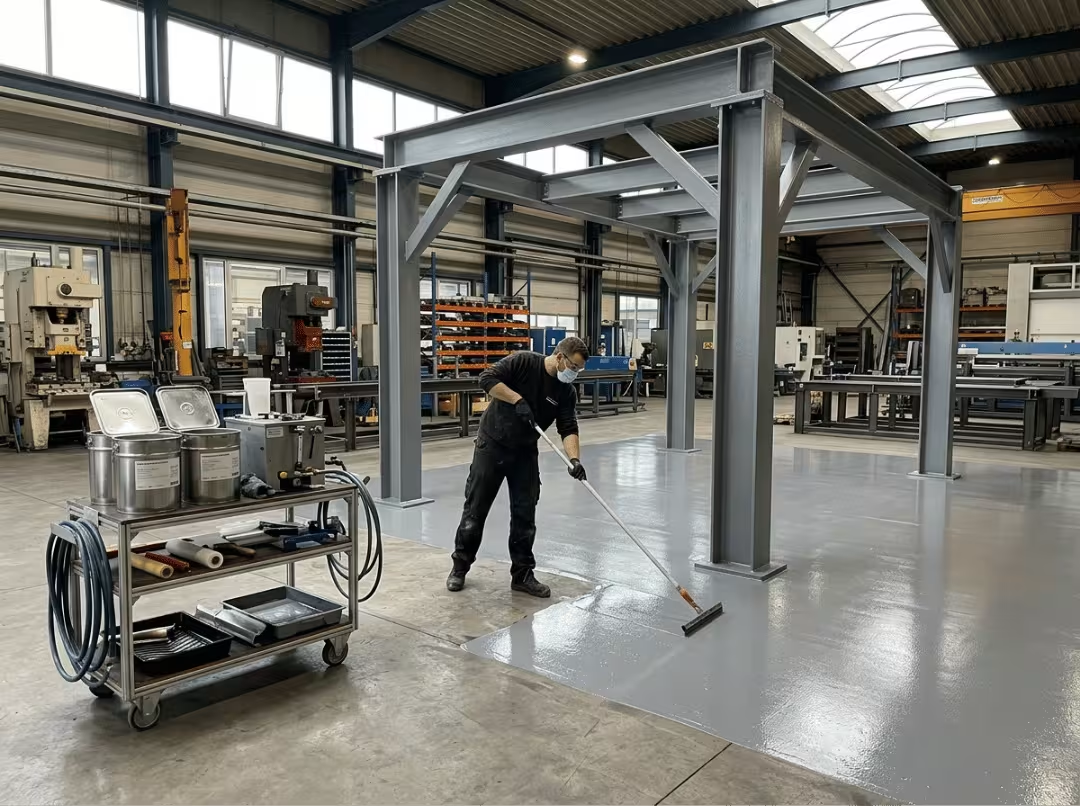
Scenario 2: A flooring contractor applying a self-leveling 2K PU coating across a 5,000 sq ft warehouse floor. Manual mixing in batches introduces timing and ratio variation between pours. On a large floor, that variation produces differential cure — visible as sheen inconsistency and surface texture variation across the finished slab. Plural component equipment eliminates this, producing a uniform cure across the full pour.
For operations that require precision metering and dispensing at industrial scale, Henghui’s Polyurethane Casting Machine offers relevant technology for high-performance PU processing applications.
Maintenance Is Not Optional
Static mixers and whip hoses require solvent flushing after each use — not at the end of the week. Blocked static mixers are one of the most common causes of plural component equipment downtime, and they’re almost always the result of skipped end-of-shift maintenance. A five-minute flush prevents hours of troubleshooting on the next job.
Choosing the Right Coating and Equipment for Your Project
Four variables drive the selection: project scale, substrate type and condition, coating chemistry (1K vs. 2K, aromatic vs. aliphatic), and required finish quality. Work through them in that order, and equipment selection follows logically.
|
Project Type |
Recommended Coating |
Equipment |
|---|---|---|
|
Small maintenance / touch-up |
1K or slow-cure 2K |
Brush / roller |
|
Automotive refinish |
2K aliphatic |
HVLP |
|
Large industrial structure |
2K aromatic, high-build |
Airless or plural component |
|
Marine topside |
2K aliphatic |
Airless or plural component |
|
Commercial floor (large area) |
2K self-leveling |
Plural component + roller |
|
Building facade / exterior |
2K aliphatic |
AAA or HVLP |
Pot life is frequently the deciding factor for 2K systems at scale. Fast-cure formulations applied over large areas don’t leave enough working time for manual batching to stay reliable. At that point, plural component equipment isn’t a useful option — it’s the necessary one.
One constraint no equipment choice can override: substrate condition must be confirmed before any equipment decision is made. No spray system compensates for inadequate preparation.
Common Mistakes That Cause Polyurethane Coating Failure
Coating failures are rarely the product’s fault. Almost every failure has an identifiable cause upstream of the coating itself.
- Skipping or under-specifying surface preparation. The single most frequent cause of coating failure across all project types. Preparation standard must match the coating system and the exposure environment — not the available budget or schedule.
- Wrong mix ratios in 2K systems. Off-ratio mixing produces soft films, adhesion failure, or complete cure inhibition. Manual mixing is error-prone at scale; calibrated plural component equipment is the reliable solution.
- Applying outside temperature and humidity limits. Most PU coatings specify application windows — typically substrate temperature between 5 and 35°C and relative humidity below 85%. Applying outside these limits causes blushing, poor cure, or delamination. None of these can be corrected once the film is down.
- Thinning without checking compatibility. Over-thinning reduces film build and can disrupt cure chemistry. Always verify solvent type and addition rate against the manufacturer’s technical data sheet before thinning.
- Neglecting PPE. Isocyanates in 2K coatings are confirmed respiratory sensitizers. Air-supplied respirators are required in confined spaces and high-volume spray environments. This is a regulatory requirement — not an optional precaution.
- Incorrect spray tip selection. The wrong tip orifice or fan angle for the coating viscosity produces poor atomization, uneven film, and wasted material. Confirm tip selection against both the product’s technical data sheet and the equipment manufacturer’s recommendation before starting any application.
Frequently Asked Questions
What’s the difference between 1-component and 2-component polyurethane coatings?
1K coatings cure by absorbing atmospheric moisture — no mixing required, straightforward application, suitable for smaller jobs and lower-demand environments. 2K coatings cure through a chemical reaction between resin and hardener, producing a denser cross-linked film with significantly higher chemical resistance, hardness, and durability. The tradeoff is more demanding application: accurate mix ratio, pot life management, and — at scale — plural component equipment. For industrial, marine, and heavy-duty work, 2K is the appropriate specification. For maintenance touch-ups and lighter-duty applications, 1K is often sufficient.
When do I need plural component equipment instead of manual mixing?
Three conditions make the case: pot life under approximately 20–30 minutes in warm ambient conditions, where manual mixing can’t keep pace before the window closes; project scale where batch-to-batch variation produces measurable inconsistency across the finished surface; and formulations where even minor ratio deviation affects cure. For 2K coatings on large surfaces with fast cure cycles, plural component equipment isn’t an upgrade — it’s the correct tool.
Can I apply polyurethane coating over existing paint or coatings?
Sometimes — but it requires verification. Run an adhesion test (cross-hatch or pull-off) on the existing surface before overcoating. Confirm chemistry compatibility between old and new systems; some combinations cause lifting, wrinkling, or adhesion failure. Intercoat adhesion promoters may be required depending on the existing coating type and condition. If the existing coating is failing, contaminated, or incompatible with the new system, no topcoat will produce a durable result. Full removal is the correct starting point in those cases.
How many coats of polyurethane coating are typically required?
It depends on the application and the dry film thickness (DFT) target. Industrial floor systems often specify 150–300 microns DFT total, typically across a primer, build coat, and topcoat sequence. Marine aliphatic topcoat systems commonly require two to three finish coats to reach specified DFT. Primers and tie-coats are frequently required for adhesion on steel and concrete substrates. Always reference the product’s technical data sheet for application-specific requirements.
What causes polyurethane coatings to yellow or chalk outdoors?
Aromatic PU coatings yellow and chalk because the aromatic ring structure absorbs UV energy and oxidizes over time. Aliphatic coatings lack that ring structure — they remain UV-stable, retaining color and gloss under sustained exterior exposure. The practical rule: any exterior or UV-exposed surface should specify aliphatic chemistry. Choosing an aromatic coating outdoors to reduce cost produces a predictable appearance failure that almost always costs more to remediate than the original savings.
How do I clean and maintain plural component spray equipment after use?
Replace static mixers at the end of each application — don’t attempt to clean and reuse them. Flush whip hoses and the gun with the appropriate solvent immediately after finishing, before mixed material in the lines begins to gel. Purge both A and B component lines following the equipment manufacturer’s procedure. Skipping this is the most common cause of blocked mixers and gelled hoses — and the leading source of unplanned downtime on 2K application jobs. A five-minute flush at the end of a shift prevents hours of troubleshooting at the start of the next.
Start With the Substrate, Work Back to the Equipment
Coating chemistry and equipment selection are linked decisions, not independent ones. The wrong equipment for a given coating system — particularly a fast-cure 2K product applied at scale — produces failures that no product quality can absorb.
For serious 2K polyurethane coating applications, plural component metering is the standard. Manual application stays viable only in a narrow set of conditions: small areas, slow-cure systems, jobs where batch-to-batch variation carries no real consequence. Outside those conditions, plural component equipment is what makes consistent results achievable across a full shift — not just under ideal circumstances.
The sequence that works: start with substrate condition and project scale. Confirm coating chemistry — 1K or 2K, aromatic or aliphatic — based on exposure environment and performance requirements. Then identify the equipment configuration that makes consistent application achievable at that scale. That order produces fewer failures than working backward from what’s already on the truck.
For industrial-scale polyurethane processing equipment — including precision metering and dispensing solutions — Henghui’s Polyurethane Casting Machine and Polyurethane Foaming Machine cover high-performance PU production applications.